Zing Forum

Reading

FlowOps: Analysis of AI-Driven Workflow Operations System and Intelligent Agent Capabilities

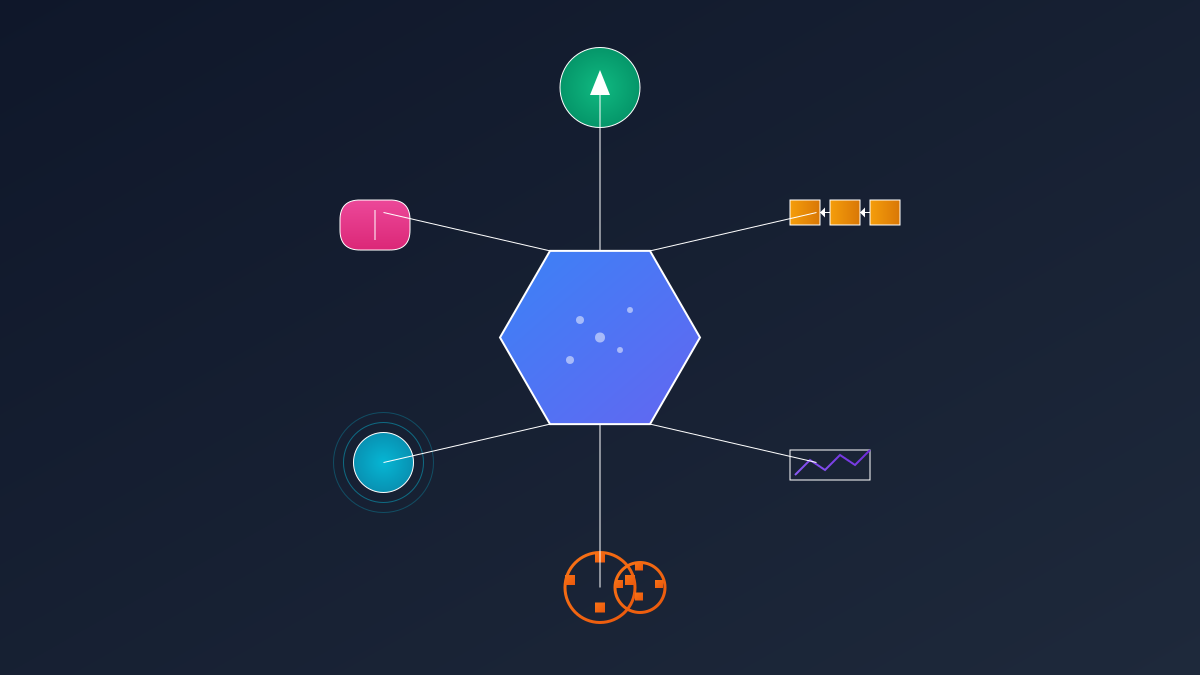
This article provides an in-depth introduction to the FlowOps open-source project, a modern system integrating AI agent capabilities with workflow operation management. Through features like intelligent task optimization, predictive analysis, natural language interaction, and real-time AI insights, FlowOps offers a complete solution for enterprise operation automation.

FlowOps工作流运营AI代理智能作业优化预测分析自然语言界面实时洞察运营自动化ReactNode.js
Published 2026-04-11 12:40Recent activity 2026-04-11 12:49Estimated read 8 min
FlowOps: Analysis of AI-Driven Workflow Operations System and Intelligent Agent Capabilities
1

Section 01

FlowOps: Core Analysis of AI-Driven Workflow Operations System

FlowOps is an open-source system integrating AI agent capabilities with workflow operation management, positioned as an AI-driven workflow operation platform. Its core goals are to optimize task scheduling, improve decision-making quality, and enhance operational transparency. Its core values include efficiency improvement (intelligent task optimization reduces resource waste), decision enhancement (predictive analysis supports data-driven decisions), and experience improvement (natural language interface lowers usage barriers). The tech stack uses React for the frontend, Node.js for the backend, and PostgreSQL as the database, providing a complete solution for enterprise operation automation.


2

Section 02

Background of Intelligent Transformation in Operation Automation

In today's business environment, enterprise operations face complexity challenges. Traditional workflow management systems are rigid and slow to respond, making it hard to adapt to dynamic business needs. The emergence of FlowOps marks the evolution of operation automation toward intelligence and agentization, deeply integrating AI agent capabilities into all links of workflow operations and bringing new possibilities for efficiency improvement to enterprises.

3

Section 03

Modern Technical Architecture of FlowOps

FlowOps uses a modern tech stack to ensure maintainability and scalability: The frontend builds a responsive interface based on React with component-based design for easy expansion; the backend uses Node.js's event-driven non-blocking I/O model to handle concurrent requests efficiently; the data layer selects PostgreSQL, which provides reliable transaction support and scalability, and reserves space for advanced functions like geographic information storage and full-text search.

4

Section 04

Intelligent Task Optimization and Predictive Analysis Capabilities

Intelligent Task Optimization: Unlike traditional fixed-rule execution, FlowOps dynamically adjusts task priority, resource allocation, and execution order based on real-time conditions. It integrates historical data, system load, and dependency relationships to generate optimal plans, improving resource utilization (e.g., merging tasks in data processing pipelines to reduce I/O overhead). Predictive Analysis: It builds models using historical data to estimate future task volume, resource requirements, and risks, helping identify bottlenecks in advance (e.g., expanding capacity ahead of peak hours). It supports users in adjusting model parameters to adapt to business characteristics.

5

Section 05

Natural Language Interface and Real-Time AI Insights

Natural Language Interface: Integrating NLP capabilities, it allows users to interact with daily language (e.g., "Show failed tasks in the past week"), lowering the threshold for non-technical personnel and shortening the decision-making cycle. Real-Time AI Insights: The intelligently upgraded monitoring dashboard not only displays metrics but also identifies abnormal patterns, correlations, and trends, actively pushing insights (e.g., analyzing root causes when database response time is abnormal) to discover hidden efficiency improvement points.

6

Section 06

Enterprise-Level Security Design Assurance

FlowOps focuses on enterprise-level security: Fine-grained access control assigns permissions by role; sensitive operations require multi-factor authentication and approval; data transmission encryption prevents leakage; audit logs fully record operations to meet compliance requirements; the architecture design ensures high availability, providing continuous service during failures and automatically synchronizing status to ensure operational continuity.

7

Section 07

Application Scenarios and Implementation Recommendations

Applicable Scenarios: IT operation and maintenance (managing deployment processes, automated maintenance), data processing (orchestrating ETL pipelines, monitoring data quality), business process automation (driving approvals, coordinating cross-system operations). Implementation Recommendations: Adopt a progressive strategy—first select 1-2 use cases for pilot testing to verify adaptability, then expand gradually after accumulating experience, and combine with customized development based on requirements to reduce risks.

8

Section 08

Summary of Future Directions for Operational Intelligence

FlowOps demonstrates the deep integration of AI into operation management, evolving from an automation tool to an intelligent partner. It improves efficiency and changes human-computer interaction through the combination of multiple capabilities. Future operation systems will focus more on adaptability, predictive maintenance, and autonomous decision-making. FlowOps provides a reference implementation for such systems and is worthy of attention and research by practitioners.

