Zing Forum

Reading

FlowAI Studio: A Visual AI Workflow Automation Platform Based on Claude API

This article introduces a production-ready visual AI workflow automation platform that supports building multi-step AI automation processes via drag-and-drop. It integrates triggers, AI processing nodes, intelligent routing, and logical branches, providing low-code AI application development capabilities for both developers and business professionals.

AI工作流Claude API可视化编程自动化平台低代码工作流编排节点编辑器多步骤自动化智能路由TypeScript
Published 2026-04-15 03:15Recent activity 2026-04-15 03:22Estimated read 8 min
FlowAI Studio: A Visual AI Workflow Automation Platform Based on Claude API
1

Section 01

[Introduction] FlowAI Studio: A Visual AI Workflow Automation Platform Based on Claude API

FlowAI Studio is a production-ready visual AI workflow automation platform built on the Claude API. It supports creating multi-step AI automation processes via drag-and-drop. The platform integrates triggers, AI processing nodes, intelligent routing, and logical branches, aiming to provide low-code AI application development capabilities for both developers and business professionals—striking a balance between the programming barriers of traditional automation tools and the logical complexity limitations of pure no-code platforms.


2

Section 02

[Background] The Need for AI Automation to Evolve into Multi-Step Workflows

With the rapid evolution of large language model capabilities, AI automation is moving from simple single-turn conversations to complex multi-step workflows. Traditional automation tools often require users to have programming skills, while pure no-code platforms struggle to handle complex business logic. FlowAI Studio was born in this context as a visual AI workflow platform, trying to find a balance between flexibility and ease of use.

3

Section 03

[Methodology] Platform Architecture and Core Node Type Analysis

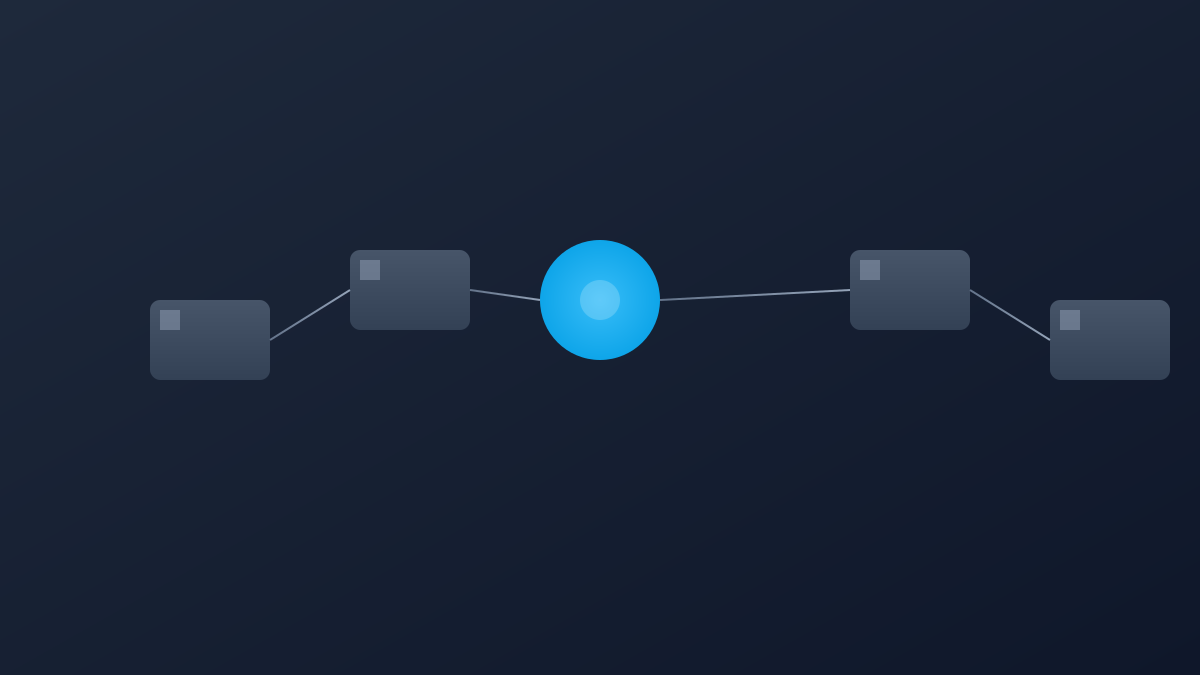
FlowAI Studio adopts a node-based architecture design, where users build automation processes by connecting different types of nodes. Core node types include:

  • Trigger Nodes: Serve as workflow entry points, supporting triggering methods like scheduling, Webhooks, file uploads, etc.
  • AI Processing Nodes: Encapsulate Claude API functions (summarization, classification, extraction, generation)
  • Intelligent Routing Nodes: Implement conditional branching and dynamic routing
  • Logical Branch Nodes: Provide control flows such as conditional judgment, loops, parallelism
  • Action Nodes: Execute external system operations (sending emails, calling APIs, etc.)

The platform's core interaction interface is a visual process editor, which includes a component panel, canvas area, property panel, and debugging console.

4

Section 04

[Technical Implementation] Frontend/Backend Architecture and Data Flow Design Details

Frontend Architecture

Developed using TypeScript, combined with modern frameworks like React/Vue and state management libraries. Canvas rendering is based on SVG/Canvas technology, requiring handling of interactions such as drag-and-drop, connection, zooming, and performance optimization.

Backend Services

  • Process Engine: Parses and executes workflows, manages node states and data flow, supports persistence and resumption from breakpoints
  • Claude API Integration: Encapsulates Anthropic API calls, handling authentication, rate limiting, retries, and caching strategies
  • User Management: Supports multi-user collaboration, permission control, and version management

Data Flow Design

Defines a unified data format and transfer protocol, supporting types like raw text, structured JSON, file references, and metadata tags.

5

Section 05

[Practical Evidence] Typical Application Scenarios of FlowAI Studio

Content Operation Automation

Marketing teams build content production pipelines: Monitor RSS/social hotspots → Generate article outlines → Classify content types → Route for review/publishing → Push to CMS/social platforms

Customer Service Intelligence

Customer service departments build intelligent ticket systems: Trigger via email/chat → Extract customer information → Classify urgency → Generate reply suggestions → Route to manual/auto response

Data Analysis Report Generation

Data teams automate report processes: Scheduled start → Extract key metrics → Convert to natural language insights → Write reports → Send to stakeholders

6

Section 06

[Advantage Comparison] Differences from Traditional RPA and Similar AI Platforms

Compared to Traditional RPA Tools

Traditional RPA simulates GUI operations and is suitable for tasks with clear rules; FlowAI Studio uses large language models to handle unstructured data and fuzzy logic, with a wider scope of application.

Compared to Other AI Workflow Platforms

FlowAI Studio's features: Deep Claude integration (long context/reasoning capabilities), rich dedicated nodes, open-source and extensible.

7

Section 07

[Usage Recommendations] Workflow Design Principles and Cost Control Strategies

Workflow Design Principles

  • Modular Design: Split complex processes into reusable sub-processes
  • Error Handling: Configure error branches and degradation strategies
  • Progressive Deployment: Gradually increase complexity from simple processes

Cost Control

  • Caching Mechanism: Cache results of repeated inputs
  • Batch Processing: Process data in batches to reduce API calls
  • Model Selection: Choose appropriate models based on task complexity
  • Usage Monitoring: Set budget alerts
8

Section 08

[Future & Conclusion] Development Trends and Value Summary of FlowAI Studio

Future Development Outlook

  • Multi-modal Support: Handle image, audio, and video content
  • Agent Integration: Call AI Agents with tool-using capabilities
  • Collaboration Enhancement: Multi-person real-time collaborative editing
  • Template Market: Community-driven workflow template sharing

Conclusion

FlowAI Studio represents the trend of tooling in AI application development, encapsulating large language model capabilities into visual components to lower the application threshold. As an open-source project, it is expected to become an important reference implementation in the AI workflow field, promoting technology popularization and maturity.

