Zing Forum

Reading

Flow: A Dynamic Workflow Engine for Any Agent, Supporting Cost-Aware Routing and Fault Recovery

This article introduces Flow, a general-purpose dynamic workflow engine that supports any AI Agent and model. It provides core capabilities including concurrent execution, cost-aware routing, schema enforcement, and fault recovery, offering infrastructure support for building reliable Agent systems.

AI Agent工作流引擎动态编排成本优化故障恢复并发执行大语言模型Agent系统
Published 2026-06-05 23:49Recent activity 2026-06-05 23:55Estimated read 7 min
Flow: A Dynamic Workflow Engine for Any Agent, Supporting Cost-Aware Routing and Fault Recovery
1

Section 01

Flow Engine Guide: Dynamic Workflow Infrastructure for Any Agent

Core Introduction to Flow Engine

Flow is a general-purpose dynamic workflow engine that supports any AI Agent and model. It provides core capabilities including concurrent execution, cost-aware routing, schema enforcement, and fault recovery, offering infrastructure support for building reliable Agent systems.

Basic Information

2

Section 02

Current State and Core Challenges of Agent Workflows

With the improvement of large language model capabilities, AI Agent systems are evolving toward complex multi-step tasks, but face the following challenges:

  1. Limitations of Static Workflows: Predefined steps lack flexibility and are difficult to adapt to unexpected or parallel scenarios.
  2. Cost Control Issues: Pricing varies greatly among different models/tools, requiring a balance between quality and cost.
  3. Reliability Requirements: Execution is prone to failure due to network/API issues, requiring fault recovery capabilities.
3

Section 03

Core Design of Flow: Dynamic Workflow and Concurrent Execution

Dynamic Workflow Graph

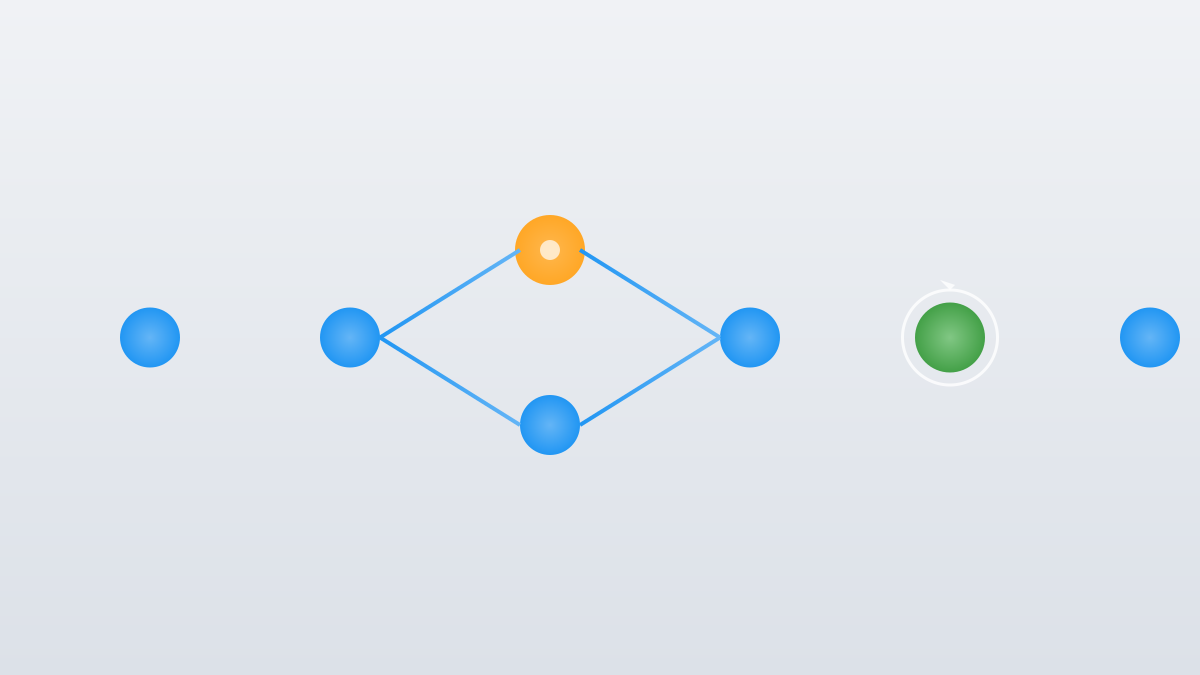
It uses a dynamic graph structure of nodes + edges, dynamically determining the execution order at runtime. It supports conditional branches, loops, and parallel paths, and can adjust strategies based on intermediate results (e.g., verifying uncertain results, skipping enhancement steps).

Concurrent Leaf Node Execution

It supports parallel scheduling of independent subtasks to reduce overall time; it also supports competitive execution (taking the first completed result) and voting mechanisms (synthesizing judgments from multiple Agents).

4

Section 04

Cost-Aware Routing and Schema Enforcement of Flow

Cost-Aware Routing

It maintains cost profiles for models/tools and dynamically selects the optimal solution: low-cost models for simple queries, high-cost models for critical decisions; it supports cost ceilings, with automatic downgrade or confirmation when exceeding thresholds.

Schema Enforcement and Validation

  • Structured Constraints: Ensure output format compliance via JSON Schema, etc. Violations trigger retries/corrections.
  • Semantic Validation: Custom functions check logical rationality (e.g., value ranges, code syntax). Failures can lead to retries or manual intervention.
5

Section 05

Fault Recovery and State Management of Flow

Checkpoints and Persistence

Automatically creates checkpoints to record state/intermediate results and stores them persistently; when recovering, loads the latest checkpoint to resume execution, with configurable strategies (time intervals/node completion).

Retry and Fallback

Automatic retries for temporary failures (fixed intervals/exponential backoff); if thresholds are exceeded, fallback to alternative solutions or manual intervention, supporting suspension and notification to operations.

6

Section 06

Integration Capabilities and Application Scenarios of Flow

Integration Capabilities

  • Model Abstraction Layer: Unified integration with OpenAI, Anthropic, etc., supporting automatic selection from model pools.
  • Agent Framework Adaptation: Provides adapters for LangChain/LlamaIndex; existing Agents can be wrapped as Flow nodes.

Application Scenarios

  • Complex task decomposition (research analysis, content creation)
  • Multi-Agent collaboration (coordinated interaction, result aggregation)
  • Long-duration tasks (data collection, batch processing)
7

Section 07

Limitations and Future Directions of Flow

Limitations

Currently only supports single-node deployment, lacking distributed execution and cross-node synchronization.

Future Directions

  1. Distributed execution and cross-node synchronization
  2. Visual editing/debugging tools
  3. Adaptive routing strategies to optimize cost-quality trade-offs
8

Section 08

Conclusion: Flow Empowers the Construction of Production-Grade Agent Systems

Flow is an important advancement in AI Agent infrastructure. Through dynamic orchestration, cost awareness, and fault recovery, it lays the foundation for production-grade Agent systems. As Agent applications move from prototypes to production, such general-purpose tools will play a key role.



