Zing Forum

Reading

Flipbook Canvas: Click-to-Explore Knowledge Flipbook, a Multimodal AI-Powered Interactive Learning Tool

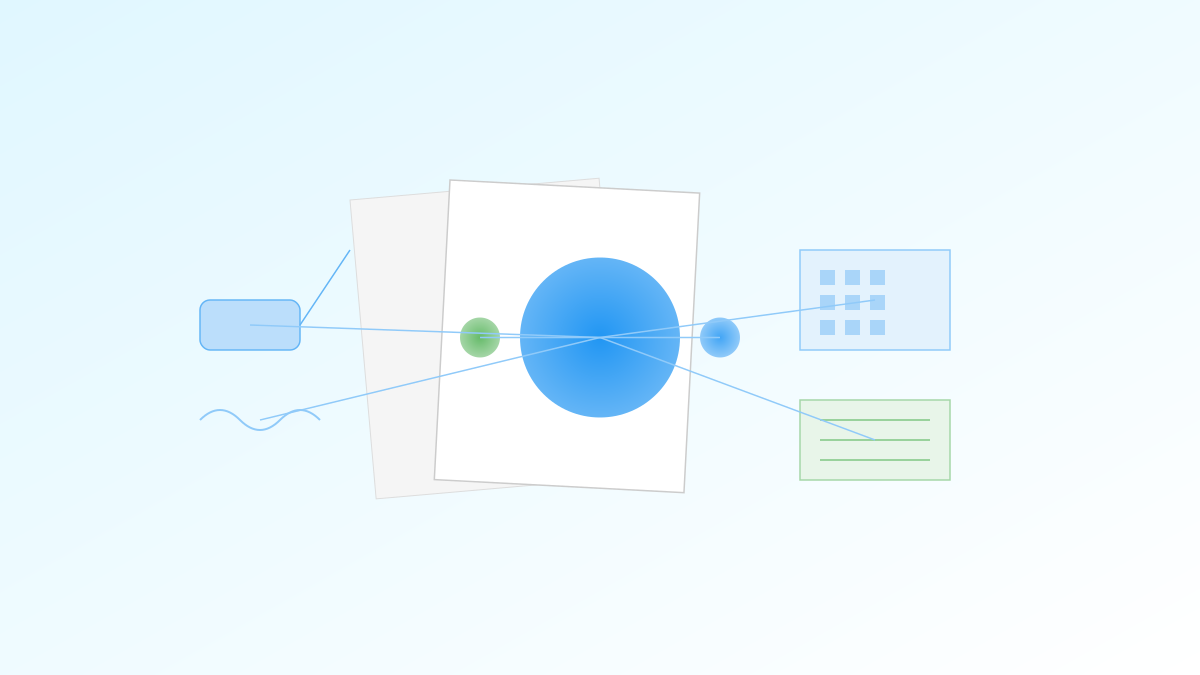
Flipbook Canvas is an innovative knowledge flipbook application that supports click-to-explore learning. Long-pressing any image generates a sub-image with text annotations, powered by a pluggable multimodal pipeline integrating capabilities like large language models, image generation, web search, and OCR.

多模态AI知识绘本交互式学习图像生成OCROpenAIGemini教育科技
Published 2026-05-30 02:10Recent activity 2026-05-30 02:27Estimated read 5 min
Flipbook Canvas: Click-to-Explore Knowledge Flipbook, a Multimodal AI-Powered Interactive Learning Tool
1

Section 01

Flipbook Canvas: Guide to the Multimodal AI-Powered Interactive Knowledge Flipbook Tool

Flipbook Canvas is an open-source knowledge flipbook application maintained by imcuttle (Source: GitHub, Link: https://github.com/imcuttle/flipbook-app, Updated: 2026-05-29). Its core is the "click-to-explore" learning mode—long-pressing an image generates a sub-image with text annotations. It integrates capabilities like large language models, image generation, web search, and OCR via a pluggable multimodal AI pipeline, supporting mainstream models such as OpenAI and Gemini. It applies to scenarios like education, technical documentation, and knowledge management, revolutionizing the way knowledge is acquired.


2

Section 02

The Need for Innovation in Knowledge Acquisition Methods

In the era of information explosion, traditional linear reading lacks intuitiveness and interactivity, especially inefficient for visual learners; while static images are intuitive, complex content easily makes readers lose track of details. Flipbook Canvas attempts to resolve this contradiction: it retains the intuitiveness of images while providing deep interactive exploration capabilities.

3

Section 03

Multimodal AI Pipeline and Support for Mainstream Models

The core competitiveness of Flipbook Canvas lies in its pluggable multimodal AI pipeline, which integrates four key capabilities:

  1. Large Language Models: Understand the content of image regions and generate text descriptions;
  2. Image Generation: Simplify complex charts or visualize abstract concepts;
  3. Web Search: Obtain the latest context to ensure the timeliness of explanations;
  4. OCR: Extract text from images as input. It supports mainstream models like OpenAI GPT, Google Gemini, and Seedream. Its model-agnostic design allows users to choose as needed and developers to extend flexibly.
4

Section 04

Application Scenarios and Value of Flipbook Canvas

  • Education: Create interactive teaching materials, such as time-travel on historical maps or virtual dissection of biological structures;
  • Technical Documentation: Lower the barrier to understanding complex architecture/flow charts, facilitating new employee training and technical sharing;
  • Knowledge Management: Build visual knowledge bases, integrate scattered documents and charts, and make knowledge discovery more natural.
5

Section 05

Technical Implementation and Open-Source Reference Value

As an open-source project, Flipbook Canvas provides a reference for the community on implementing multimodal AI applications: it demonstrates how to integrate different AI capabilities, design scalable pipelines, and handle input/output of multimodal data. It offers a valuable starting point for developers to build similar applications, helping them learn about multimodal integration and interactive knowledge product design.

6

Section 06

New Paradigm of Knowledge Exploration and Future Outlook

Flipbook Canvas represents a new paradigm of knowledge acquisition: from passive reception to active exploration, from linear reading to multi-dimensional interaction. With the support of AI technology, this paradigm is becoming a reality. In the future, as multimodal AI capabilities improve, more similar products will emerge, making knowledge acquisition more intuitive, efficient, and enjoyable. Flipbook Canvas is an early complete example of this trend.

