Zing Forum

Reading

Flightdeck: A Local-First AI Agent Workflow Management Platform

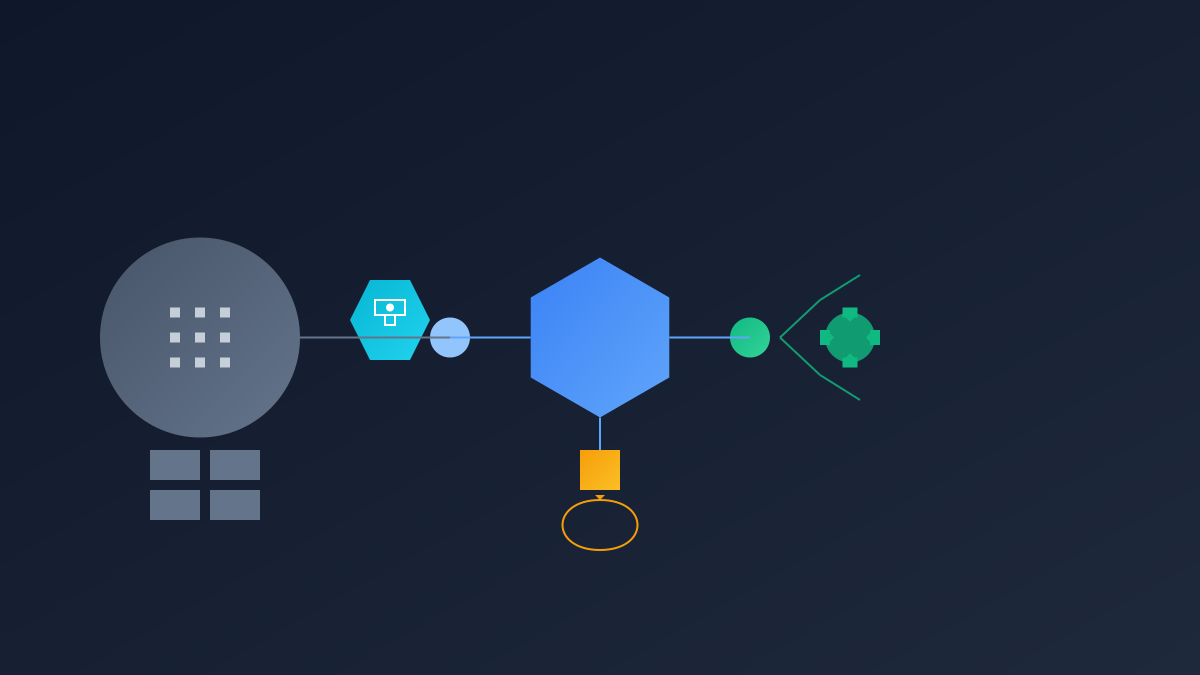
Flightdeck is a local-first tool designed specifically for developers to organize, plan, and launch AI Agent workflows across multiple codebases, offering a private development cockpit experience.

AI Agent工作流管理本地优先开发工具多代码库隐私保护自动化开源
Published 2026-06-06 05:45Recent activity 2026-06-06 05:50Estimated read 7 min
Flightdeck: A Local-First AI Agent Workflow Management Platform
1

Section 01

Flightdeck: Introduction to the Local-First AI Agent Workflow Management Platform

Flightdeck is a local-first tool designed specifically for developers to organize, plan, and launch AI Agent workflows across multiple codebases, offering a private development cockpit experience. The project is maintained by Hazihell and was released on GitHub on June 5, 2026 (link: https://github.com/Hazihell/flightdeck). Its core value lies in solving the problem of coordinating complex workflows across multiple codebases in modern AI development, while ensuring data privacy and autonomous control.


2

Section 02

Background: Workflow Challenges in Modern AI Development

With the rapid development of AI Agent technology, developers often need to coordinate AI services, tools, and automated processes across multiple codebases, facing challenges such as cross-repository management, dependency tracking, and context switching. Flightdeck aims to solve these complex workflow management issues through a unified cockpit interface.

3

Section 03

Core Features and Design Philosophy

Local-First Architecture

  • Data Privacy: Sensitive code and data remain local and are not uploaded to the cloud
  • Offline Availability: Organize and plan workflows without an internet connection
  • Response Speed: Local operations avoid network latency
  • Autonomous Control: Developers have full control over tools and data

Multi-Codebase Coordination

  • Unified View: Manage AI-related code across different repositories
  • Dependency Tracking: Identify cross-repository dependencies to ensure sequential execution of workflows
  • Context Switching: Quickly switch between projects to maintain development continuity

AI Agent Orchestration

  • Visual Planning: Intuitively design and adjust Agent flows
  • Parameter Configuration: Set API keys, model parameters, etc.
  • Execution Monitoring: Track task status and output in real time
  • Error Handling: Intelligent retries and detailed logs
4

Section 04

Technical Implementation Details

Architecture Design

Uses a modular architecture with key components:

  • Core Engine: Task scheduling and state management
  • Codebase Adapter: Supports integration with version control systems like Git and SVN
  • Agent Executor: Encapsulates interfaces for OpenAI, Anthropic, local models, etc.
  • User Interface: Two interaction modes (command-line and graphical interface)

Configuration Management

Uses declarative YAML/JSON configuration files:

  • Define workflow steps and dependencies
  • Securely store environment variables and sensitive information
  • Set trigger conditions and execution strategies
5

Section 05

Use Cases: Solving Real-World Development Pain Points

AI Integration in Microservices Architecture

Coordinate multi-service AI calls, cross-service Agent communication, and unified monitoring of distributed workflows

Multi-Model AI Application Development

Orchestrate multi-model call sequences, manage input/output format conversion, and optimize execution efficiency

Automated Development Workflows

  • Code Review Agent: Automatically analyze changes and generate reports
  • Documentation Generation: Generate API documentation from comments
  • Test Case Generation: Generate unit tests based on code logic
6

Section 06

Privacy Security and Ecosystem Extensibility

Privacy and Security

  • Local Data Protection: Sensitive information is stored in a local encrypted repository and protected using system key management services (e.g., macOS Keychain)
  • Network Isolation: By default, only communicates with external AI services when necessary; proxy rules can be configured to restrict network access

Ecosystem and Extensibility

  • Plugin System: Supports custom adapters (version control, AI services, Agent types)
  • Tool Integration: IDE plugins (VS Code, JetBrains), CI/CD (GitHub Actions, etc.), monitoring tools (Prometheus, etc.)
7

Section 07

Future Directions and Conclusion

Future Development Directions

  • Collaboration Mode: Securely share workflow configurations under the local-first premise
  • Intelligent Recommendations: Optimize workflow parameters based on historical data
  • Visual Debugging: Graphical tracking of Agent execution processes

Conclusion

Flightdeck represents a new direction for AI development tools: enjoying the capabilities of AI Agents while maintaining full control over data and tools. It is of great significance to developers who value privacy and need to manage AI workflows across multiple codebases. As AI becomes more popular, local-first tools will become even more important.

