Zing Forum

Reading

flight-analysis: A LangGraph-based Agent Workflow for U.S. Flight Delay Analysis

An Agentic workflow project built with LangGraph, specifically designed for analyzing U.S. flight delay data and demonstrating the application of modern AI workflow orchestration technology.

LangGraphAgentic Workflow航班延误数据分析AI工作流
Published 2026-05-06 17:45Recent activity 2026-05-06 17:54Estimated read 7 min
flight-analysis: A LangGraph-based Agent Workflow for U.S. Flight Delay Analysis
1

Section 01

Introduction to the flight-analysis Project

flight-analysis is an open-source project built on the LangGraph framework, focusing on U.S. flight delay data analysis. It demonstrates the core concept of Agentic Workflow—enabling AI systems to autonomously plan, execute multi-step tasks, and dynamically adjust strategies, serving as a typical application of modern AI workflow orchestration technology.


2

Section 02

Technical Background of LangGraph

What is LangGraph

LangGraph is developed by the LangChain team, a framework for building complex AI application workflows. It orchestrates Agent execution processes based on graph structures, supporting advanced features like loops, conditional branches, and state management, which differentiates it from traditional linear workflows.

Core Design Philosophy

Model AI applications as state machines, where nodes represent processing steps and edges represent state transitions. It is suitable for Agent applications involving multi-round reasoning, tool calls, and dynamic decision-making.

3

Section 03

Architecture Analysis of flight-analysis

Data Acquisition and Processing

Obtain information from aviation data APIs, flight schedules, and other data sources. The Agent has the ability to interact with external data sources.

Analysis Process Orchestration

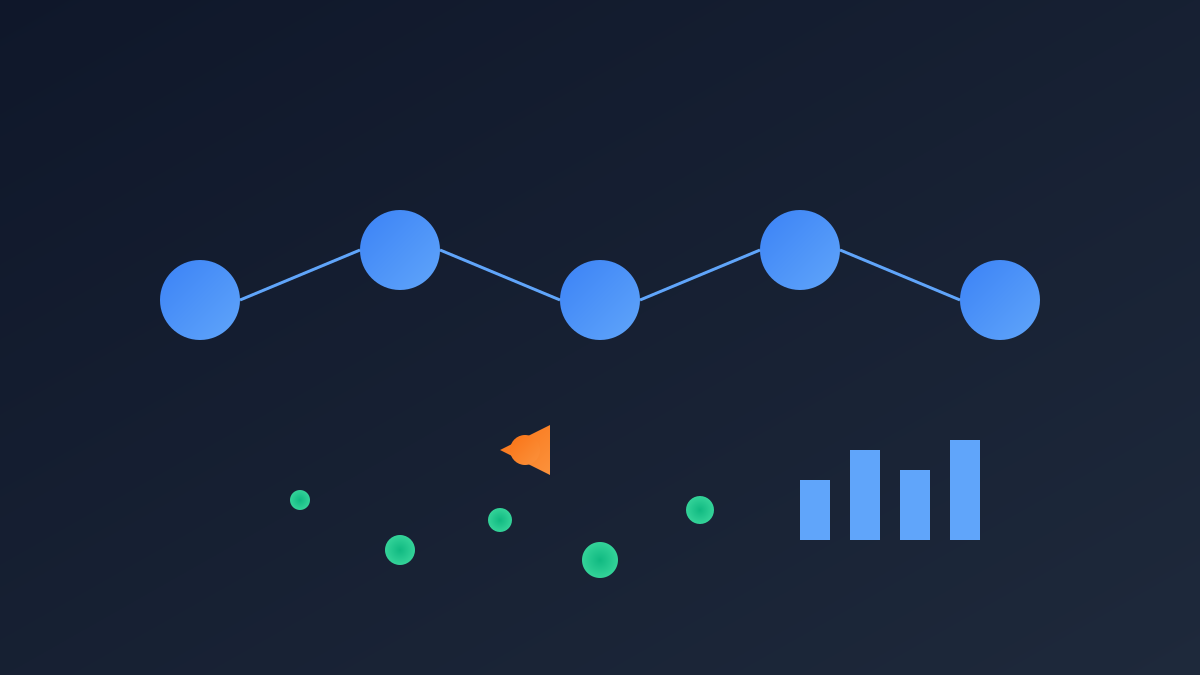
Decomposed into 5 steps: Data Collection → Data Cleaning (handling missing values, anomaly detection) → Analysis and Calculation (statistical delay frequency, average time, pattern identification) → Insight Generation → Report Output.

State Management Mechanism

Transfer raw data, intermediate results, and analysis conclusions through LangGraph state management to ensure each step has access to the required information.

4

Section 04

Manifestation of Agentic Workflow Features

Autonomous Decision-Making Ability

Adjust strategies autonomously based on data characteristics, such as triggering in-depth analysis when an airline's delay rate is detected to be abnormal.

Tool Call Integration

Flexibly orchestrate tools like data querying, statistical calculation, and visualization, selecting appropriate tools based on task requirements.

Error Handling and Retry

Address exceptions like API failures and incomplete data by implementing retries or switching to alternative data sources to ensure analysis continuity.

5

Section 05

Application Scenarios and Value

Airline Operation Optimization

Identify high-delay periods, routes, and causes to optimize scheduling, resource allocation, and emergency response plans.

Passenger Travel Decision-Making

Help select reliable flights, plan travel times, and reduce inconvenience caused by delays.

Airport Resource Planning

Optimize runway usage, gate allocation, and ground service scheduling to improve operational efficiency.

Academic Research

Accelerate data analysis in fields like transportation and operations research, supporting large-scale studies.

6

Section 06

Technical Implementation Details

Graph Structure Definition

Define the graph structure of the workflow, where nodes correspond to processing tasks and edges correspond to flow rules, reflecting business logic.

Conditional Edges and Branch Logic

Use conditional edges to implement intelligent branching, such as generating alerts or supplementary data collection based on the severity of delays.

Persistence and Checkpoints

Support workflow state persistence, allowing recovery after interruptions, as well as auditing and playback of historical executions.

7

Section 07

Insights from Development Practice

From Simple to Complex

First implement core analysis logic, then gradually add error handling, optimization strategies, and extended functions.

Observability Considerations

Monitor node execution time, success rate, and output quality to identify issues promptly.

Human-Machine Collaboration Mode

Retain human supervision and intervention, allowing involvement at key decision points to enhance system reliability.

8

Section 08

Project Summary

flight-analysis is an excellent example of LangGraph application, applying the Agentic Workflow concept to the flight data analysis scenario. Through graph structure orchestration, state management, and tool calls, it demonstrates methods for building AI systems that autonomously execute complex tasks. Such technologies will play an important role in fields like data analysis and automated operation and maintenance, driving AI evolution from simple Q&A to complex task execution.