Zing Forum

Reading

FinDocFlow: A Multimodal Intelligent Financial Document Analysis Platform, Building a Professional-level Investment Research Report Generation System

FinDocFlow is an end-to-end multimodal financial document processing pipeline that supports multiple formats including PDF, HTML, XBRL, and Excel. It extracts charts and tables via visual models, uses Neo4j knowledge graph for cross-page entity association, and finally generates structured analyst reports.

金融AI多模态分析投研报告知识图谱LLaVA文档智能Neo4jKubernetes量化分析财务文档
Published 2026-04-17 02:32Recent activity 2026-04-17 02:53Estimated read 8 min
FinDocFlow: A Multimodal Intelligent Financial Document Analysis Platform, Building a Professional-level Investment Research Report Generation System
1

Section 01

FinDocFlow: Introduction to the Multimodal Intelligent Financial Document Analysis Platform

FinDocFlow is an end-to-end multimodal intelligent financial document analysis platform designed to address the pain points of financial analysts in processing massive financial documents. Its core functions include:

  • Supports document ingestion of multiple formats such as PDF, HTML, XBRL, and Excel
  • Extracts chart and table content via visual models (e.g., DETR, CLIP)
  • Implements cross-page entity association using Neo4j knowledge graph
  • Generates structured analyst reports that meet industry standards This project is open-source, created by developer Akshay007724, combining large language models and computer vision technology to enhance the efficiency and depth of financial document analysis.

2

Section 02

Background: Pain Points in Financial Document Analysis and the Birth of FinDocFlow

Traditional financial document analysis faces many pain points:

  • Manual processing of massive documents is time-consuming and labor-intensive, making it difficult to capture implicit associations across documents and pages
  • Key information is scattered in various forms such as tables, charts, footnotes, etc., leading to easy omission of details FinDocFlow emerged as an open-source project that provides an end-to-end multimodal financial document reasoning pipeline, converting unstructured/semi-structured documents into intelligent data assets. It represents an important progress in the field of financial AI—integrating LLM reasoning capabilities with computer vision technology to achieve deep understanding of complex financial documents.
3

Section 03

Core Capabilities: Four-Stage Intelligent Processing Pipeline

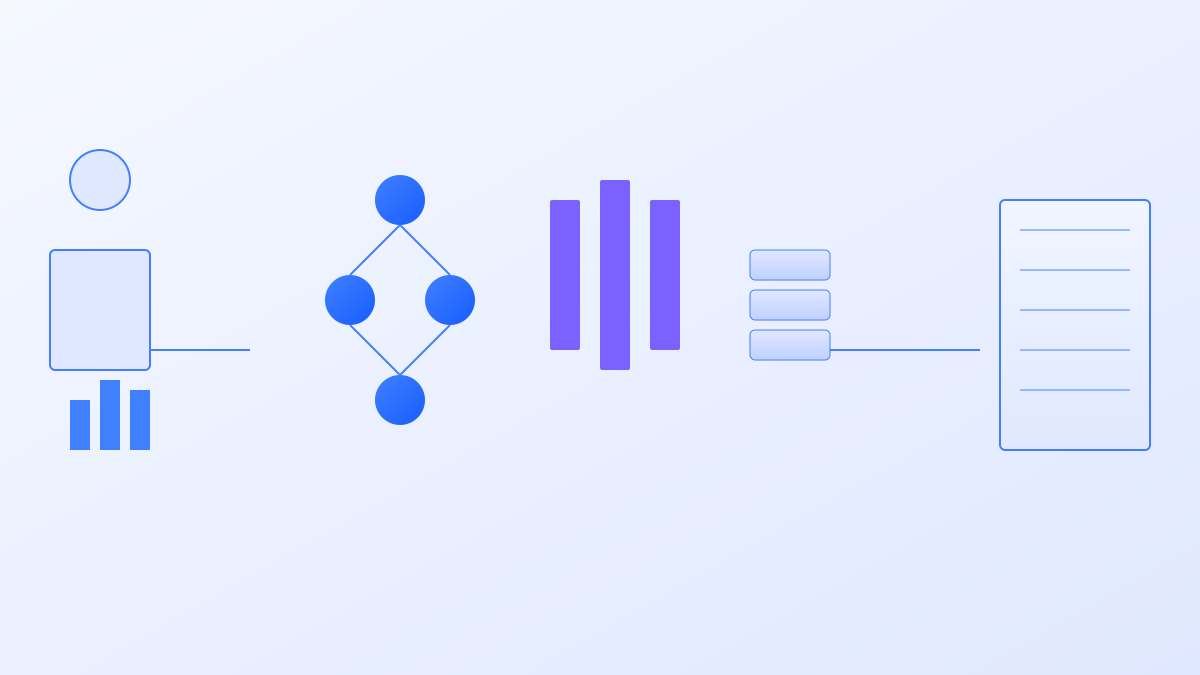
FinDocFlow adopts a four-stage microservice architecture to form a complete processing pipeline:

  1. Document Ingestion: Supports formats like PDF, HTML, XBRL, Excel; uses Kafka producer + 10-thread pool to enable batch processing and resumable transfer
  2. Multimodal Extraction: Uses EasyOCR (arm64 optimized), DETR (table detection), CLIP (chart classification); 10-thread parallel processing improves throughput
  3. Entity Association: Builds a knowledge graph based on Neo4j, enabling entity recognition, relationship establishment, cross-page parsing, and semantic search
  4. Intelligent Reasoning: Deploys LLaVA multimodal model via Ollama, supporting direct image understanding, chart value extraction, complex table parsing; uses THINK→ACT→VERIFY reasoning loop to ensure accuracy
4

Section 04

Investment Research Report Generation and Professional Interactive Interface

Investment Research Report Generation: One-click output of professional reports containing 9 standard chapters (Investment Summary, Business Description, Industry Analysis, Financial Analysis, Key Risks, ESG Analysis, Management Quality, Growth Catalysts, Valuation Metrics); 4-thread parallel generation, supports Markdown download. Professional Interactive Interface:

  • Visual design: Dark OLED theme, drawing on Bloomberg style, three-in-one interface (document library, report generator, chat interface)
  • Document management: Batch upload/SEC EDGAR ingestion, status display and content caching
  • Intelligent Q&A: Document-based chat with page number references, supports multi-round conversations and domain configuration (editable prompt templates to adjust analysis frameworks)
5

Section 05

Deployment Architecture and Technology Stack

Deployment Methods:

  • Local development: Start services via Docker Compose, pull LLaVA model (about 4.7GB), access localhost:8501
  • Production environment: Kubernetes native deployment (including Deployment, Service, HPA), supports one-click Helm deployment (customizable configuration) Technology Stack:
  • Message queue: Apache Kafka
  • Cache: Redis
  • Graph database: Neo4j
  • Object storage: MinIO (S3 compatible, Iceberg format)
  • Model service: Ollama (local LLaVA deployment)
  • Container orchestration: Kubernetes + Helm
6

Section 06

Compatibility Optimization and Project Summary

Compatibility Optimization: Specifically optimized for Apple Silicon (M-series chips), all services natively support linux/arm64 architecture; uses EasyOCR instead of PaddleOCR to improve ARM compatibility. Project Summary: FinDocFlow is an important exploration in the practical application of financial AI, with its value reflected in:

  • Multimodal understanding: Breaking through pure text limitations to understand charts and tables
  • Knowledge graph: Solving the problem of information fragmentation
  • Standardized output: Conforming to industry report formats
  • Customizability: Editable prompt templates
  • Local deployment: Protecting sensitive data and meeting compliance requirements It is suitable for professionals such as quantitative analysts and fundamental researchers, and is expected to become a standard tool for financial analysis in the future.


