Zing Forum

Reading

Filmtools: Using Large Language Models to Convert Camera Manuals into Structured Databases

Filmtools demonstrates an innovative document processing method: using large language models to extract and structure PDF camera manuals into queryable JSON and SQLite databases, providing new ideas for the digitization and retrieval of technical documents.

FilmtoolsLLM大语言模型PDF处理文档结构化SQLiteFTS5全文检索技术文档知识提取
Published 2026-07-13 06:48Recent activity 2026-07-13 07:02Estimated read 6 min
Filmtools: Using Large Language Models to Convert Camera Manuals into Structured Databases
1

Section 01

Filmtools Project Introduction: Empowering Camera Manual Structuring with Large Language Models

Filmtools is a project on GitHub aimed at solving the problem that traditional PDF camera manuals are difficult to parse and retrieve by programs. It uses large language models (LLMs) to convert unstructured PDF manuals into structured JSON data, which is further imported into an SQLite database (combined with FTS5 full-text search) to achieve digitization and efficient retrieval of technical documents, providing new ideas for technical document processing.


2

Section 02

Project Background and Core Issues

Camera manuals are detailed but complex in structure. Traditional PDF formats are only convenient for human reading and cannot be effectively understood and retrieved by machines. Filmtools needs to solve three core issues: 1) How to enable machines to truly understand structured knowledge in manuals (such as functions, operation steps, and associations); 2) How to map natural language queries to specific entries; 3) How to preserve the relationships between knowledge points.

3

Section 03

Three-Stage Solution Architecture

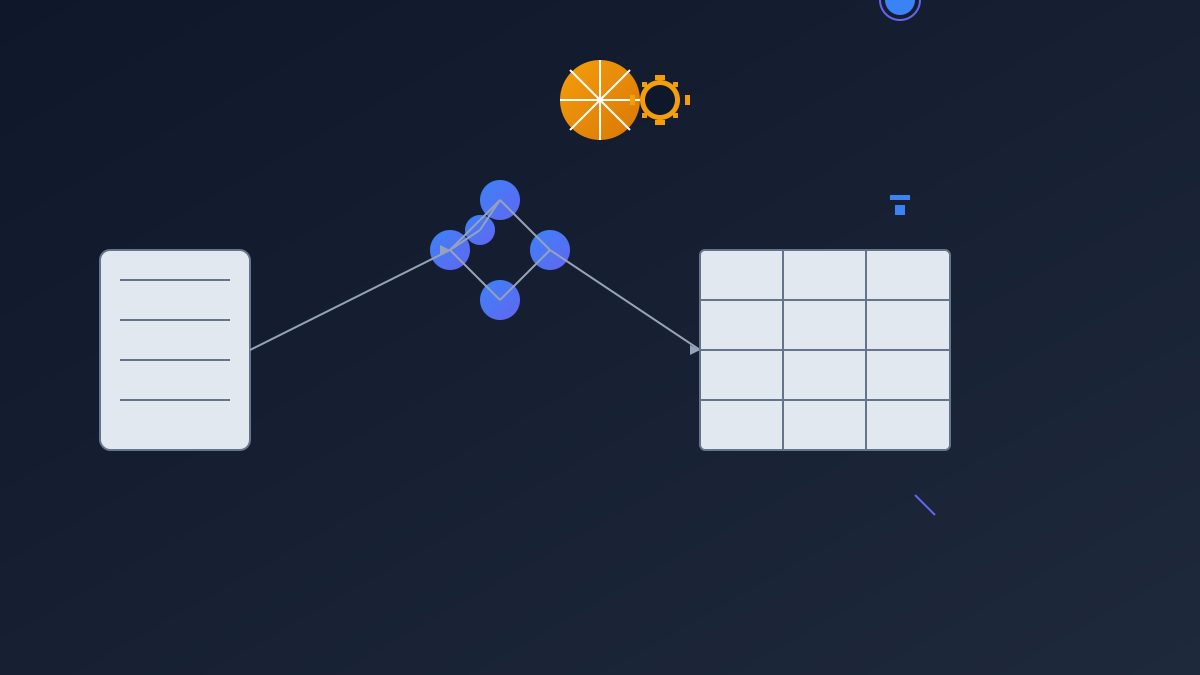
Filmtools adopts a three-stage process: 1) LLM Extraction: Identify topic entries and extract titles, categories, summaries, keywords, related topics, and page numbers; 2) JSON Structuring: Organize the extracted information into a standardized format (including fields such as id, title, category) for subsequent processing and association; 3) SQLite Database Integration: Import JSON data into SQLite via Python scripts, use FTS5 virtual tables to achieve efficient full-text search, support relevance sorting, and is lightweight and easy to deploy.

4

Section 04

Data Examples and Content Coverage

Filmtools successfully extracted rich content from the Polaroid Go Generation 2 camera manual, including hardware components (shutter button, lens, etc.), operation guides (power on/load film, etc.), function descriptions (flash/self-timer mode, etc.), troubleshooting (indicator light meanings), etc. Each entry includes a summary, detailed content, keywords, and related topics, forming a complete knowledge network.

5

Section 05

Technical Implementation Details

The project's Python script import_records.py has the following features: supports flexible reading of JSON arrays, JSON Lines, and single JSON objects; standardizes field types via the normalize_record function (e.g., converting keywords to JSON strings); uses batch insertion to improve efficiency; supports UPSERT (INSERT OR REPLACE) to avoid duplicate import errors.

6

Section 06

Application Scenarios and Expansion Possibilities

The Filmtools solution can be extended to multiple fields: intelligent customer service (natural language query of manuals), enterprise knowledge bases (structured internal documents), multilingual support (LLM translation + structuring), voice interaction (combined with speech recognition/synthesis), AR assistance (pointing to components to display function descriptions), etc.

7

Section 07

Limitations and Improvement Directions

As a proof-of-concept project, Filmtools has room for improvement: 1) It does not show details of PDF text extraction (e.g., layout analysis); 2) The cost of calling commercial LLMs is high, so open-source models can be considered; 3) A data quality control mechanism needs to be established (to avoid LLM hallucinations); 4) Lack of an incremental update scheme; 5) It does not handle multimodal content such as images in manuals.

8

Section 08

Technical Insights and Summary

Filmtools reflects three major technical trends: 1) LLMs as general-purpose extractors, replacing complex parsing rules; 2) Lightweight search solutions (SQLite FTS5) balancing functionality and complexity; 3) Human-machine collaboration (LLM extraction + manual review) improving efficiency. Although the project is small, it demonstrates the potential of LLMs in the field of document processing and provides a referenceable solution for the digitization of technical documents.