Zing Forum

Reading

From Figma to Code: Nuxt Agentic Demo Shows AI-Driven Design-to-Development Workflow

Explore how the nuxt-agentic-demo project automatically converts Figma designs into deployable Nuxt.js landing pages via an agentic workflow, revealing a new paradigm for AI-assisted front-end development.

Nuxt.js智能体工作流FigmaAI代码生成前端自动化设计转代码Vue.jsagentic workflow
Published 2026-05-06 02:13Recent activity 2026-05-06 02:21Estimated read 7 min
From Figma to Code: Nuxt Agentic Demo Shows AI-Driven Design-to-Development Workflow
1

Section 01

Introduction: Nuxt Agentic Demo Explores New AI-Driven Design-to-Development Paradigm

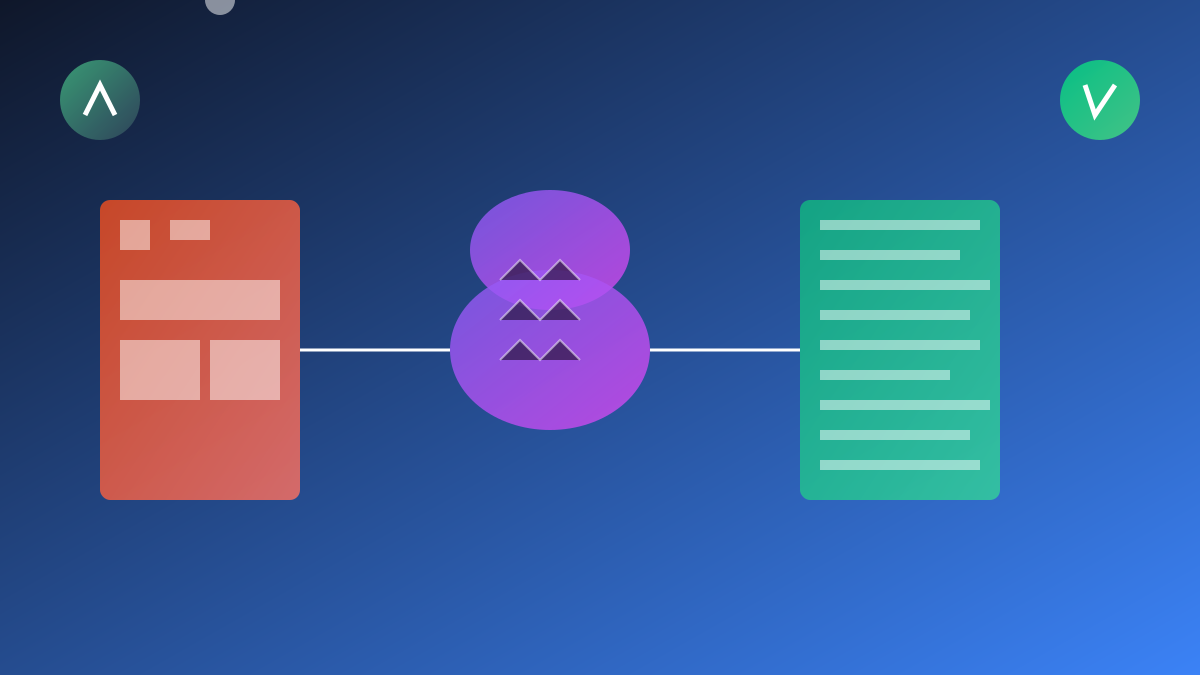
This article introduces the nuxt-agentic-demo experimental project, which uses an agentic workflow to automatically convert Figma designs into deployable Nuxt.js landing pages. It aims to solve the time-consuming and error-prone pain points of design-to-code conversion in front-end development and showcase a new paradigm for AI-assisted front-end development.


2

Section 02

Project Background and Core Objectives

In front-end development, the design-to-code phase is time-consuming and error-prone, requiring repeated communication between designers and developers on details. The core objective of the nuxt-agentic-demo project is to bridge the gap between design and code via an agentic workflow, reducing the time cost from design to deployment. Nuxt.js was chosen as the target platform because it is a full-stack framework in the Vue ecosystem with excellent server-side rendering capabilities, automatic routing, and modular design. Beyond static UI generation, it also addresses engineering issues like SEO optimization, performance optimization, and deployment configuration.

3

Section 03

Technical Architecture of the Agentic Workflow

The agentic workflow decomposes complex tasks into subtasks, completed collaboratively by AI agents:

  1. Design Parsing Phase: Extract layer structure, style attributes, component relationships via the Figma API, and identify design semantics (e.g., buttons, cards, layout containers);
  2. Component Mapping and Code Generation: Map parsed data to the Nuxt/Vue component system, generate Vue single-file components, Tailwind/UnoCSS class names, and handle responsive breakpoints and type-safe Props interfaces;
  3. Content and Logic Injection: Extract copy and support localization, generate interaction logic (form validation, animations, state management) and SEO metadata;
  4. Build and Deployment: Coordinate dependency installation, type checking, static generation/SSR configuration, and deploy to edge nodes.
4

Section 04

Technical Challenges and Solutions

Three major challenges were encountered during implementation:

  • Understanding Design Intent: Figma only provides visual information without semantics (e.g., a rectangle could be a button, input box, or decoration), requiring judgment via context reasoning and pattern recognition;
  • Code Quality and Maintainability: Automatically generated code is often poorly readable and has many hard-coded parts, so it's necessary to generate maintainable code that complies with team standards;
  • Design System Consistency: When design drafts use design system components, prioritize reusing existing component libraries instead of generating duplicate code.
5

Section 05

Implications for Front-End Development

This project represents an important direction in the evolution of front-end toolchains, establishing an end-to-end automated pipeline from design to deployment. Changes for teams:

  1. Accelerated Prototype Validation: PMs and designers can quickly turn ideas into interactive prototypes, shortening the feedback loop;
  2. Reduced Repetitive Work: Developers are freed from style reproduction and can focus on business logic and architectural design;
  3. Guaranteed Design Consistency: The automated process reduces human errors and ensures a high degree of consistency between implementation and design drafts.
6

Section 06

Limitations and Future Outlook

Current technical limitations: Scenarios like complex interactions, custom animations, and performance optimization still require human intervention; the quality of design drafts directly affects code quality (messy layers lead to messy code). Future outlook:

  • More intelligent design intent recognition (combining visual language models);
  • Deep integration with mainstream design systems (Ant Design, Material Design);
  • Optimize human-AI collaboration models to allow developers to elegantly take over and modify AI-generated code.
7

Section 07

Conclusion

nuxt-agentic-demo is a strong proof of concept for the application potential of agent technology in front-end engineering. Although it is still far from fully replacing manual development, it has proven that AI can significantly accelerate the design-to-code process. For front-end teams pursuing efficiency, paying attention to and experimenting with such tools is an important strategy to maintain competitiveness.