Zing Forum

Reading

FateFormerApp: A Multimodal Deep Learning Application Platform for Predicting Cell Fate Reprogramming

A companion application for the FateFormer model, using multimodal deep learning technology to predict the fate trajectory of cells during reprogramming, providing an intelligent analysis tool for regenerative medicine and cell biology research.

cell fatereprogrammingmultimodaldeep learningscRNA-seqregenerative medicinesingle-cell analysis
Published 2026-04-13 22:55Recent activity 2026-04-13 23:22Estimated read 7 min
FateFormerApp: A Multimodal Deep Learning Application Platform for Predicting Cell Fate Reprogramming
1

Section 01

FateFormerApp: Introduction to the Multimodal Deep Learning Platform for Predicting Cell Fate Reprogramming

FateFormerApp is a companion application for the FateFormer model. It uses multimodal deep learning technology to integrate single-cell RNA sequencing (scRNA-seq) data, cell morphological images, and time-series dynamic information to predict the fate trajectory of cells during reprogramming. This platform provides an intelligent analysis tool for regenerative medicine and cell biology research, enabling biologists without programming backgrounds to use advanced AI technology for cell analysis.


2

Section 02

Background of Cell Reprogramming and Regenerative Medicine

Cell reprogramming technology is a revolutionary breakthrough in the biomedical field. By reversing differentiated somatic cells into pluripotent stem cells, it opens new avenues for disease modeling, drug screening, and cell therapy. However, the reprogramming process is complex and inefficient—many cells fail or differentiate abnormally. Predicting the fate of individual cells is key to improving efficiency. Traditional methods rely on endpoint detection and cannot track dynamic changes in real time; while single-cell sequencing technology can monitor transcriptome states, integrating multi-dimensional data to build predictive models remains a challenge in computational biology.

3

Section 03

FateFormer Model and Application Architecture

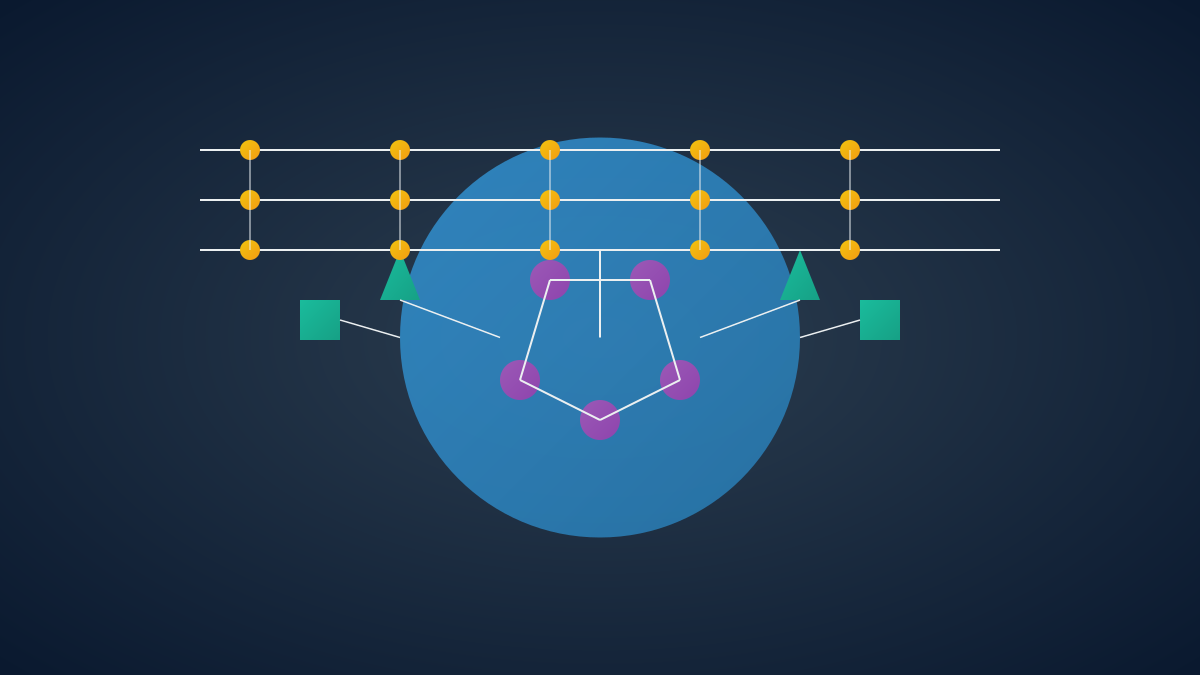
FateFormer is a multimodal deep learning model for predicting cell reprogramming fate. It integrates scRNA-seq data, morphological images, and time-series information to build an end-to-end framework. As a companion application, FateFormerApp encapsulates the model's inference capabilities into a user-friendly interface, allowing biologists to use it without programming. The multimodal architecture is core: transcriptome data reflects molecular states, morphological images capture phenotypic features, and time-series records dynamic trajectories—their fusion provides a comprehensive and robust foundation for prediction.

4

Section 04

Technical Implementation and Model Design

The model uses modular encoders: the transcriptome encoder processes gene expression matrices based on graph neural networks or Transformers; the visual encoder extracts morphological features using convolutional neural networks or Vision Transformers; the time-series encoder captures dynamic evolution using recurrent neural networks or state-space models. The multimodal fusion module uses attention mechanisms or gating strategies to adaptively adjust the weights of each modality (e.g., relying on other modalities when data quality is low). The App supports importing multiple data formats (10x Genomics, TIFF/PNG, etc.), and provides data preprocessing, parameter configuration, and result visualization (charts, heatmaps, trajectory plots).

5

Section 05

Application Scenarios and Scientific Value

FateFormerApp has wide applications in regenerative medicine: optimizing iPSC generation (identifying successful cells, improving screening efficiency), tracking direct reprogramming (predicting differentiation directions); in disease modeling, analyzing reprogramming barriers in patient cells to discover disease mechanisms; in drug screening, high-throughput prediction of cell fate under different treatments to accelerate candidate drug identification.

6

Section 06

Technical Challenges and Solutions

Challenges and solutions: 1. Data heterogeneity (batch effects): corrected using adversarial training or variational autoencoders; 2. Class imbalance (few successful cells): addressed using resampling, cost-sensitive learning, or imbalance loss functions; 3. Interpretability: integrated attention visualization, SHAP value analysis, or gradient attribution to help understand the model's decision-making basis.

7

Section 07

Future Development Directions

In the future, we will integrate more data modalities (spatial transcriptomics, single-cell multi-omics, proteomics) to improve prediction accuracy; develop real-time prediction capabilities (combining microfluidics and online learning); expand to other cell state transition scenarios such as cell senescence, carcinogenesis, and immune activation, becoming a universal prediction platform.

8

Section 08

Conclusion

FateFormerApp is a typical case of the intersection between AI and life sciences. It applies cutting-edge deep learning to basic cell biology problems, providing a powerful tool for regenerative medicine. As technology matures and data accumulates, such AI-driven platforms will accelerate the translation from basic discoveries to clinical applications.

