Zing Forum

Reading

Evolva: A Lightweight Self-Evolving Agent Engineering Framework for Local Deployment

Evolva is a local agent engineering framework designed specifically for CLI/TUI conversation scenarios. It integrates complete capabilities including planning, memory, skill precipitation, MCP tool ecosystem, workflow orchestration, observability, evaluation closed-loop, policy protection, and self-evolution, providing developers with an out-of-the-box solution for building local agents.

Agent 框架本地部署LLM自进化MCPCLITUIPython开源
Published 2026-06-02 00:44Recent activity 2026-06-02 00:51Estimated read 9 min
Evolva: A Lightweight Self-Evolving Agent Engineering Framework for Local Deployment
1

Section 01

【Introduction】Evolva: A Local-First Lightweight Self-Evolving Agent Engineering Framework

Evolva is an open-source Python project maintained by koppx (GitHub link: https://github.com/koppx/Evolva, updated on 2026-06-01). It is positioned as a lightweight self-evolving agent engineering framework for local deployment, focusing on CLI/TUI conversation scenarios. It integrates nine core capabilities: planning, memory, skill precipitation, MCP tool ecosystem, workflow orchestration, observability, evaluation closed-loop, policy protection, and self-evolution, providing developers with an out-of-the-box solution for building local agents. It is suitable for scenarios with sensitive data privacy, offline operation, or the need for full control over agent behavior.


2

Section 02

Project Positioning and Background

Evolva differs from mainstream cloud-based agent services and is positioned as a 'Local Self-Evolving Agent Harness', focusing on local deployment scenarios, especially suitable for conversational AI applications in CLI/TUI environments. Its core concept is to provide a complete self-contained agent runtime environment, allowing developers to build, run, and iterate intelligent agents on local machines without relying on external cloud services, meeting the needs of sensitive data privacy, offline operation, or full control over agent behavior.

3

Section 03

Panoramic View of Core Capabilities

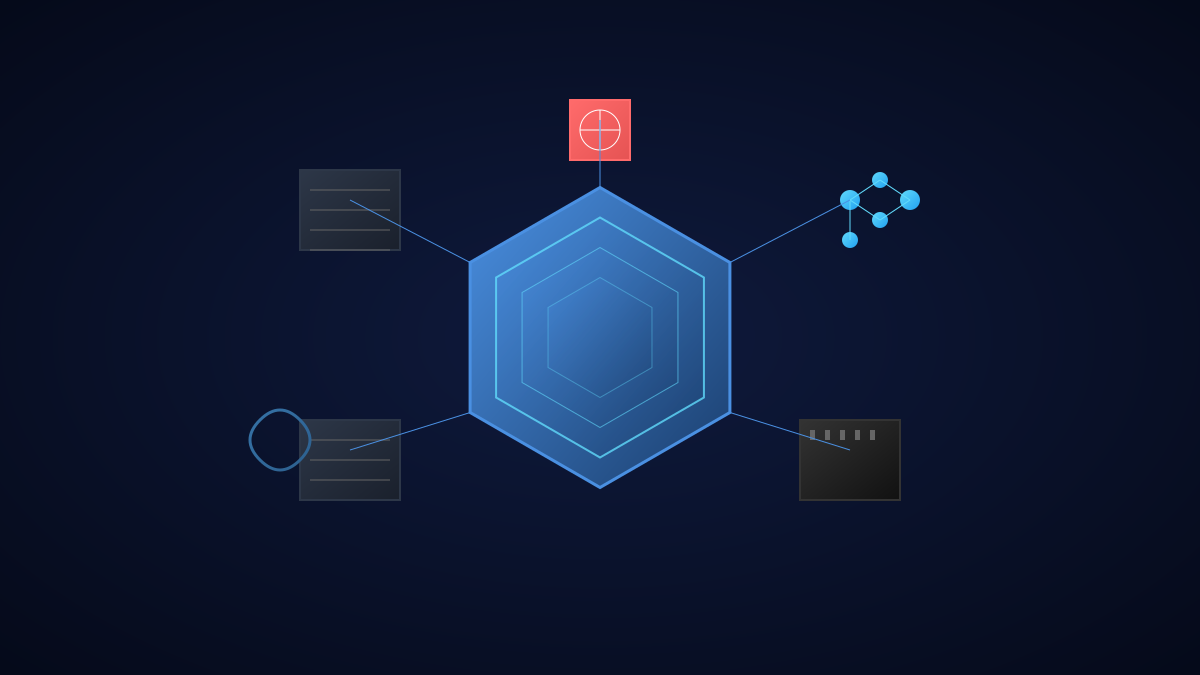
Evolva has a complete capability stack built-in for production-level agents:

  1. Planning and Execution: Decompose complex requests into executable subtask sequences;
  2. Long-Short Term Memory: Maintain conversation context in the short term, and persist cross-session knowledge and preferences in the long term;
  3. Skill Precipitation: Convert common task patterns into reusable skills to form knowledge assets;
  4. MCP Tool Ecosystem: Integrate Model Context Protocol to seamlessly connect external tools (file systems, databases, APIs, etc.);
  5. Workflow Orchestration: Define collaborative processes declaratively, supporting non-technical personnel to participate in design;
  6. Observability: Record agent decisions, tool calls, and state changes for easy debugging and optimization;
  7. Evaluation Closed-Loop: Provide evaluation infrastructure, supporting task definition, result collection, and performance indicator calculation;
  8. Policy Protection: Insert security checks, content filtering, and behavior constraints at key nodes;
  9. Self-Evolution: Automatically optimize prompts, tool selection, and planning logic based on execution feedback to achieve continuous capability improvement.
4

Section 04

Technical Architecture and Implementation

Evolva is developed using Python 3.10+ and uses uv for dependency management. Its main modules include:

  • Core Engine: Agent runtime, planner, memory manager;
  • Evaluation Tasks: Predefined set of evaluation tasks;
  • Test Suite: Unit tests and integration tests;
  • Resource Files: Documentation and presentation resources. The framework design embodies engineering thinking, with clear module boundaries, comprehensive test coverage, and a standardized project structure.
5

Section 05

Application Scenario Analysis

Evolva's local-first architecture is suitable for the following scenarios:

  1. Privacy-Sensitive Scenarios: Processing information that cannot leave the local environment, such as medical records and financial data;
  2. Development and Debugging Scenarios: Rapid local iteration, real-time execution tracking, and flexible configuration adjustments;
  3. Edge Deployment Scenarios: Running on resource-constrained devices, with modular design allowing function cropping on demand;
  4. Customization Requirement Scenarios: Deeply modifying planning algorithms, replacing memory implementations, extending tool protocols, without being restricted by cloud APIs.
6

Section 06

Comparison with Similar Projects

Comparison between Evolva and similar agent frameworks:

Dimension Evolva LangChain/LangGraph AutoGPT OpenAI Assistants
Deployment Mode Local-First Hybrid Cloud/Local Local/Cloud Pure Cloud
Interaction Interface CLI/TUI Code/API Web/CLI API
Self-Evolution Built-in Need to build Experimental None
Evaluation Closed-Loop Built-in Need to integrate Limited None
Open Source Degree Fully Open Source Open Source Open Source Closed Source
Evolva is more suitable for technical teams pursuing full local control, needing self-evolution capabilities, and valuing the evaluation closed-loop.
7

Section 07

Selection Recommendations and Outlook

Selection Recommendations:

  • Suitable for: Teams with Python development capabilities, strict requirements for data privacy, need for deep customization of agent behavior, desire to build an internal skill library, and resources for local model deployment;
  • Trade-offs: Teams familiar with JS/TS ecosystem, need for quick launch, existing mature cloud agent infrastructure, or no urgent need for self-evolution. Outlook: Evolva represents the evolution direction of agent frameworks from 'connecting to cloud-based large models' to 'building local intelligent systems'. As edge-side model capabilities improve and privacy compliance requirements strengthen, local-first frameworks will receive more attention. The project is in an active development phase and is worth developers' attention and contributions.
