Zing Forum

Reading

Evo-OSIII: A Cognitive Agent Orchestration System Under the Nine-Layer Pyramid Architecture

Explore the nine-layer pyramid architecture of Evo-OSIII, from constitutional governance to quantum-inspired navigation, and learn how to build an agent execution environment with cognitive memory, semantic anchoring, and controlled evolution.

智能体编排AI架构多智能体系统认知记忆工作流管理LLM应用智能体治理
Published 2026-06-03 05:14Recent activity 2026-06-03 05:17Estimated read 8 min
Evo-OSIII: A Cognitive Agent Orchestration System Under the Nine-Layer Pyramid Architecture
1

Section 01

[Introduction] Evo-OSIII: Core Analysis of the Cognitive Agent Orchestration System Under the Nine-Layer Pyramid Architecture

Evo-OSIII (ep-osa-core) is an agent orchestration system maintained by EvoPyramidini on GitHub. Its core is a nine-layer pyramid architecture, ranging from constitutional governance to quantum-inspired navigation, which builds an agent execution environment with cognitive memory, semantic anchoring, and controlled evolution. This architecture integrates quantum thinking, cognitive science, and contract-based design to address core challenges of next-generation AI systems such as multi-agent collaboration, workflow orchestration, and memory management, while balancing governability, evolvability, and long-term stability.


2

Section 02

Background: Need for a New Paradigm in Agent Orchestration

With the rapid evolution of Large Language Model (LLM) capabilities, a single model can hardly meet the needs of complex business scenarios. Multi-agent collaboration, workflow orchestration, and memory management have become core challenges for next-generation AI systems. The Evo-OSIII project proposes a nine-layer pyramid architecture, aiming to build a complete agent execution environment from bottom-layer governance to top-layer cognition—it is both a technical framework and a design philosophy for AI systems.

3

Section 03

Methodology: Detailed Explanation of the Nine-Layer Pyramid Architecture

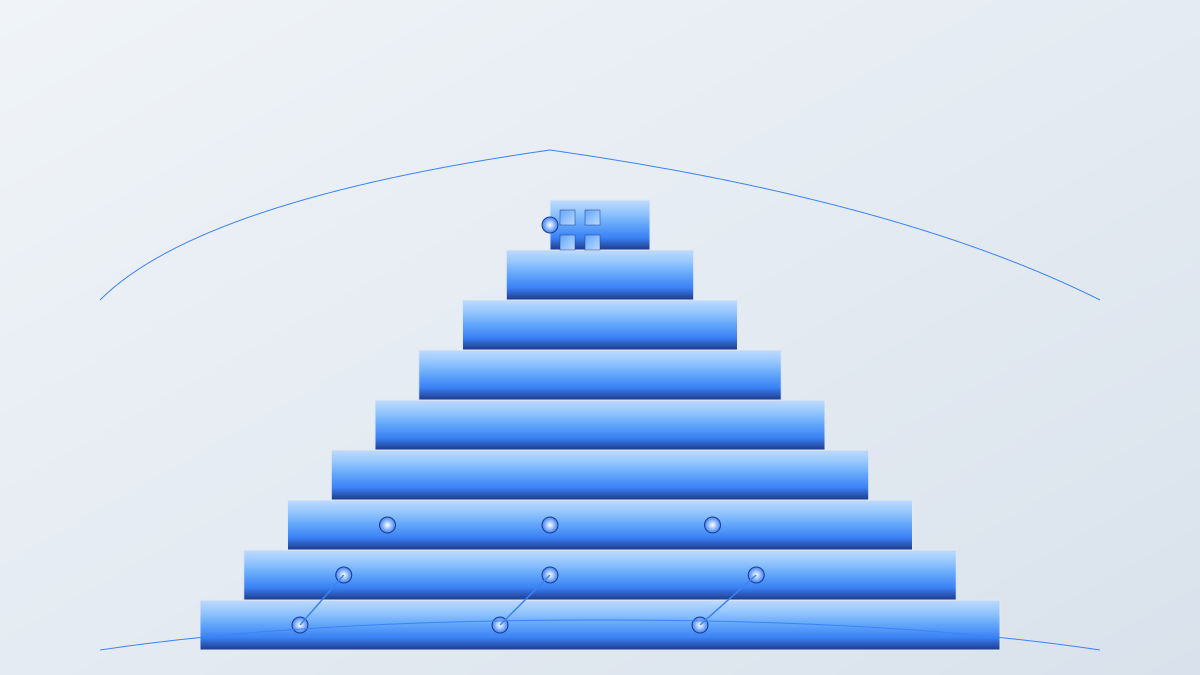
The nine-layer architecture of Evo-OSIII is strictly layered with clear responsibilities for each layer:

  1. Constitutional Layer: Immutable governance principles to ensure safety and ethical guidelines;
  2. Contract Layer: Explicit interaction interfaces to ensure component predictability and testability;
  3. Schema Layer: Strongly typed data definition and validation;
  4. Runtime Layer: Resource-constrained secure execution environment supporting failure isolation;
  5. Skill Layer: Composable capability units that can be dynamically loaded and unloaded;
  6. Orchestration Layer: Coordinates skill combinations to execute complex workflows;
  7. Tracing Layer: Full-link observability to support debugging and auditing;
  8. Memory Layer: Hierarchical storage + semantic anchors to maintain context coherence;
  9. Research Layer: Experiments with cutting-edge concepts; successful ones are integrated as formal features.
4

Section 04

Core Concepts and Technical Implementation Highlights

Core concepts include:

  • EvoAbsolut: Quantum-inspired self-evolution core supporting non-linear state transitions, energy conservation, and self-reflection;
  • HybridSession: Dual-buffer session management that handles tasks synchronously + optimizes memory asynchronously;
  • PEAR Framework: A four-dimensional interaction model covering Purpose, Environment, Agent, and Result. Technical highlights:
  • Cognitive Memory Pyramid: L0-L4 hierarchical storage adapted to different task granularities;
  • Magnetic Orchestration Protocol: Field-driven cognition to reduce central control overhead;
  • Constitution-driven Evolution: Changes must pass constitutional checks to ensure core principles are maintained.
5

Section 05

Application Scenarios and Value

Evo-OSIII is suitable for the following scenarios:

  1. Enterprise-level intelligent assistants: Long-term memory, multi-turn conversations, tool calls;
  2. Autonomous workflow systems: Multi-agent collaboration to complete complex business processes;
  3. Research experiment platforms: Safe experimentation of new algorithm architectures;
  4. Compliance-sensitive applications: Fields such as finance and healthcare that require strict auditing and controlled evolution.
6

Section 06

Conclusion and Outlook

Evo-OSIII represents a new direction in agent system architecture, focusing on governability, evolvability, and long-term stability. The nine-layer architecture provides a clear thinking framework to help developers design agent systems comprehensively. As AI moves from experimentation to production, and from short-term tasks to long-term services, such architectures that emphasize governance and evolution will become increasingly important. Building a truly intelligent system requires powerful models + robust engineering practices + well-thought-out architectural design.

7

Section 07

Recommendations: For Developers and Users

  1. Developers can use the nine-layer architecture to design agent systems in layers, ensuring clear responsibilities for each layer;
  2. When applying in compliance-sensitive fields, pay attention to the governance principles of the constitutional layer to ensure system safety and ethics;
  3. When experimenting with new features, verify them first in the research layer, then integrate them into lower layers if successful;
  4. Use semantic anchors in the memory layer to improve the context coherence of agents and enhance user experience.
