Zing Forum

Reading

EurekAgent: An Environmental Engineering Agent System for Autonomous Scientific Discovery

This paper proposes the EurekAgent system, which optimizes the agent execution environment through environmental engineering methods from four dimensions: authority, product, budget, and human-machine collaboration. It achieves state-of-the-art (SOTA) results in mathematics, kernel engineering, and machine learning tasks, including discovering a new optimal solution to the 26-circle packing problem with an API cost of less than $11.

environment engineeringautonomous scientific discoveryagent systembudget-aware explorationhuman-in-the-loopartifact managementpermission engineering
Published 2026-06-12 01:56Recent activity 2026-06-15 12:27Estimated read 7 min
EurekAgent: An Environmental Engineering Agent System for Autonomous Scientific Discovery
1

Section 01

【Introduction】EurekAgent: An Environmental Engineering-Driven Agent System for Autonomous Scientific Discovery

This paper proposes the EurekAgent system, which optimizes the agent execution environment through environmental engineering methods from four dimensions: authority, product, budget, and human-machine collaboration. It achieves state-of-the-art (SOTA) results in mathematics, kernel engineering, and machine learning tasks, including discovering a new optimal solution to the 26-circle packing problem with an API cost of less than $11. The original author team published it on arXiv (2026-06-11), original paper link: http://arxiv.org/abs/2606.13662v2.


2

Section 02

Research Background: Bottleneck Shift in Autonomous Scientific Discovery

Automation Trend in Scientific Discovery

Agents based on large language models (LLMs) have significant potential in automated scientific discovery, being able to propose, verify, and iterate solutions, even surpassing human designs.

Bottleneck Shift

With the improvement of model capabilities, the bottleneck of autonomous scientific discovery has shifted from agent workflow design to agent environment design—focusing on resources, constraints, and interfaces that shape agent behavior, opening up new directions for improving reliability.

3

Section 03

Core Concepts of Environmental Engineering: Definition and Differences from Prompt Engineering

Definition of Environmental Engineering

Constructing environments to enhance efficient behaviors (open exploration, systematic product management, agent collaboration) and suppress harmful behaviors (reward cheating, high-friction manual supervision).

Differences from Prompt Engineering

Prompt engineering focuses on input prompts to guide output, while environmental engineering shapes agent behavior through systematic constraints and resource allocation, which is a higher-level optimization method.

4

Section 04

EurekAgent Architecture: Environmental Engineering Design from Four Dimensions

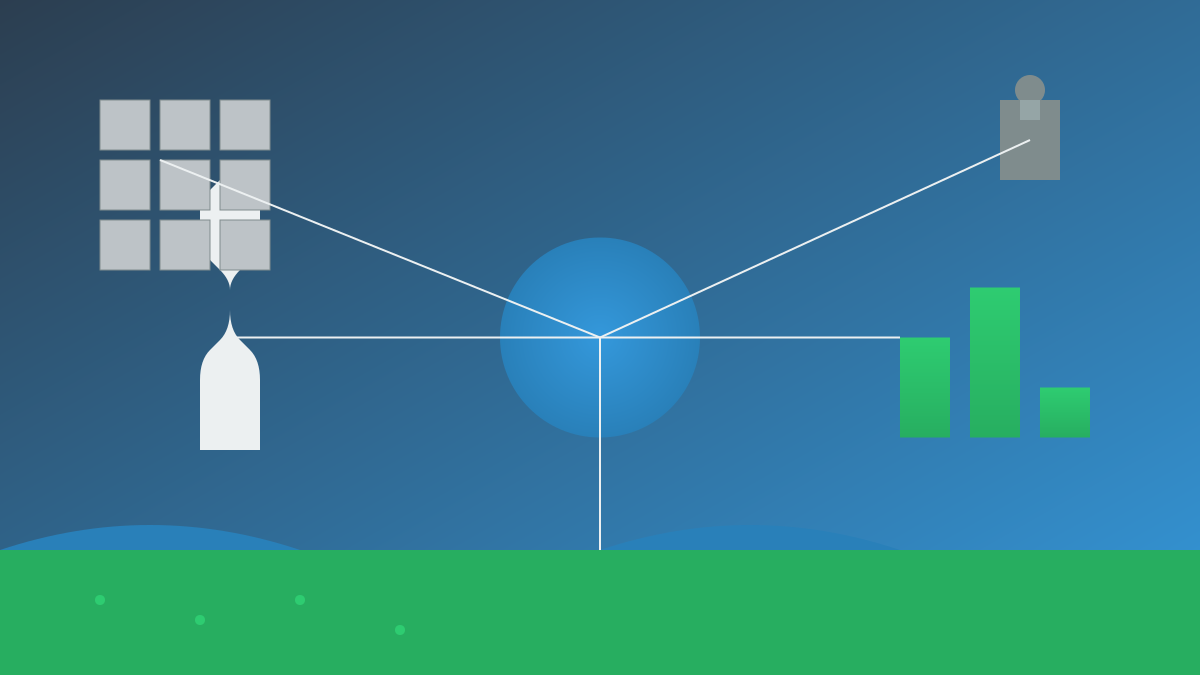
EurekAgent optimizes the environment from four dimensions:

  1. Authority Engineering: Define execution boundaries, isolate evaluation environments, and balance freedom and risk through authority grading;
  2. Product Engineering: Structured product management (code/data/documents), integrated Git version control, and support for multi-agent collaboration;
  3. Budget Engineering: Real-time cost monitoring, intelligent resource allocation, and adaptive exploration strategies;
  4. Human-Machine Collaboration Engineering: Intuitive interaction interface, manual review of key decisions, and flexible intervention interfaces.
5

Section 05

Experimental Results: Multi-Domain SOTA and Low-Cost Breakthroughs

Task Coverage

Achieves SOTA in mathematics (geometric optimization, etc.), kernel engineering (performance optimization), and machine learning (architecture design) fields.

26-Circle Packing Breakthrough

Discovered a new optimal solution with an API cost of less than $11, which is far more cost-effective than traditional methods.

Cost-Effectiveness

Traditional methods require weeks/months of human effort, while EurekAgent achieves breakthroughs at extremely low cost, promoting large-scale automated exploration.

6

Section 06

Open Source Contributions and Community Insights: New Paradigm and Interdisciplinary Impact

Open Source Contributions

Open-sourced code and results to support reproducibility, community expansion, and transparency.

New Research Paradigm

Calls for environmental engineering to be a core direction: shifting from prompt design to environment design, from single-agent capability to interaction, and from full automation to efficient human-machine collaboration.

Interdisciplinary Impact

The concept can be applied to software engineering, educational technology, robotics, scientific research, and other fields.

7

Section 07

Limitations and Future Directions: Challenges and Development Paths

Current Limitations

  1. Domain specificity: mainly targeted at scientific discovery tasks;
  2. Complexity of environment design: requires domain expertise;
  3. Evaluation criteria: open problem of quantifying the effect of environmental engineering.

Future Directions

  1. General environment framework;
  2. Automatic environment optimization (meta-learning);
  3. Multi-agent environment design;
  4. Integration of ethics and safety.
8

Section 08

Conclusion: Environmental Engineering Leads a New Direction in Autonomous Scientific Discovery

EurekAgent provides an efficient, reliable, and controllable solution for autonomous scientific discovery through environmental engineering in four dimensions, achieving multi-domain SOTA and low-cost breakthroughs. The research calls for environmental engineering to be a core research direction, promoting the development of autonomous agent technology and the automated transformation of scientific research.

