Zing Forum

Reading

ETHICS-AI-RAG-CHATFLOW: RAG-based AI Ethics Dialogue System

An AI ethics discussion chatbot integrating Retrieval-Augmented Generation (RAG) technology, providing context-based accurate and ethically grounded responses.

ragai-ethicschatbotretrieval-augmented-generationknowledge-base
Published 2026-04-07 18:12Recent activity 2026-04-07 18:20Estimated read 6 min
ETHICS-AI-RAG-CHATFLOW: RAG-based AI Ethics Dialogue System
1

Section 01

[Introduction] ETHICS-AI-RAG-CHATFLOW: Core Introduction to the RAG-based AI Ethics Dialogue System

ETHICS-AI-RAG-CHATFLOW is an AI ethics discussion chatbot integrating Retrieval-Augmented Generation (RAG) technology. It aims to address the problem of AI ethics information scattered across multiple sources, providing accurate and ethically grounded answers. It applies to scenarios like education and training, enterprise compliance consulting, and public science popularization, helping promote responsible AI development and application.


2

Section 02

Project Background and Problem Awareness

While AI development brings opportunities, it also raises ethical issues such as algorithmic bias and privacy protection, requiring attention from multiple parties. However, relevant information is scattered in academic papers, policy documents, and other sources, making it hard to obtain accurate and authoritative content. This project uses RAG technology to build an intelligent dialogue system for AI ethics topics to solve this problem.

3

Section 03

Technical Architecture and Implementation Methods

Core Value of RAG

Traditional chatbots rely on model parameterized knowledge, which is prone to hallucinations and timeliness issues. RAG alleviates these problems by retrieving external documents and injecting knowledge before generation.

Knowledge Base Construction

Collect and organize authoritative documents (academic journals, industry guidelines, government policies) and select content covering core AI ethics issues like fairness and transparency.

Retrieval and Generation Process

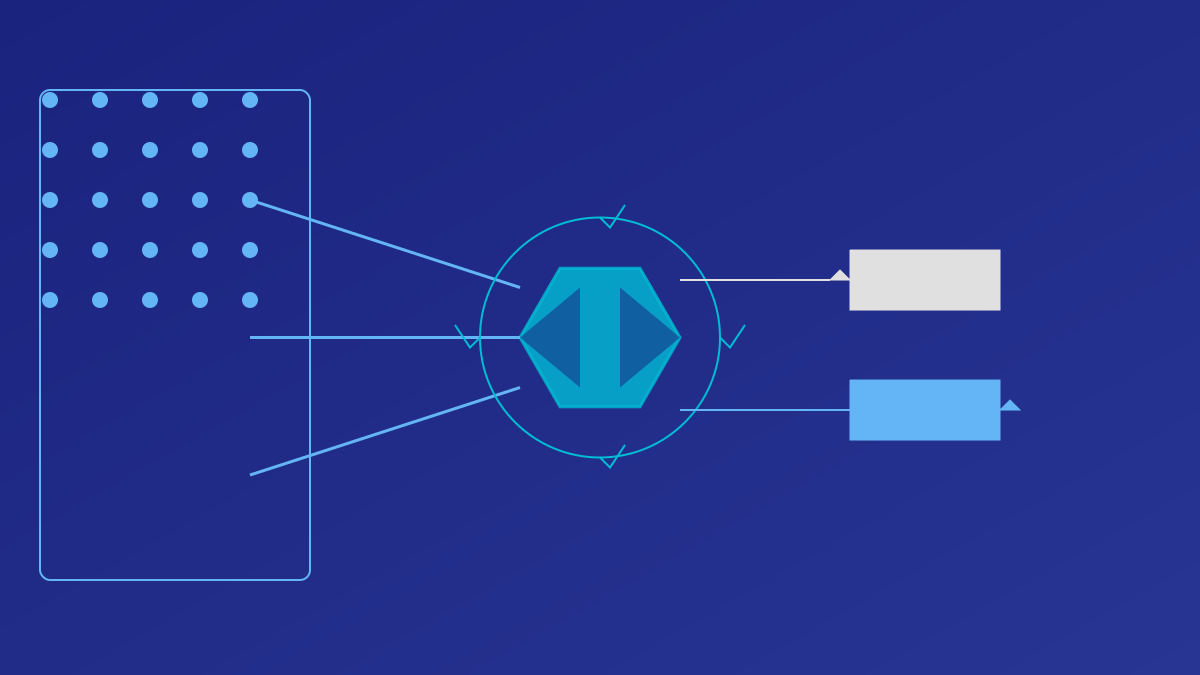
After a user asks a question, the system converts the question into a vector to retrieve relevant document fragments, which are sent as context to the large language model to generate responses balancing fluency and accuracy.

4

Section 04

Application Scenarios and Value

Education and Training Scenario

Provide interactive learning tools for students and practitioners to explore ethical issues through dialogue and get evidence-based answers from authoritative materials.

Enterprise Compliance Consulting

Help developers quickly understand ethical considerations and compliance requirements in specific scenarios, guiding decision-making.

Public Science Popularization

Help non-technical users understand AI’s social impact, promoting rational cognition and participation.

5

Section 05

Highlights of Technical Implementation

  1. Context Awareness: Maintains coherence in multi-turn dialogues, supporting in-depth discussions of ethical issues.
  2. Source Traceability: Responses are based on specific document fragments, with original sources displayable.
  3. Multi-Framework Integration: The knowledge base includes multiple ethical perspectives, presenting diverse viewpoints in responses.
6

Section 06

Limitations and Improvement Directions

Limitations

Restricted by the knowledge base’s coverage and update frequency, emerging issues may not be included; ethical issues involve complex value judgments, so responses are for reference only.

Improvement Directions

Expand knowledge base coverage (including international/cross-cultural perspectives), establish regular update mechanisms, and introduce multimodal support for processing rich-content documents.

7

Section 07

Project Summary and Significance

This project demonstrates RAG technology’s application in domain-specific knowledge services, providing tools for technical ethics education, enterprise compliance consulting, and public science popularization. It is of great significance for promoting responsible AI development and application.

