Zing Forum

Reading

Engram: Retrieving 'Sunken' Conversation History for AI Agents

Engram is an OpenCode plugin that enables agents to access complete conversation history on demand through two core modules—Context Graph and Upstream History Retrieval. It addresses the information loss issue in traditional context compression and opens up a new paradigm for multi-agent collaboration.

EngramOpenCode上下文压缩多智能体对话历史AI插件上下文管理拉取式范式
Published 2026-04-12 19:15Recent activity 2026-04-12 19:18Estimated read 5 min
Engram: Retrieving 'Sunken' Conversation History for AI Agents
1

Section 01

Engram: Retrieving 'Sunken' Conversation History for AI Agents (Introduction)

Engram is an OpenCode plugin. Through two core modules—Context Graph and Upstream History Retrieval—it proposes a 'pull-based' history access paradigm, allowing agents to obtain complete conversation history on demand. This solves the information loss problem in traditional 'push-based' context compression and opens up a new paradigm for multi-agent collaboration.


2

Section 02

Background: Neglected Value of Conversation History and Dilemmas of Push-Based Paradigm

In AI applications, conversation history (including reasoning chains, rejected paths, and user constraints) is valuable task-specific experience, yet it is often 'sunken' into storage and cannot be reused. The current mainstream push-based context transfer faces three key dilemmas: cognitive asymmetry (the model doesn't know what it's missing), pre-decision risk (unknown subsequent tasks during compression), and cumulative distortion (early information disappears due to repeated summarization).

3

Section 03

Engram's Dual-Module Architecture: Context Graph and Upstream History Retrieval

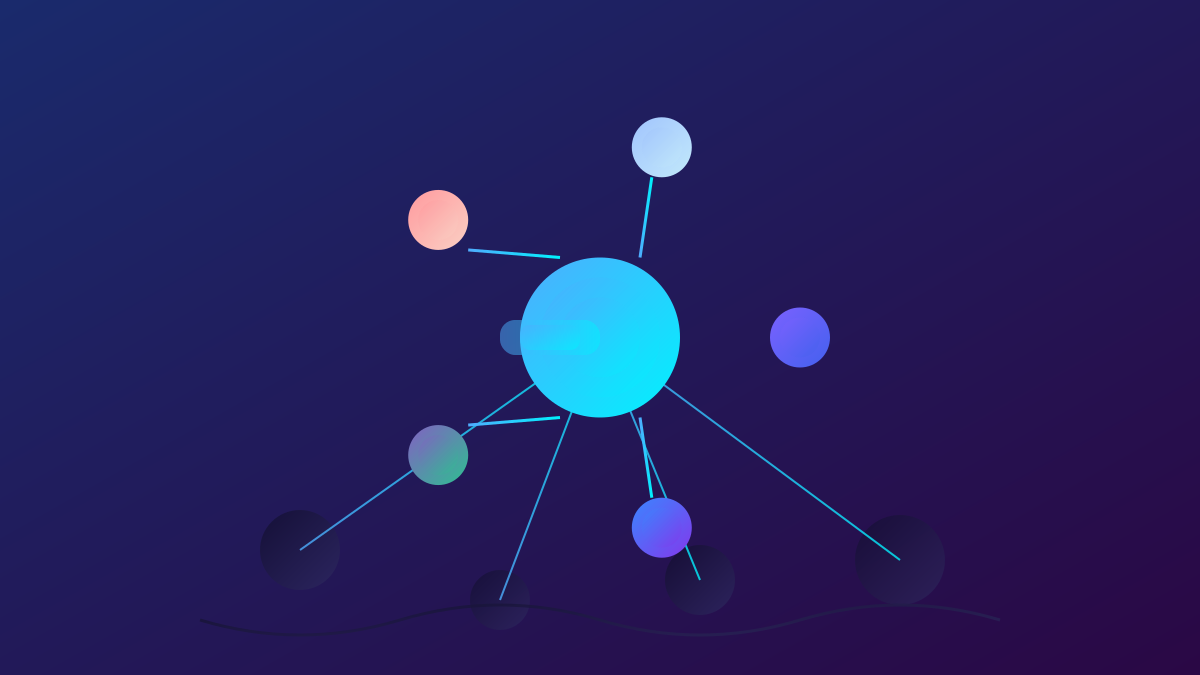
Engram solves the problem through two modules: 1. Context Graph: Extracts lossless indexes (not lossy summaries) from original conversations, allowing agents to pull original history on demand; 2. Upstream History Retrieval: Enables sub-agents to independently retrieve the complete conversation history of upstream agents, breaking the limitations of information filtering.

4

Section 04

Core Advantages of Pull-Based Paradigm: On-Demand Access and Autonomous Decision-Making

The pull-based paradigm is the opposite of the push-based one—agents obtain the required context on their own when the need arises. Its advantages include: delaying filtering until the need emerges, and having the agent itself (which best understands its needs) as the filtering subject. Engram is the first to apply this paradigm to context transfer scenarios.

5

Section 05

Technical Implementation and Ecosystem Positioning: Open Exploration as an OpenCode Plugin

Engram is a plugin for the OpenCode platform (a non-official personal project) that leverages the platform's openness in conversation history access and plugin integration. Its architectural design considers deployment needs: structured storage of navigation data blocks supports efficient retrieval, history access interfaces are called on demand, and compliance with OpenCode specifications ensures compatibility.

6

Section 06

Application Scenarios and Value: Long Conversations, Multi-Agent Collaboration, and Debugging/Auditing

Engram's value is reflected in: 1. Long conversation maintenance: Avoids 'amnesia' caused by traditional compression and retrieves key decision points; 2. Multi-agent collaboration: Downstream agents independently explore upstream reasoning, reducing misunderstandings and omissions; 3. Debugging and auditing: Traces the agent's thinking path to locate the root cause of problems.

7

Section 07

Conclusion: Redefining the Paradigm of Context Management

Engram is not just a practical plugin; it redefines the context management paradigm: turning conversation history from a 'sunk cost' into a 'retrievable resource', laying the foundation for building more reliable, transparent, and collaborative agent systems, and pointing the way for future research.

