Zing Forum

Reading

EdgeThemis-FMEA: A Zero-Copy Architecture for Building a Causal Reasoning Tribunal on 8GB Edge Devices

Breaking the physical limits of large models' 'causal face blindness', this work achieves industrial-grade causal reasoning and dynamic error correction on edge devices with 8GB VRAM through a collaborative architecture of System 1 and System 2.

因果推理边缘AI零拷贝架构FMEARust大语言模型d-分离Kahn算法System 1System 2
Published 2026-05-14 00:07Recent activity 2026-05-14 00:18Estimated read 8 min
EdgeThemis-FMEA: A Zero-Copy Architecture for Building a Causal Reasoning Tribunal on 8GB Edge Devices
1

Section 01

[Main Floor/Introduction] EdgeThemis-FMEA: Zero-Copy Architecture for Causal Reasoning Tribunal on 8GB Edge Devices

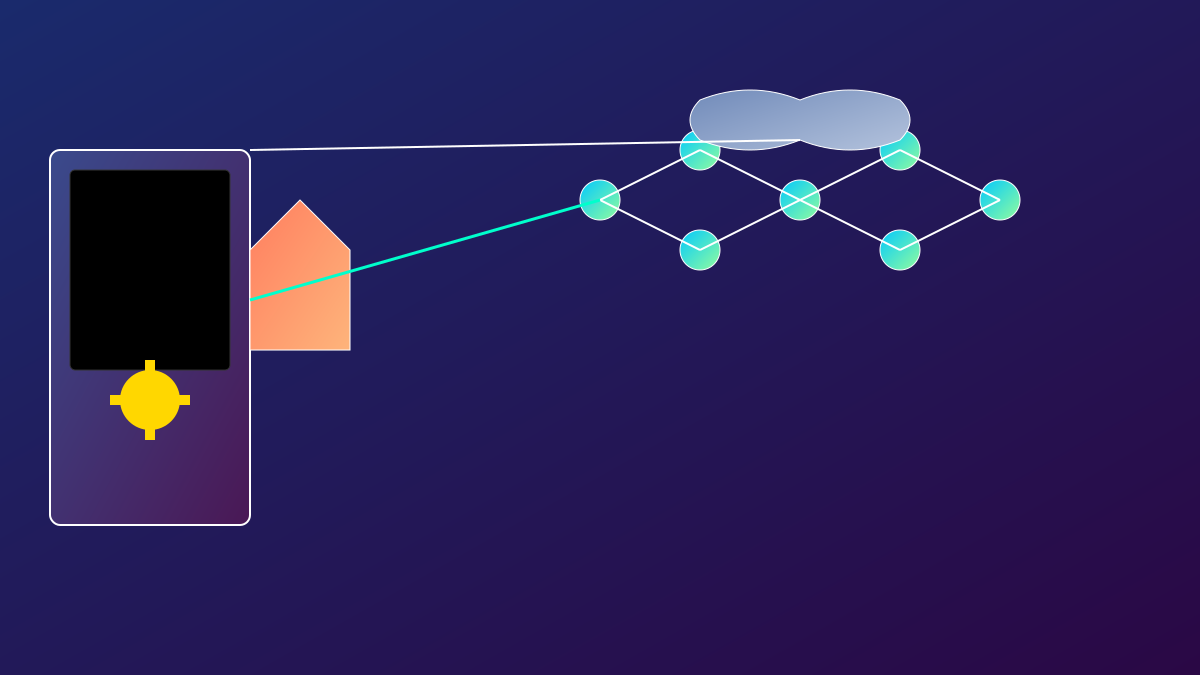
The EdgeThemis-FMEA project aims to solve the 'causal face blindness' problem of large models and the high resource consumption dilemma of traditional causal reasoning methods. Through a collaborative architecture of System1 (intuitive LLM) and System2 (rational Rust graph engine) plus zero-copy data flow design, it achieves industrial-grade causal reasoning and dynamic error correction on edge devices with only 8GB VRAM. Combining the FMEA methodology, the project targets providing reliable causal reasoning capabilities in edge scenarios (e.g., industrial maintenance, medical diagnosis).


2

Section 02

Background and Challenges: Large Models' 'Causal Face Blindness' and Edge Deployment Difficulties

Current large language models (LLMs) have the 'causal face blindness' phenomenon—they easily produce hallucinations and logical breaks when facing causal inferences with strict logical chains, which is fatal in high-precision scenarios like medical care and industry. Traditional causal reasoning methods (e.g., Bayesian networks, causal graph models) require tens of GB of video memory, making them hard to deploy on edge devices. However, edge scenarios (factory workshops, mobile medical care, etc.) are exactly where reliable causal reasoning capabilities are most needed.

3

Section 03

Architecture Design: Dual-System Collaboration and Zero-Copy Data Flow

System1: Intuitive LLM Layer

Composed of lightweight LLMs, it quickly generates initial causal hypotheses. Leveraging advantages in pattern recognition and knowledge retrieval, it proposes possible causal paths in milliseconds but is prone to cognitive bias interference.

System2: Rational Rust Graph Engine

A high-performance graph computing engine written in Rust, implementing Kahn's topological sorting (to detect DAG loops) and d-separation algorithm (to judge conditional independence of variables), ensuring reasoning rigor.

Zero-Copy Data Flow

Through shared memory mapping and zero-copy buffers, the causal graph generated by System1 is directly read and verified by System2 without intermediate serialization/deserialization, optimizing memory usage and latency, supporting operation on 8GB VRAM.

4

Section 04

Core Technologies: Kahn Algorithm and d-Separation Path Tracking Optimization

Kahn's Topological Sorting Algorithm

Used to verify the validity of causal graphs. By removing nodes with zero in-degree to determine linear order, it quickly identifies logical errors like cyclic causality (e.g., A→B and B→A).

d-Separation Path Tracking

Judges whether two variables are statistically independent under given observed variables by tracking paths in the causal graph and analyzing node types (chain, fork, collider). The Rust implementation is optimized for edge devices, using bitmap compression and path caching techniques to control computational complexity within polynomial time.

5

Section 05

Industrial-Grade FMEA Dynamic Error Correction Mechanism: Closed-Loop Self-Improvement

Integrating the FMEA methodology into the system, a 'generate-verify-correct' closed loop is built:

  1. Error Classification: Classify errors into causal loops, missing variables, confounding factors, etc., according to FMEA standards;
  2. Severity Assessment: Evaluate the impact of errors on results;
  3. Correction Suggestion Generation: Provide correction suggestions based on error types;
  4. Iterative Optimization: Re-verify the corrected causal graph until all checks are passed. Continuous self-improvement is achieved without manual intervention.
6

Section 06

Application Scenarios: Value of Causal Reasoning Implementation in Edge Environments

EdgeThemis-FMEA is suitable for resource-constrained edge scenarios:

  • Industrial Predictive Maintenance: Factory edge devices analyze sensor data to identify root causes of failures without uploading sensitive data;
  • Medical Auxiliary Diagnosis: Offline terminals assist doctors in analyzing the causal relationship between symptoms and diseases, protecting privacy;
  • Autonomous Driving Decision-Making: On-board units perform real-time causal reasoning to ensure consistent decision logic;
  • Financial Risk Control: Local devices analyze causal patterns in transaction data to prevent fraud.
7

Section 07

Technical Insights and Future Outlook: Multi-System Collaboration is the Breakthrough Direction for Edge AI

EdgeThemis-FMEA reveals that combining modules with different cognitive characteristics (intuitive vs. rational) instead of a single all-purpose model can achieve high intelligence under resource constraints. This has reference significance for the development of large models: exploring multi-system collaboration, allowing subsystems to focus on their specialized areas, may break through current AI bottlenecks. For edge AI developers, it provides a technical blueprint: zero-copy to optimize memory, dual systems to improve reasoning quality, and industrial methodology to ensure reliability—these can be migrated to other edge scenarios.

