Zing Forum

Reading

EcoTab: A New Cost-Aware Model Routing Framework for Table Reasoning

EcoTab achieves more precise stepwise model routing by distinguishing the uncertainty distributions of table tokens and text tokens, significantly reducing inference costs while maintaining reasoning accuracy.

模型路由表格推理成本优化不确定性估计大语言模型推理效率
Published 2026-05-28 11:49Recent activity 2026-05-29 14:26Estimated read 6 min
EcoTab: A New Cost-Aware Model Routing Framework for Table Reasoning
1

Section 01

EcoTab Framework Overview: Precise Routing Reduces Table Reasoning Costs

EcoTab is a new cost-aware model routing framework for table reasoning. By distinguishing the uncertainty distributions of table tokens and text tokens, it achieves more precise stepwise model routing, significantly reducing costs while maintaining reasoning accuracy. This framework comes from the arXiv paper Rethinking Stepwise Model Routing: A Cost-Efficient Table Reasoning Perspective (published on 2026-05-28, link: http://arxiv.org/abs/2605.29319v1) and is proposed by the paper's author team.


2

Section 02

Problem Background: Cost and Performance Dilemma in Table Reasoning

Large Reasoning Models (LRMs) perform well on table reasoning tasks but have high inference costs. Stepwise model routing is a potential solution—dynamically selecting small/large models to handle steps of different difficulty. However, existing methods do not consider the uniqueness of table reasoning (needing to process both natural language and structured table data), leading to suboptimal routing decisions.

3

Section 03

Key Finding: Uncertainty Differences Between Table and Text Tokens

The study found two types of tokens in table reasoning: 1. Table tokens (cell values, column headers, etc.), whose uncertainty is related to the complexity of the table structure; 2. Text tokens (logical connectives, reasoning explanations, etc.), whose uncertainty reflects the difficulty of semantic understanding. Existing methods treat them the same, leading to suboptimal routing.

4

Section 04

Core Design of EcoTab Framework: Dual-Channel Modeling and Dynamic Routing

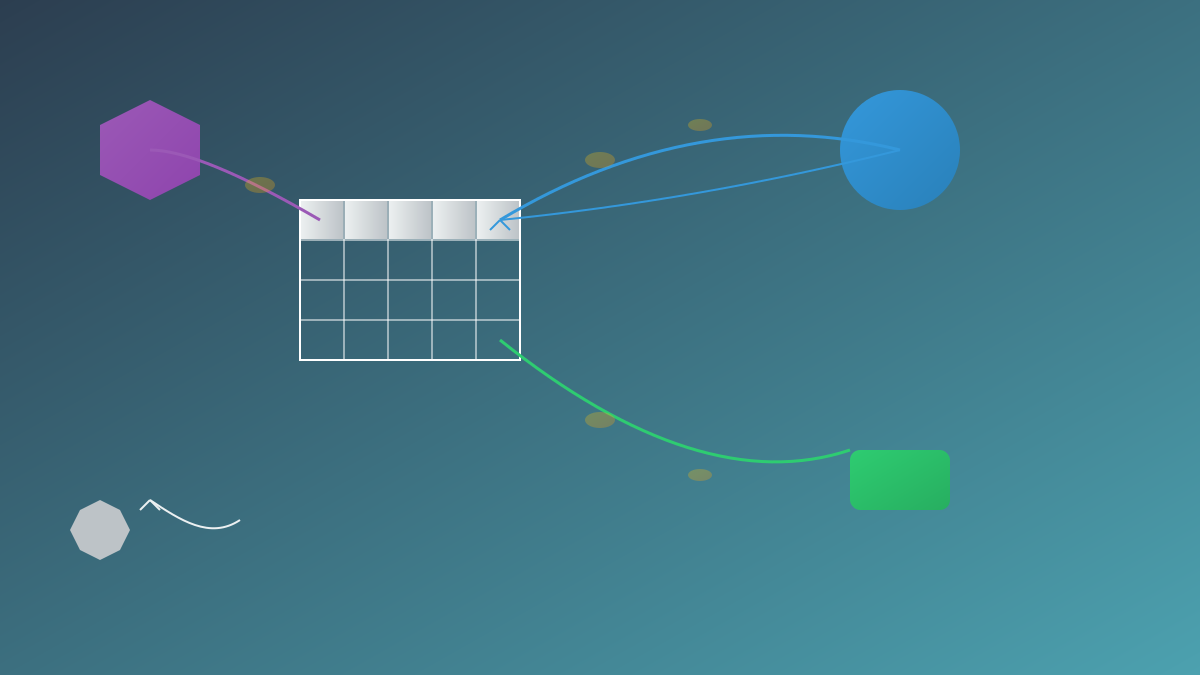
The core innovations of EcoTab are: 1. Dual-channel uncertainty estimation: Calculate the uncertainty of table tokens (confidence in structural operations) and text tokens (confidence in semantic reasoning) separately; 2. Risk mapping: Convert the two types of uncertainty into the risk of failure in the next step; 3. Dynamic routing: Select small models (low risk) or large models (high risk) based on the comprehensive risk score, avoiding a one-size-fits-all approach.

5

Section 05

Experimental Validation: Performance and Cost Advantages of EcoTab

In benchmark tests like WikiTableQuestions and TabFact, EcoTab outperforms strong baselines: 1. Higher accuracy (calling large models for key steps avoids error accumulation); 2. Lower cost (reduces the number of inference tokens); 3. Better accuracy-cost trade-off (Pareto improvement). Ablation experiments prove that considering both types of tokens is a necessary condition for optimal routing.

6

Section 06

Practical Application Value: Cost Optimization in Multiple Scenarios

The value of EcoTab in practical scenarios: 1. Enterprise-level table question answering systems: Reduce costs while ensuring quality; 2. Real-time table analysis: Reduce latency and improve user experience; 3. Resource-constrained environments: Run high-quality reasoning with limited computing power.

7

Section 07

Limitations and Future Research Directions

Limitations of EcoTab: 1. Specifically designed for table reasoning; adaptation is needed for migration to other domains; 2. Threshold hyperparameter settings affect performance. Future directions: Extend to graph/time-series data, automated threshold learning, and optimize routing strategies by combining reinforcement learning.

8

Section 08

Conclusion: Significance and Insights of EcoTab

By identifying the uncertainty differences between the two types of tokens in table reasoning and modeling them separately, EcoTab achieves precise routing, significantly reducing costs while maintaining high accuracy. It provides a reference framework for reasoning efficiency and cost optimization, enlightening us that we need to deeply understand task characteristics to customize optimization strategies.

