Zing Forum

Reading

DVC Framework: Solving the Error Accumulation Problem of Large Language Models with Verification-Driven DAG Reasoning

DVC is a novel training-free reasoning framework that effectively mitigates the error propagation problem of large language models (LLMs) in complex reasoning by dynamically constructing directed acyclic graphs (DAGs) and verifying intermediate steps.

大语言模型推理框架DAG错误传播验证机制思维链分而治之IJCNN 2026
Published 2026-04-12 17:36Recent activity 2026-04-12 17:52Estimated read 7 min
DVC Framework: Solving the Error Accumulation Problem of Large Language Models with Verification-Driven DAG Reasoning
1

Section 01

DVC Framework: An Innovative Solution to Error Accumulation in LLM Complex Reasoning

The Divide, Verify, and Conquer (DVC) framework proposed in the IJCNN 2026 paper is a novel training-free reasoning solution. Its core lies in dynamically constructing directed acyclic graphs (DAGs) and verifying intermediate steps to effectively mitigate the error propagation problem of large language models (LLMs) in complex reasoning. Adopting the divide-and-conquer approach, this framework has advantages such as error isolation, interpretability, and modularity, providing reliable support for LLM applications in high-risk scenarios.


2

Section 02

Fatal Weakness of LLM Reasoning and the Background of DVC's Proposal

LLMs perform well in complex reasoning tasks but have a fatal weakness—error propagation: mistakes in intermediate steps will snowball and lead to completely wrong final conclusions, severely limiting their applications in high-risk scenarios such as healthcare and law. To address this issue, the IJCNN 2026 paper proposes the DVC framework, which fundamentally solves error accumulation through structured reasoning and verification mechanisms.

3

Section 03

Core Ideas and Technical Architecture of the DVC Framework

Core Ideas

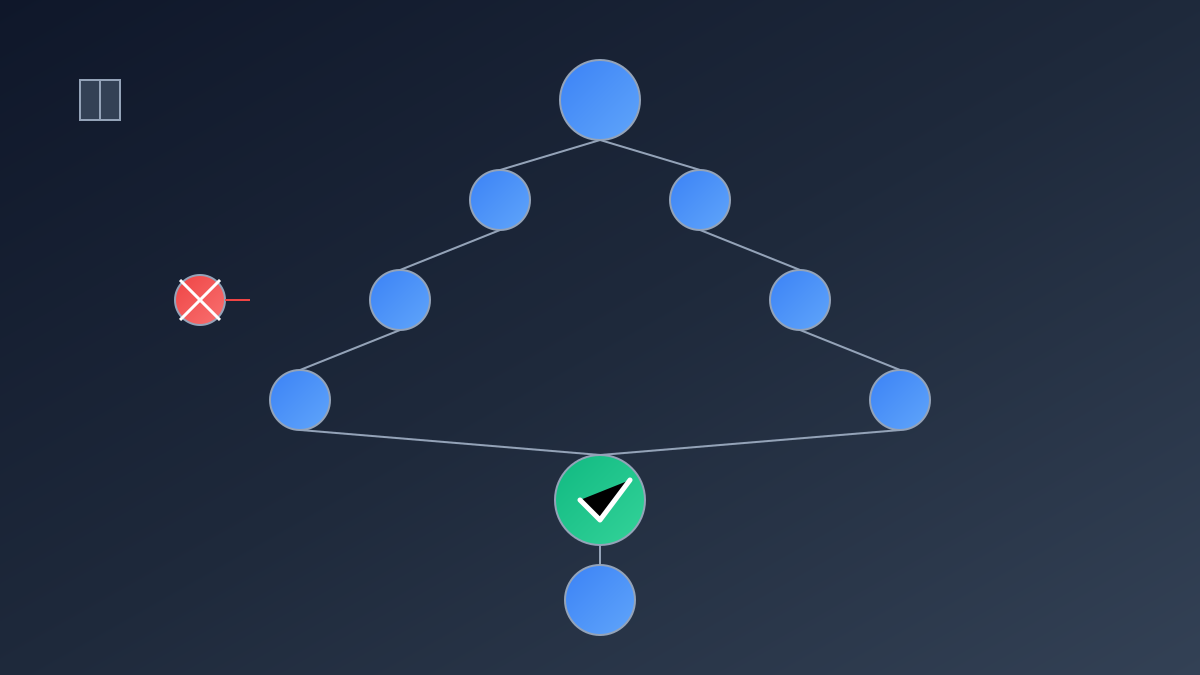
The DVC framework redesigns the reasoning process into a dynamically constructed DAG (each node represents a sub-problem, edges represent dependencies) instead of the traditional linear chain of thought. It consists of three core stages:

  1. Divide: Split complex problems into sub-problems
  2. Verify: Validate the correctness of intermediate results
  3. Conquer: Combine the verified answers of sub-problems

Six Major Components

  • Problem Structurer: Convert the original problem into structured conditions and objectives
  • Planner: Dynamically select frontier nodes and transformation strategies (PE equivalent transformation / PD decomposition / DS direct solving)
  • Verifier: Check the validity of transformation results and intercept errors
  • Evaluator: Directly solve simple leaf nodes
  • Aggregator: Aggregate sub-problem answers from bottom to top
4

Section 04

DVC Workflow Example: Solving the Chicken-Rabbit Cage Problem

Take the problem "There are 35 chickens and rabbits in total, with 94 legs. Find the number of each." as an example:

  1. Structuring: Extract conditions (total count:35, legs:94, chickens have 2 legs, rabbits have 4 legs) and objectives
  2. Planning & Decomposition: The Planner uses the PD strategy to split into two sub-problems (leg difference if all are chickens, calculate rabbit count based on the difference)
  3. Verification: The Verifier confirms the rationality of the decomposition
  4. Solving: The Evaluator directly obtains sub-problem answers (leg difference:24, rabbits:12, chickens:23)
  5. Aggregation: The Aggregator verifies the total count and leg number, then outputs the final result
5

Section 05

Technical Advantages and Applicable Scenarios of DVC

Technical Advantages

  1. Error Isolation: Intermediate verification limits the scope of error propagation
  2. Interpretability: The DAG structure clearly shows the reasoning path
  3. Training-Free: Directly leverages existing LLM capabilities without fine-tuning costs
  4. Modularity: Components can be independently optimized or replaced

Applicable Scenarios

Covers multi-step reasoning scenarios such as mathematical problem solving, code generation and debugging, scientific reasoning, and legal analysis

6

Section 06

Limitations and Future Outlook of the DVC Framework

Limitations

  • Verifier reliability is crucial: The design of general domain-independent verifiers still needs research
  • High computational cost: The overhead of DAG construction for complex problems is large
  • Open-source version is minimal: Complete experiment reproduction and benchmark testing are pending

Future Directions

Optimize verifier design, reduce computational costs, improve framework implementation, etc.

7

Section 07

Evolution of Reasoning Paradigms and DVC Open-Source Resources

DVC represents the evolution of LLM reasoning paradigms from linear chain of thought to structured DAGs, with the core idea of "making models think smarter rather than bigger". The project code has been open-sourced on GitHub; interested parties can visit the repository to learn details and apply it to their own reasoning tasks.

