Zing Forum

Reading

DUYA: Redefining Visual Workflow Interaction for AI Agent Desktop Clients

DUYA is a next-generation AI Agent desktop client built on Electron and Next.js. It breaks through the limitations of traditional chat interfaces, providing a visual canvas for users to dynamically orchestrate Agent workflows and explore new paradigms of human-computer interaction.

AI Agent桌面客户端可视化工作流ElectronNext.js人机交互工作流编排
Published 2026-05-10 15:44Recent activity 2026-05-10 15:50Estimated read 7 min
DUYA: Redefining Visual Workflow Interaction for AI Agent Desktop Clients
1

Section 01

DUYA: Redefining Visual Workflow Interaction for AI Agent Desktop Clients (Main Thread Guide)

DUYA is a next-generation AI Agent desktop client built on Electron and Next.js. It breaks through the limitations of traditional chat interfaces, providing a visual canvas for users to dynamically orchestrate Agent workflows and explore new paradigms of human-computer interaction. This article will discuss aspects including background, project overview, design philosophy, technical architecture, application scenarios, limitations, and future outlook.


2

Section 02

Background: Dilemmas in AI Agent Interaction and Industry Explorations

With the development of large language model (LLM) technology, AI Agents have become intelligent assistants. However, most products still rely on traditional chat interfaces. Linear, single-threaded interaction falls short in complex tasks (repeated prompt input, difficulty tracking progress, inability to combine multi-agent capabilities). Industry explorations for breakthroughs: ChatGPT plugins, Claude Artifacts, LangChain chain calls, AutoGPT autonomous execution. But a real breakthrough requires rethinking the interaction carrier—if Agents can be freely combined and orchestrated on an open canvas, new possibilities will emerge.

3

Section 03

DUYA Project Overview: Open-Source Local-First AI Agent Client

DUYA is an open-source project born from the above reflections. As a next-generation AI Agent desktop client, it deconstructs Agent capabilities into modular components that can be orchestrated on a visual canvas. It uses Electron to build a cross-platform framework, combined with the Next.js frontend tech stack, to implement a local-first architecture: conversation history, workflow configurations, and sensitive data are saved locally, ensuring privacy security and a smooth offline experience.

4

Section 04

Core Design Philosophy: Interaction Innovation from Conversation to Canvas

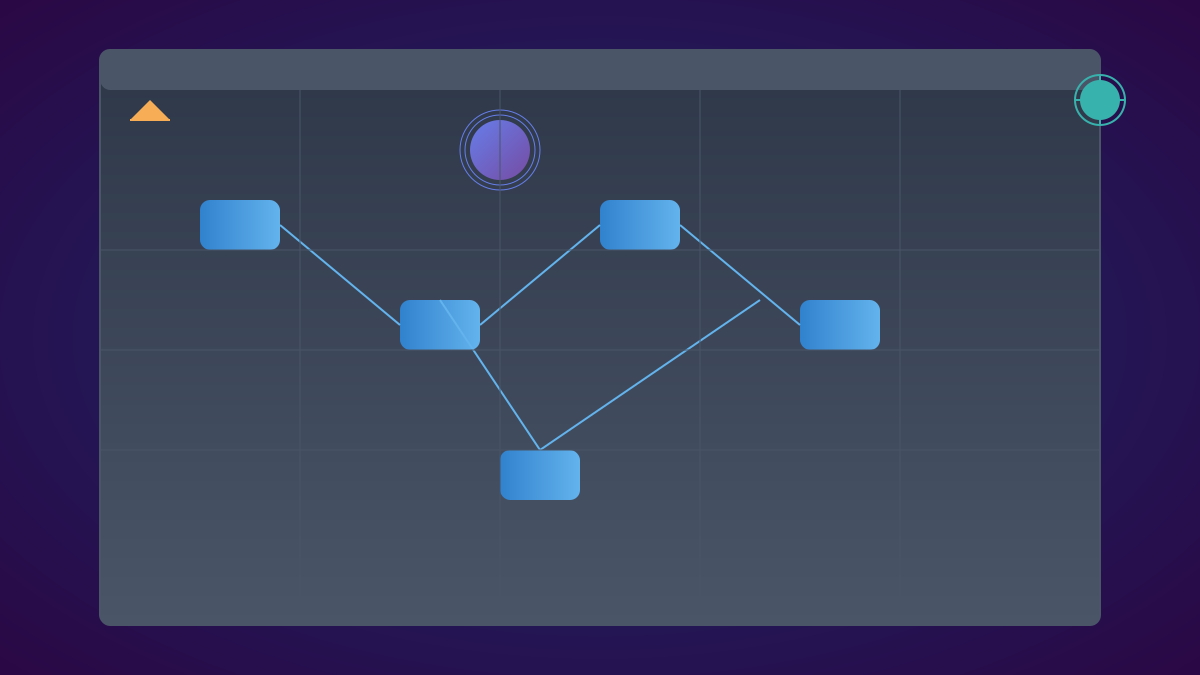
DUYA's most notable innovation is the 'canvas-based' interaction paradigm: traditional chat interfaces stack conversation history vertically, while the visual canvas allows spatial organization of information and workflows. Each Agent capability is a draggable and connectable node; users can string them into workflows (e.g., document parsing → summary generation → translation → email sending). The design draws inspiration from ETL tools (Airflow, n8n) and visual programming environments (Scratch, Node-RED), lowering the threshold for non-technical users while providing extensibility for advanced users.

5

Section 05

Technical Architecture and Implementation: Cross-Platform and Plugin-Based Design

The technical selection follows modern desktop application best practices: Electron provides cross-platform native capabilities (local file access, system notifications) plus web development convenience; Next.js brings server components, routing optimization, and a good development experience. Agent capability integration adopts a plugin-based architecture: different AI models (OpenAI, Anthropic, local models) and tools (file processing, web search, code execution) are integrated as plugins. Users can combine them freely, and the community can contribute new plugins, ensuring openness and extensibility.

6

Section 06

Application Scenarios and Value: Workflow Solutions Adaptable to Multiple Scenarios

DUYA's visual workflow mode is suitable for the following scenarios:

  1. Complex Task Automation: For multi-Agent collaborative tasks, the canvas makes the process clear and easy to debug and optimize;
  2. Knowledge Workflow Management: Researchers/analysts can orchestrate reusable templates for literature retrieval, data extraction, and report generation;
  3. Team Collaboration Standardization: Create standardized workflow templates to ensure consistent processes among team members;
  4. Agent Capability Exploration and Learning: Provides an intuitive experimental environment for users to deeply understand the capabilities of AI Agents.
7

Section 07

Limitations and Outlook: Early Development and Future Directions

DUYA is currently in the early stage, with gaps in feature completeness, ecosystem richness, and stability compared to mature commercial products. However, its design philosophy represents an important direction in the evolution of AI Agent interaction: shifting from 'conversational' to 'canvas-based', and from 'single-round interaction' to 'workflow orchestration'. As multi-modal models improve and Agent technology matures, visual workflow orchestration may become the standard interaction paradigm for next-generation AI applications. For developers, it is an architectural example; for designers, it demonstrates the possibility of breaking through chat interfaces; for users, it foreshadows the future form of collaboration—no longer simple question-and-answer, but working side by side.

