Zing Forum

Reading

DocuMind: A Multifunctional Intelligent Document Processing System Based on Large Language Models and RAG

DocuMind is an open-source intelligent document processing system that combines large language models (LLMs) and Retrieval-Augmented Generation (RAG) technology to enable intelligent parsing of multi-format documents, semantic retrieval, and question-answering generation.

RAG大语言模型文档处理智能检索向量数据库LangChain知识管理
Published 2026-05-21 14:45Recent activity 2026-05-21 14:47Estimated read 8 min
DocuMind: A Multifunctional Intelligent Document Processing System Based on Large Language Models and RAG
1

Section 01

【Introduction】Core Introduction to the DocuMind Intelligent Document Processing System

DocuMind is an open-source intelligent document processing system that combines large language models (LLMs) and Retrieval-Augmented Generation (RAG) technology. It aims to solve the problems of traditional document processing, such as reliance on manual work, low efficiency, and difficulty in mining deep information. The system supports multi-format document parsing, semantic retrieval, and natural language question-answering generation, providing users with an efficient intelligent document interaction experience.


2

Section 02

Project Background and Motivation

In the wave of digital transformation, enterprises and individuals need to process massive documents (such as contracts, reports, technical manuals). Traditional methods rely on manual reading and keyword search, which are inefficient and make it difficult to mine deep information. The DocuMind project was born to build an intelligent processing system that deeply understands document content and supports natural language interaction through LLM and RAG technologies.

3

Section 03

System Architecture Overview

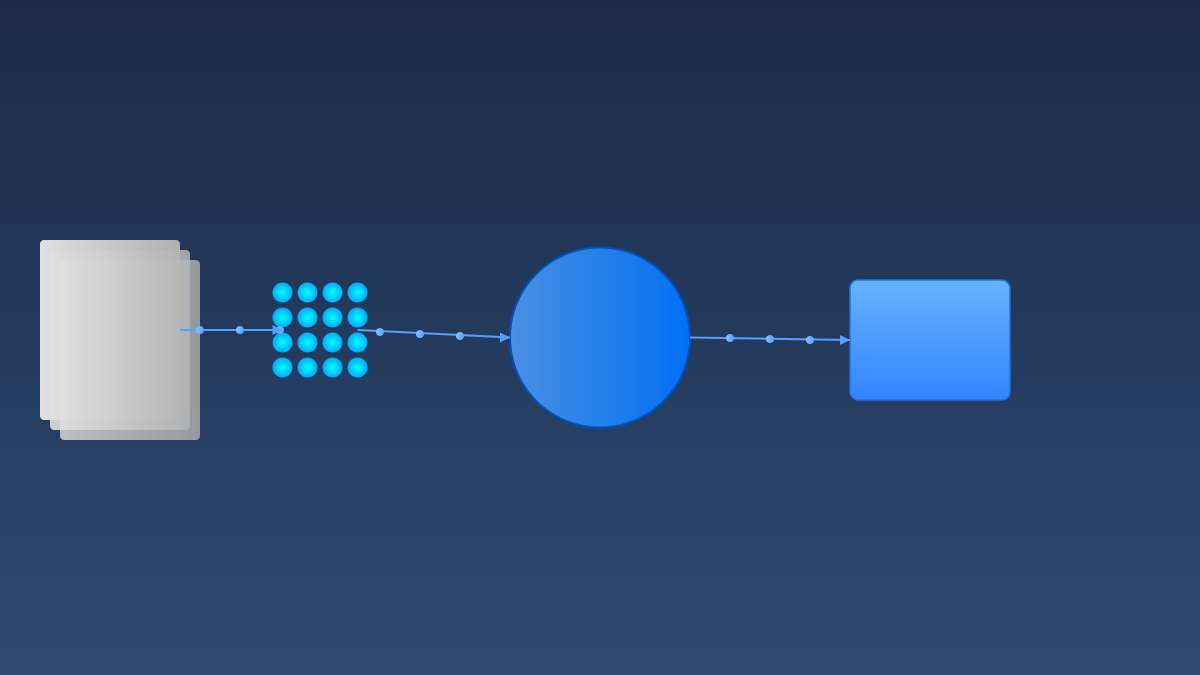
DocuMind adopts a modular design, with core components including:

  • Document Parsing Engine: Supports import and structured extraction of multiple formats such as PDF, Word, and TXT. It processes scanned documents via OCR and identifies chapter, table, and chart structures through layout analysis.
  • Vector Index System: Splits documents into semantic chunks, generates vectors using embedding models, and stores them in vector databases (e.g., Chroma or Pinecone) to support similarity retrieval.
  • Retrieval-Augmented Generation Module: When a user queries, it first retrieves relevant fragments, then combines the context and the question and sends them to the LLM to generate accurate and traceable answers.
  • Dialogue Management Interface: Provides a web interface and API endpoints, supporting multi-turn dialogues, history management, and result export.
4

Section 04

Core Technical Implementation Details

Retrieval-Augmented Generation (RAG) Mechanism

RAG is the core technology, and its process includes:

  1. Indexing Phase: Documents are split into text chunks of 500-1000 characters, embedded and encoded, then stored in the vector database with metadata retained.
  2. Retrieval Phase: Queries are encoded into vectors, and Top-K relevant fragments are recalled via the ANN algorithm.
  3. Generation Phase: Combine the context and the question into a prompt to guide the LLM to generate factual answers and label the sources.

Multimodal Document Processing Capabilities

  • Table Recognition: Uses LayoutLM to identify table structures and convert them into structured formats.
  • Image Understanding: Calls multimodal models (e.g., GPT-4V) to extract chart information and generate descriptions.
  • Chapter Hierarchy Reconstruction: Analyzes visual features to automatically build a chapter tree, supporting retrieval by chapter.
5

Section 05

Application Scenarios and Practical Value

DocuMind can be widely applied in:

  • Enterprise Knowledge Management: Build internal knowledge bases, allowing employees to quickly obtain information such as policies and processes through natural language queries.
  • Legal Contract Review: Quickly locate key clauses, identify risk points, and improve review efficiency.
  • Academic Research Assistance: Import papers to sort out research contexts and compare the pros and cons of methodologies.
  • Customer Service Support: Integrate product manuals and FAQs to provide 7x24 intelligent Q&A and reduce manual pressure.
6

Section 06

Technology Selection and System Scalability

The project uses Python as the main development language, with the core technology stack including:

  • LangChain: Orchestrates LLM calling processes and RAG pipelines
  • FastAPI: Provides high-performance RESTful APIs
  • Streamlit: Builds interactive web demo interfaces
  • PostgreSQL + pgvector: Unifies storage of structured data and vector data

The system supports integration with LLMs from different vendors (OpenAI, Anthropic, local Llama, etc.), and can flexibly replace embedding models and vector databases, with strong scalability.

7

Section 07

Summary and Future Outlook

DocuMind represents the direction of document processing towards intelligence and interactivity. By combining the language understanding ability of LLMs with the fact-grounding mechanism of RAG, it improves information acquisition efficiency while ensuring answer accuracy.

Future plans: Enhance multilingual support, optimize long-document retrieval strategies, explore integration with external data sources (e.g., ERP, CRM), and build a more complete intelligent document processing ecosystem.

