Zing Forum

Reading

Document Extractor LLM: An Intelligent Document Parsing and Data Extraction Tool Based on RAG

This article introduces Document Extractor LLM, an open-source document parsing tool based on Streamlit and RAG technology. It uses large language models to intelligently extract structured data from various documents, supports one-click Docker deployment, and is suitable for automated data processing and information retrieval scenarios.

文档解析RAGStreamlit数据提取ChromaLLM应用Docker部署
Published 2026-06-10 22:37Recent activity 2026-06-10 22:54Estimated read 6 min
Document Extractor LLM: An Intelligent Document Parsing and Data Extraction Tool Based on RAG
1

Section 01

[Introduction] Document Extractor LLM: An Intelligent Document Parsing Tool Based on RAG

This article introduces the open-source project Document Extractor LLM, released by vsancnaj on GitHub in June 2026. Based on Streamlit and RAG technology, it supports one-click Docker deployment and can intelligently extract structured data from various documents, suitable for automated data processing and information retrieval scenarios. Core technologies include Chroma vector database, OpenAI LLM integration, etc., aiming to solve the problems of low efficiency and high error rate in traditional document extraction.


2

Section 02

Project Background: The Need for Automation in Document Data Extraction

In the digital transformation, enterprises/individuals face the need to process massive documents (contracts, invoices, reports, etc.). Manual extraction is inefficient and error-prone, while OCR can only recognize text but cannot convert it into structured data. Although LLMs can understand text, their implementation needs to solve problems such as context length limitations and domain knowledge adaptation. This project combines RAG, vector database, and web interface to provide an out-of-the-box solution.

3

Section 03

Core Functions and Technical Architecture Analysis

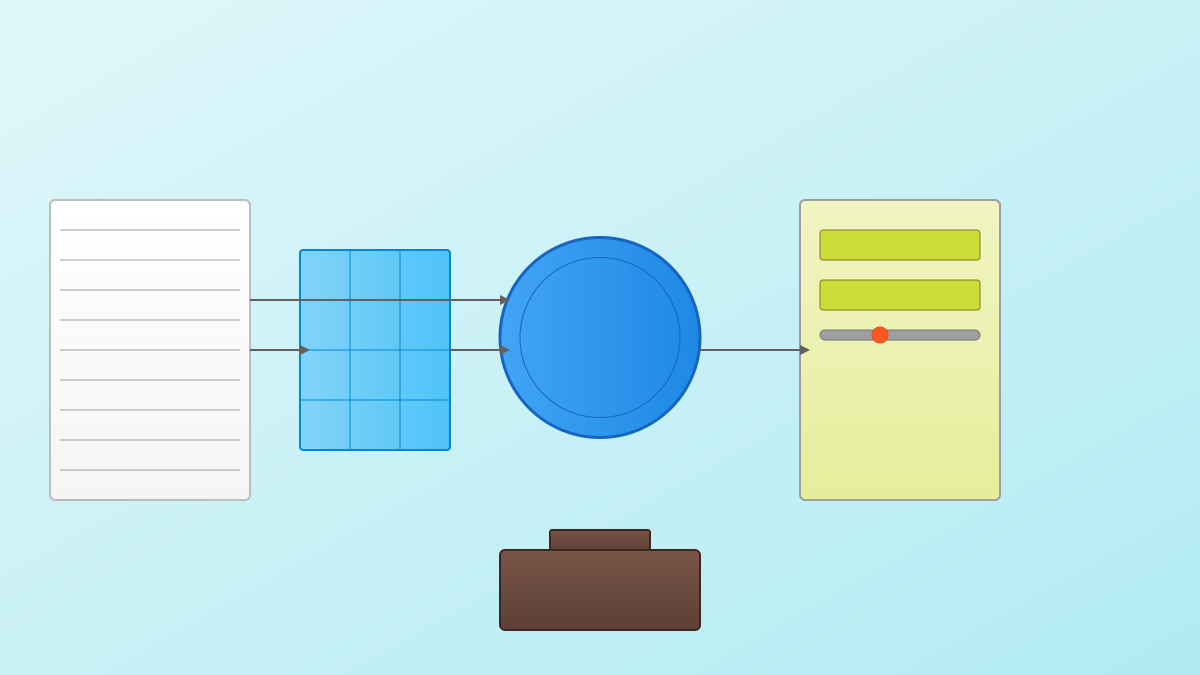
  1. Document Parsing and Vectorization: Split text into chunks → Convert to vectors via embedding model → Store in Chroma vector database; 2. RAG Architecture: Semantically retrieve relevant fragments and inject into prompts to reduce LLM hallucinations; 3. LLM Integration: OpenAI GPT series models extract structured data according to user-defined schemas; 4. Streamlit Interface: A user-friendly interactive web interface built with Python; 5. Docker Deployment: One-click run of the image with strong environment consistency.
4

Section 04

Quick Deployment and Usage Guide

Three steps for Docker deployment: 1. Pull the image: docker pull vsanchezn/streamlit-app; 2. Run the container: docker run -p 8501:8501 vsanchezn/streamlit-app; 3. Visit http://localhost:8501. Usage process: Upload document → Define extraction fields → System automatically processes → View structured results; parameters can be adjusted to optimize the effect.

5

Section 05

Application Scenarios and Practical Value

Applicable to: 1. Contract information extraction (batch generation of structured databases); 2. Invoice and bill processing (extraction of key financial fields); 3. Research report summarization (quick generation of structured summaries); 4. Customer feedback analysis (extraction of decision insights); 5. Knowledge base construction (structuring enterprise documents for easy retrieval).

6

Section 06

Analysis of Project Features, Advantages, and Limitations

Features and Advantages: Low code threshold (Streamlit simplifies front-end), modular architecture (easy to replace components), open-source and extensible (free customization), Dockerization convenience (simple deployment and migration). Limitations: Dependence on OpenAI API (cost and compliance risks), context window limitations (global information may be lost), extraction quality requires manual verification, multi-language support depends on the model.

7

Section 07

Conclusion: Future Potential of Intelligent Document Processing

Document Extractor LLM demonstrates the practical value of LLMs in the field of document processing, simplifying complex tasks into interactive applications. Although it is in the initial stage, its architecture is clear and open-source, and it can support local LLMs and optimize context processing in the future. With the progress of LLM technology and the increase in digital demand, such tools will help organizations unlock the value of document data.

