Zing Forum

Reading

dgxarley: Automated Deployment Solution for Distributed LLM Inference Cluster Based on NVIDIA DGX Spark

A set of Ansible automation scripts for quickly deploying a K3s cluster consisting of 3 NVIDIA DGX Spark nodes, optimized for distributed large language model (LLM) inference.

NVIDIA DGXK3s分布式推理AnsibleLLM部署集群自动化GPU集群
Published 2026-03-28 22:16Recent activity 2026-03-28 22:23Estimated read 6 min
dgxarley: Automated Deployment Solution for Distributed LLM Inference Cluster Based on NVIDIA DGX Spark
1

Section 01

dgxarley: Introduction to the Automated Deployment Solution for Distributed LLM Inference Cluster Based on NVIDIA DGX Spark

As the scale of large language models (LLMs) grows, single-machine deployment can hardly meet production needs, making distributed inference a key technology. The dgxarley project provides Ansible automation scripts to quickly deploy a 3-node K3s cluster of NVIDIA DGX Spark, optimized for distributed LLM inference, solving the complexity of infrastructure setup. Core technology selections include DGX Spark (hardware), K3s (lightweight container orchestration), and Ansible (automated operation and maintenance).


2

Section 02

Project Background and Technology Selection

Background: The expansion of LLM scale makes single-machine deployment unable to meet production environment needs, and distributed inference is the solution. Technology Selection:

  • NVIDIA DGX Spark: A compact AI supercomputer that integrates high-performance GPUs and an optimized AI software stack, suitable for edge AI and distributed computing scenarios;
  • K3s: A lightweight Kubernetes distribution with optimized resources and fast startup, suitable for edge devices;
  • Ansible: An agentless automation tool that ensures repeatable and consistent deployment, reducing the risk of human errors.
3

Section 03

Architecture Design and Automated Deployment Process

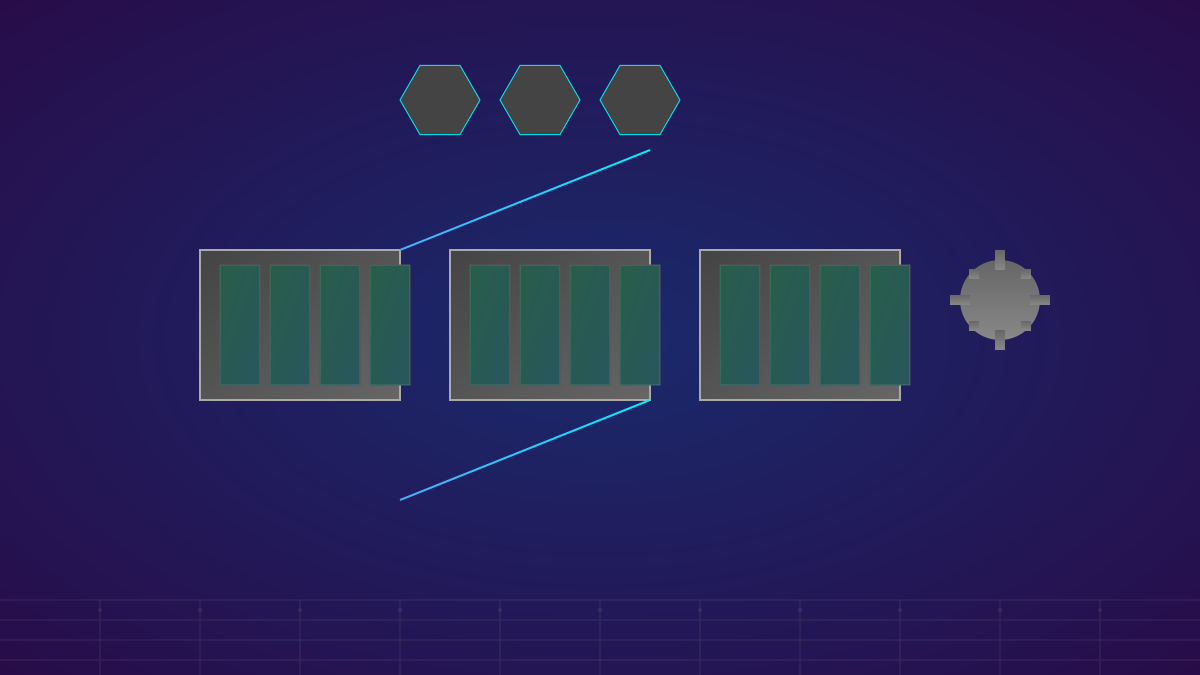
Architecture Design: A 3-node high-availability K3s cluster with a master-slave architecture (1 server node responsible for management and scheduling, 2 agent nodes executing computing tasks), optimized for LLM inference (configuring NVIDIA Container Toolkit to recognize GPUs, optimizing node communication to reduce latency). Deployment Process:

  1. Users configure the Ansible inventory file (node IPs, SSH credentials);
  2. The script automatically completes: installing system dependencies, configuring NVIDIA drivers/CUDA, deploying K3s, setting up container runtime, and deploying monitoring and logging components;
  3. Pre-deployment check scripts verify hardware, network, and software dependencies to resolve issues in advance.
4

Section 04

Distributed Inference Optimization and Operation Monitoring

Inference Optimization:

  • Model parallelism: Efficient parameter splitting strategy, where large models are scattered across multiple nodes' GPU memory;
  • Data parallelism: Request load balancing to avoid single-point bottlenecks;
  • Integrates tuning templates for high-performance inference engines like vLLM. Operation Monitoring:
  • Integrates Prometheus+Grafana to monitor hardware metrics (GPU utilization, memory, temperature) and application metrics (throughput, latency, error rate);
  • Centralized log storage and analysis for easy troubleshooting and performance optimization.
5

Section 05

Scalability, Application Scenarios, and Technical Challenge Solutions

Scalability: Supports adding DGX Spark nodes; modular Playbooks allow customizing functions (enabling/disabling components, adding custom steps); provides security hardening options (network isolation, access control, etc.). Application Scenarios: AI startups (quickly building inference platforms), enterprise IT (standardized deployment to ensure consistency), research institutions (lowering the threshold for experimental environments). Technical Challenge Solutions:

  • DGX hardware configuration: Targeted Ansible tasks ensure correct application of drivers/software;
  • Network communication: Uses the Calico solution and optimizes it;
  • GPU scheduling: Configures NVIDIA plugins to achieve fair resource sharing.
6

Section 06

Community Contributions and Project Value Summary

Community Contributions: Open-sourced on GitHub, accepts Issue feedback and PR submissions; the maintenance team continuously updates to support new software/hardware versions. Value Summary: dgxarley simplifies distributed LLM inference cluster deployment through automation, lowers technical thresholds, meets production-level inference platform needs, and will play an important role in the AI ecosystem.

