Zing Forum

Reading

DevSquad-Agent: Practice of Multi-Agent Collaborative Software Engineering Workflow

Explore the DevSquad-Agent project, a multi-agent AI system that simulates a real software development team. It transforms user requirements into production-grade code through collaboration between developer, reviewer, QA, and fix agents.

多智能体系统软件工程AI代码生成代码审查工作流自动化代理协作DevOps
Published 2026-05-08 17:45Recent activity 2026-05-08 17:49Estimated read 7 min
DevSquad-Agent: Practice of Multi-Agent Collaborative Software Engineering Workflow
1

Section 01

DevSquad-Agent: Guide to Multi-Agent Collaborative Software Engineering Workflow Practice

DevSquad-Agent is a multi-agent AI system that simulates a real software development team. It transforms user requirements into production-grade code through collaboration between developer, reviewer, QA, and fix agents. The core of this project lies in drawing on human software engineering best practices, improving overall output quality through specialized division of labor and process-based collaboration, and demonstrating the application potential of multi-agent systems in the field of software engineering.


2

Section 02

Project Background and Design Philosophy

Although current large language models have strong code generation capabilities, they face challenges such as difficulty ensuring the quality of single-generation outputs, lack of systematic review mechanisms, and inability to handle multiple iterations of complex requirements. The design philosophy of DevSquad-Agent is "Divide and Conquer, Layered Check": each agent is responsible for its specialized area, and work flow is achieved through clear interfaces and state transfer. This not only makes it easy to understand and maintain but also provides clear checkpoints for quality control at each stage.

3

Section 03

System Architecture and Workflow

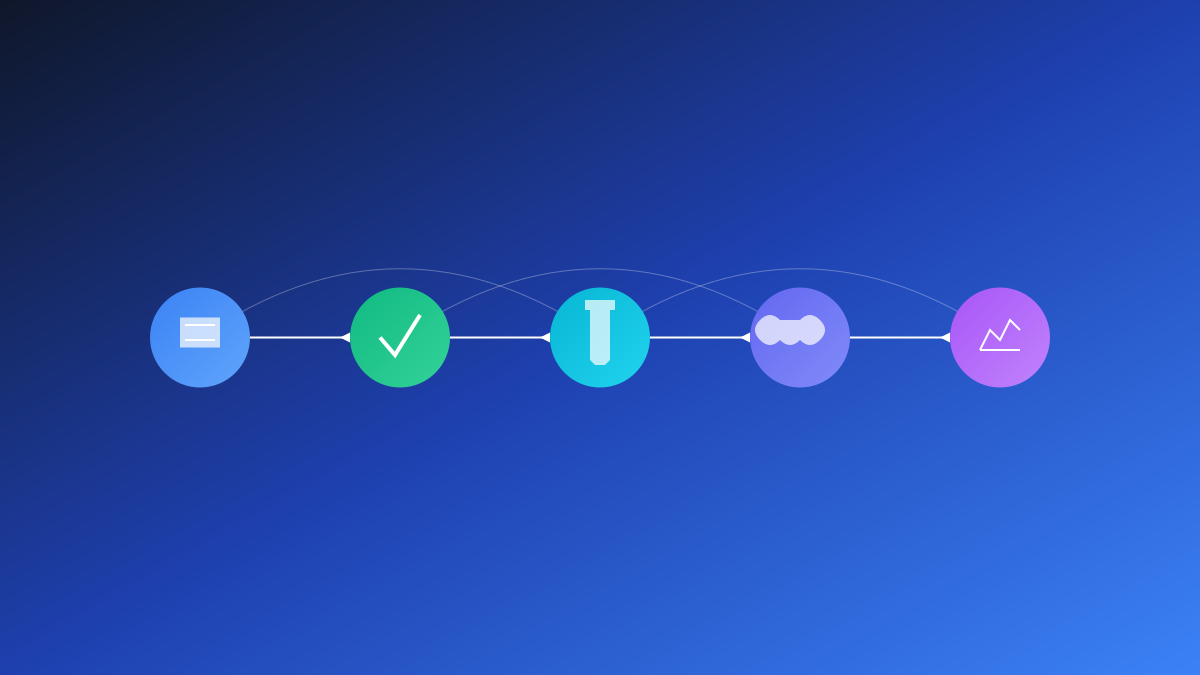
DevSquad-Agent builds a closed-loop quality assurance system, which includes five core stages:

  1. Requirement Understanding and Development: The Developer Agent transforms requirements into code and explanations of implementation ideas;
  2. Code Review: The Review Agent evaluates from dimensions such as style and logical defects and outputs structured comments;
  3. Quality Assurance Testing: The QA Agent generates test cases to verify code robustness;
  4. Intelligent Routing Decision: Based on review/test results, problematic code is routed to the Fix Agent for modification and then re-reviewed. If passed, it enters the report stage;
  5. Engineering Report Generation: A structured report that records the complete development process (requirements, review comments, repair records, etc.).
4

Section 04

Key Technical Implementation Points

The key technical choices of DevSquad-Agent include:

  • Graph-based Decision Routing: Define workflows using graph structures for flexible adjustment and expansion;
  • State-driven Agent Collaboration: Agents transfer information through state objects, and the loosely coupled design facilitates independent development and testing;
  • Quality Gate Mechanism: Set clear quality standards for each stage, drawing on CI/CD best practices.
5

Section 05

Application Scenarios and Value

The application scenarios of DevSquad-Agent include:

  • Personal Developer Assistant: Provide real-time review and test feedback;
  • Teaching and Training: Transparent processes help understand the working methods of professional development teams;
  • Rapid Prototype Development: Accelerate the transformation from requirements to prototypes while maintaining basic quality;
  • Code Review Automation: Pre-filter common issues to reduce the burden of manual review.
6

Section 06

Limitations and Future Outlook

Current limitations: Agent collaboration is relatively simple, modular decomposition capabilities for large projects need to be enhanced, and the depth of external tool integration is insufficient. Future directions: Introduce intelligent context management to handle large-scale codebases, enhance agent learning capabilities to optimize workflows, and explore human-machine collaboration models at key decision points.

7

Section 07

Conclusion: A New Paradigm of Multi-Agent Collaborative Software Engineering

DevSquad-Agent demonstrates a new paradigm of AI-assisted software development, emphasizing that the value of large language models lies not only in their generation capabilities but also in being organized into effective collaborative systems. By simulating the division of labor and collaboration of human teams, multi-agent systems are expected to balance efficiency and quality reliability, making it an open-source project worthy of in-depth research and reference.

