Zing Forum

Reading

DevFlow: Agentic Development Toolkit for Production-Grade Code

DevFlow is an advanced intelligent development toolkit that provides comprehensive support for production-grade code development through 18 parallel code reviewers, persistent work memory, and self-learning workflows.

DevFlowAgentic开发代码审查AI编程智能体协作工作流自动化生产级代码插件系统
Published 2026-03-29 06:46Recent activity 2026-03-29 06:51Estimated read 5 min
DevFlow: Agentic Development Toolkit for Production-Grade Code
1

Section 01

DevFlow: Agentic Development Toolkit for Production-Grade Code

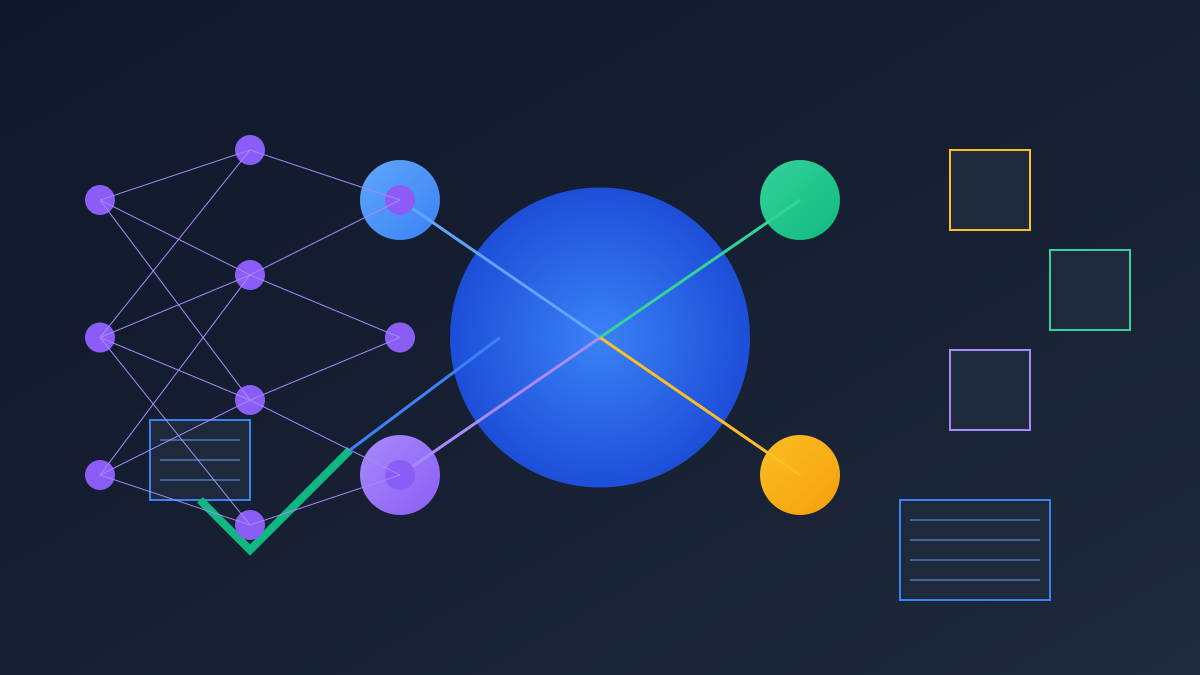
DevFlow is an advanced intelligent development toolkit designed to address production-level code's quality, consistency, and maintainability needs. Its core concept is 'Agentic Collaboration'—a network of specialized AI agents for parallel code reviews. Key features include 18 parallel code reviewers, persistent work memory, self-learning workflows, and a composable plugin system, integrating AI deeply into software engineering best practices.


2

Section 02

Background: Gaps in Current AI Programming Tools

Most existing AI-assisted programming tools focus on code completion or single-turn conversations, failing to meet production software's strict demands for quality, consistency, and maintainability. DevFlow was created to fill this gap as a complete agentic development workflow platform.

3

Section 03

Core Architecture: 18 Parallel Code Review Mechanism

DevFlow’s innovative design uses 18 parallel code reviewers, each targeting distinct quality dimensions:

  • Security: Detect vulnerabilities (injection attacks, sensitive info leaks, unsafe dependencies)
  • Performance: Identify bottlenecks and suggest optimizations
  • Maintainability: Evaluate complexity, annotations, and naming
  • Architecture consistency: Align with project design patterns
  • Test coverage: Analyze boundary condition coverage
  • Type safety: Reinforce constraints in dynamic languages Results are aggregated via context-aware priority sorting, prioritizing issues based on code changes, project stages, and historical data to avoid 'review fatigue'.
4

Section 04

Persistent Work Memory: Breaking Context Limitations

DevFlow solves context limitations with a project-level knowledge graph maintaining:

  • Architecture Decision Records (ADR) and technical choices
  • Module dependencies and data flows
  • Project-specific coding standards
  • Historical bug patterns to prevent recurrence
  • Developer preferences and feedback tendencies The system evolves incrementally, updating as the project progresses to stay current.
5

Section 05

Self-Learning Workflow & Plugin System

DevFlow’s self-learning workflow adapts via developer feedback (accepted/ignored suggestions) and adjusts review strategies per project stage (e.g., stricter security checks for production). Its composable plugin system allows customization: adding review dimensions (compliance, internationalization), integrating external tools, customizing rules, and extending workflows. This open architecture fosters community contributions and ecosystem growth.

6

Section 06

Production-Ready Enterprise Features

DevFlow supports enterprise needs:

  • Private deployment to keep code in internal networks
  • Audit logs for compliance
  • Integration with identity/permission systems It’s optimized for performance (parallel processing, incremental reviews for large codebases) and integrates with mainstream IDEs (real-time suggestions) and CI/CD pipelines (quality gates before merge).
7

Section 07

Conclusion & Future Outlook

DevFlow represents the evolution of AI-assisted programming from code generation to full workflow intelligence. It provides a practical intelligent assistant for production code via parallel reviews, persistent memory, self-learning, and plugins. As software complexity grows, such agentic tools will become standard, complementing human developers by handling repetitive reviews and letting them focus on creative tasks like architecture design and problem-solving.

