Zing Forum

Reading

Dev Harness: A Workflow Framework for Code Execution and Review Based on Dual-Agent Collaboration

A dual-agent development workflow that separates code execution (Claude Code/Cursor) and code review (Codex) via a file coordination mechanism, enabling more reliable AI-assisted development.

AI编程代码审查Claude CodeCursorCodex双智能体工作流自动化代码质量
Published 2026-04-09 14:40Recent activity 2026-04-09 14:51Estimated read 6 min
Dev Harness: A Workflow Framework for Code Execution and Review Based on Dual-Agent Collaboration
1

Section 01

Core Introduction to the Dev Harness Framework: Dual-Agent Collaboration Reshapes AI-Assisted Development Processes

Dev Harness is a workflow framework for code execution and review based on dual-agent collaboration. It separates code execution (handled by Claude Code or Cursor) and code review (handled by Codex) via a file coordination mechanism, simulating the collaboration mode of human development teams. It aims to address the reliability issues caused by a single agent both executing and reviewing code in current AI-assisted development, thereby improving code quality and development efficiency.


2

Section 02

Project Background: Core Pain Points of Current AI-Assisted Development

With the popularity of AI programming assistants such as Claude Code, Cursor, and GitHub Copilot, developers' work styles have transformed. However, the existing model has fundamental issues: the same AI instance often handles both code modification execution and review quality, lacking the independent "code review" step found in human development processes. The Dev Harness project is designed precisely to address this problem.

3

Section 03

Dual-Agent Architecture and File Coordination Mechanism

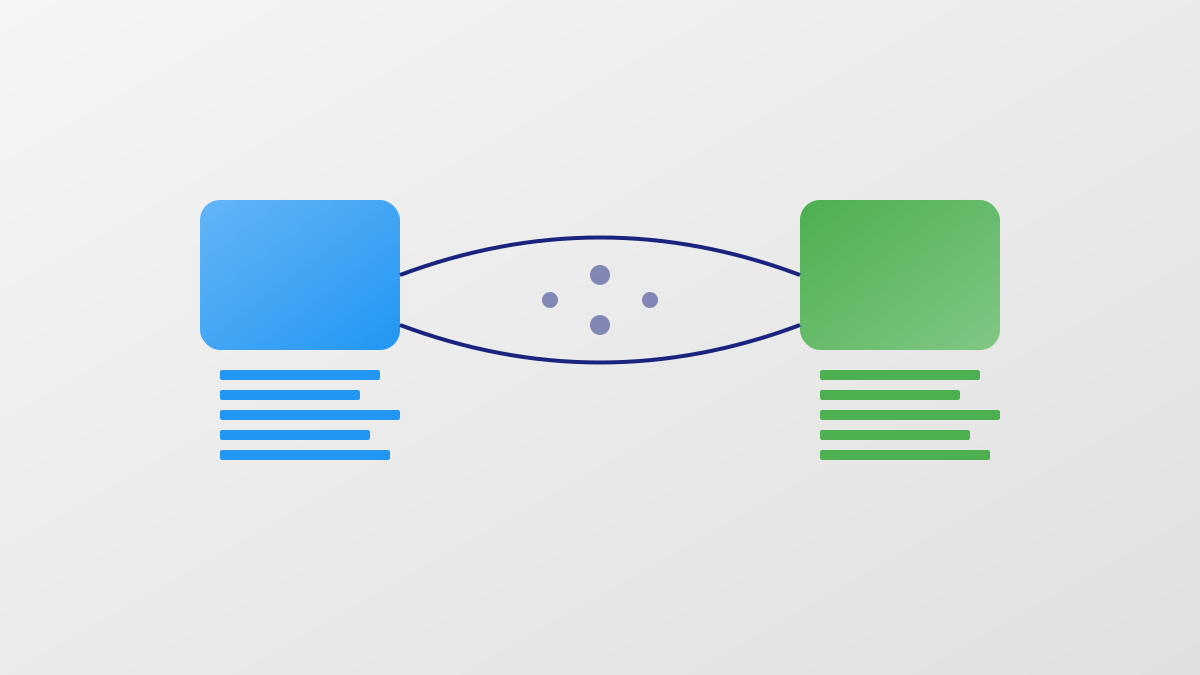
Dev Harness adopts a dual-agent architecture with division of labor: the Executor agent is responsible for code writing and modification (e.g., Claude Code/Cursor), while the Reviewer agent handles quality checks (e.g., Codex). The two agents coordinate via the file system: the Executor writes changes to specific files/directories, and the Reviewer periodically scans and outputs review result files. The advantages of this mechanism include: decoupling execution rhythm, providing a complete audit trail, and supporting human intervention at any time to view intermediate states.

4

Section 04

Workflow of Executor and Reviewer Agents

Executor Agent: Receives task descriptions, implements code modifications, and follows structured output specifications (including a list of modified files, change summaries, and context information) to facilitate review and human understanding.

Reviewer Agent: With Codex as its core, it evaluates changes from dimensions such as code style, logical errors, security risks, and best practices, outputting a structured report containing problem descriptions, severity levels, and improvement suggestions to achieve automated quality control.

5

Section 05

Human-Machine Collaboration Practices and Application Scenarios

Human-Machine Collaboration: Human developers hold the final decision-making power. They can configure the strictness of reviews, trigger conditions (e.g., specific file types/change scales), and take over the process at any time.

Application Scenarios: It can serve as a self-review tool for individual developers; help small teams make up for insufficient manual review resources; and act as an automated screening step before formal reviews in large organizations—all of which can improve code quality and efficiency.

6

Section 06

Technical Implementation and Future Outlook

Technical Implementation: The core coordination logic is a script/lightweight service that supports flexible configuration (selecting execution/review tools) and a plugin mechanism (extending review rules or integrating other AI models) to adapt to different development environments.

Future Outlook: It represents the direction of AI-assisted development shifting from single-agent to multi-agent collaboration, and is expected to become a standard component in developers' toolchains, driving the development of the field.

