Zing Forum

Reading

DeepTrace: A Real-Time Observability Layer for AI Agent Systems

DeepTrace is a real-time observability layer designed for AI agent systems. It can intercept, trace, visualize, and protect every LLM inference and tool call within agent clusters. It provides AI applications with monitoring capabilities similar to traditional distributed systems, helping developers understand and debug complex agent behaviors.

AI智能体可观测性追踪LLM监控工具调用安全调试分布式追踪智能体集群实时监控
Published 2026-04-22 08:45Recent activity 2026-04-22 12:05Estimated read 9 min
DeepTrace: A Real-Time Observability Layer for AI Agent Systems
1

Section 01

DeepTrace: Introduction to the Real-Time Observability Layer for AI Agent Systems

DeepTrace is a real-time observability layer designed for AI agent systems, aiming to address the challenges that traditional monitoring tools cannot handle the dynamics and uncertainty of agents. It can intercept, trace, visualize, and protect every LLM inference and tool call within agent clusters, providing monitoring capabilities similar to traditional distributed systems. It helps developers understand and debug complex agent behaviors, supporting scenarios such as development, operation and maintenance, performance optimization, and compliance auditing.


2

Section 02

Observability Challenges in the Agent Era

Traditional observability tools excel at monitoring deterministic system behaviors like API calls and database queries, but agent systems have new complexities: recursive execution flows form complex call chains (feedback loops of multiple LLM inferences and tool calls), and behaviors have inherent uncertainty (the same input may produce different outputs), making it extremely difficult to reproduce problems and understand system behaviors. Developers need tools that can fully record execution paths, LLM inference inputs/outputs, and tool call parameters/results.

3

Section 03

Core Capabilities of DeepTrace

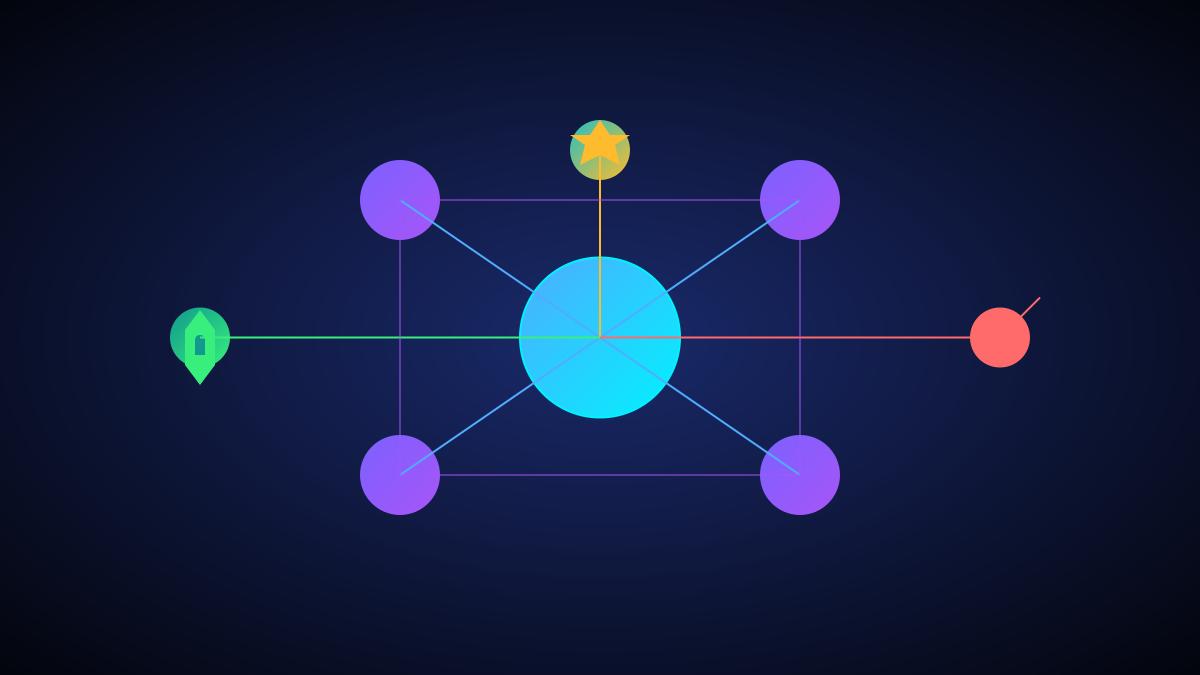
DeepTrace provides four core capabilities:

  1. Interception: Transparently capture every LLM inference request/response and tool call without modifying the core logic of agents, implemented via lightweight SDK or proxy;
  2. Tracing: Generate complete trace records containing key events such as LLM calls, tool calls, state transitions, and decision points, with structured storage supporting complex query analysis;
  3. Visualization: Intuitively display execution flows, supporting single call chain viewing and aggregated analysis of statistical patterns across multiple executions to help discover behavioral and abnormal patterns;
  4. Security: Monitor sensitive data flows, detect potential risks like prompt injection attacks and data leaks, and provide a security defense line for agent systems.
4

Section 04

Architectural Design and Technical Implementation of DeepTrace

DeepTrace's architecture is optimized for AI workloads:

  • Data Collection Layer: Provides language-specific SDKs (Python, TypeScript, etc.), proxy mode (no-code modification to intercept network traffic), and plug-and-play integration with standard frameworks (LangChain, LlamaIndex);
  • Data Storage Layer: Adopts a flexible schema design to adapt to high-dimensional structured data from different agent systems (LLM inputs/outputs, tool call parameters/results, etc.), supporting efficient query aggregation;
  • Analysis Layer: Offers basic visualization and advanced analysis functions (comparing agent version differences, analyzing input processing patterns, identifying execution bottlenecks/anomalies).
5

Section 05

Application Scenarios and Value of DeepTrace

DeepTrace demonstrates value in multiple scenarios:

  • Development & Debugging: Trace the complete decision-making process to understand the reasons for unexpected outputs under specific inputs, which is more structured and easier to analyze than traditional logs;
  • Production Monitoring: Set up alerts based on trace data (e.g., abnormal LLM call frequency, rising tool error rates) to reflect the health status of agents;
  • Performance Optimization: Identify inefficient patterns (redundant LLM calls, cacheable tool results, parallelizable operations, etc.);
  • Compliance & Auditing: Provide complete execution records to meet audit requirements in industries like finance and healthcare, showing sensitive data processing and key decision-making processes.
6

Section 06

Comparison of DeepTrace with Existing Tools

Differences between DeepTrace and existing tools:

  • Compared to traditional APM tools (e.g., Datadog, New Relic): Specifically designed for AI workloads, understands the uniqueness of LLM calls, and can parse and display unstructured text content;
  • Compared to LLM-specific tools (e.g., LangSmith, Weights & Biases): More general (not limited to specific frameworks) and provides more complete execution chain tracing;
  • Unique positioning: Focuses on observability of agent clusters, can trace cross-agent call chains, and display the operation status of the entire agent ecosystem.
7

Section 07

Open Source Ecosystem and Community of DeepTrace

DeepTrace is an open-source project using the MIT license, allowing wide commercial use. It encourages community contributions (bug reports, feature implementations, documentation improvements, case sharing, etc.). New contributors are advised to start with tasks marked as "good first issue" and gradually dive into core functions.

8

Section 08

Future Development Directions of DeepTrace

DeepTrace will continue to evolve in the future, with possible directions including:

  • Smarter anomaly detection (using AI to analyze trace data and automatically identify anomalies);
  • Stronger security capabilities (integrating more threat detection rules);
  • Better multimodal support (tracing the processing of non-text content like images and audio);
  • Deeper causal analysis (understanding the root causes of agent decisions). As more agent systems are deployed in production, DeepTrace will become an important part of the infrastructure, helping build reliable agent applications and accumulate industry best practice data.

