Zing Forum

Reading

DeepSeek V4 Flash Distillation Dataset: An Open Treasure Trove of High-Quality Reasoning Data

The DeepSeek-V4-Flash-Distillation project has open-sourced a large number of high-quality distillation datasets and reasoning traces generated by the DeepSeek V4 Flash teacher model, providing valuable resources for model distillation research.

DeepSeek模型蒸馏知识蒸馏推理轨迹教师模型学生模型微调开源数据集大语言模型
Published 2026-05-22 13:41Recent activity 2026-05-22 13:53Estimated read 6 min
DeepSeek V4 Flash Distillation Dataset: An Open Treasure Trove of High-Quality Reasoning Data
1

Section 01

DeepSeek V4 Flash Distillation Dataset: An Open Treasure Trove of High-Quality Reasoning Data

This post introduces the DeepSeek-V4-Flash-Distillation open-source project, which provides high-quality distillation datasets, reasoning traces, and fine-tuning pipelines generated by the DeepSeek V4 Flash (Max Thinking) teacher model. It aims to lower the threshold for high-quality model development by enabling small models (students) to learn from large, capable teacher models via distillation. The project is valuable for researchers and developers working on model distillation and efficient LLM deployment.


2

Section 02

Background: The Need for Model Distillation & Its Core Principles

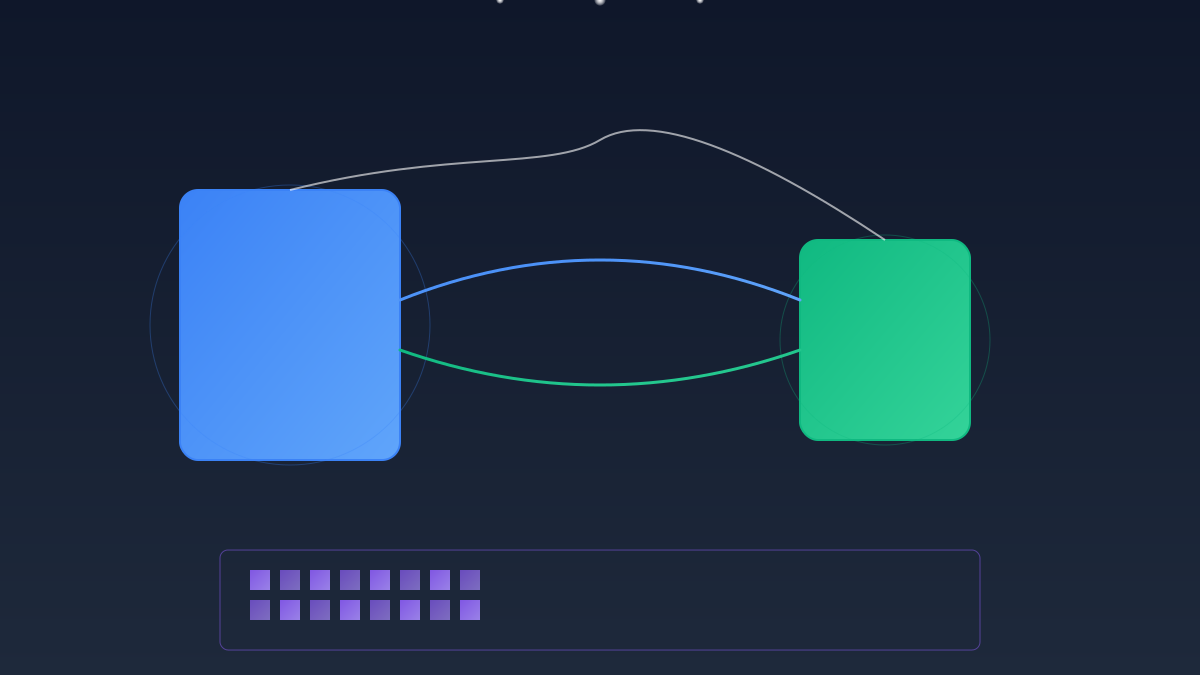
Large LLMs like GPT-4 or DeepSeek-V3 offer strong capabilities but are costly to deploy. Model distillation addresses this by letting small "student" models learn from large "teacher" models. Key ideas:

  • Teacher models provide rich "dark knowledge" (probability distributions over outputs, not just answers).
  • For reasoning tasks, learning the full reasoning process (traces) is more valuable than just answers—helping with process supervision, interpretability, and error analysis.
3

Section 03

DeepSeek V4 Flash Distillation Project: Key Components & Teacher Model

The project includes three main parts:

  1. Distillation Datasets: Curated, diverse, high-quality data suitable for SFT, DPO, and alignment tasks.
  2. Reasoning Traces: Complete thinking processes (problem understanding → strategy → execution → validation) to train reasoning capabilities in students.
  3. Fine-tuning Pipelines: Ready-to-use scripts for downloading data, selecting base models, and training distilled models.

The teacher model is DeepSeek V4 Flash (Max Thinking), optimized for reasoning with features like MoE architecture, multi-token prediction, and RLHF alignment.

4

Section 04

Application Scenarios of the Distillation Dataset

This project benefits various users:

  • Resource-constrained teams: Avoid training large models from scratch; use pre-made distillation data for efficient fine-tuning on consumer hardware.
  • Domain adaptation: Inject domain expertise into small models while keeping them lightweight.
  • Edge devices: Deploy capable models on mobile/IoT devices where size and speed matter.
5

Section 05

Technical Notes: Data Quality, Training, & Evaluation

To ensure effective distillation:

  • Data quality: Choose strong teacher models, filter low-quality samples, and ensure data diversity.
  • Training strategies: Adjust temperature for soft labels, balance distillation and task losses, use proper learning rate scheduling and early stopping.
  • Evaluation: Focus on ability retention (vs teacher), efficiency gains (speed/resource use), and robustness across scenarios.
6

Section 06

Industry Trends & Future of Distillation

The project aligns with key trends:

  • Open-source distillation: Growing community efforts (Hugging Face tools, open teacher data).
  • Small model revival: Models like Phi, Gemma, Llama3.2 show small models can be powerful via distillation.
  • Widespread adoption of reasoning: Distillation facilitates the transfer of advanced reasoning capabilities (e.g., as demonstrated by DeepSeek R1's success).

Future expectations: More multilingual/domain datasets, standardized benchmarks, automated tools, and deeper theoretical understanding of distillation.

7

Section 07

Suggestions for Using the Project

For developers/researchers:

  1. Clarify goals: Define the specific capabilities you want to distill.
  2. Select base models: Pick a student model architecture suitable for your scenario.
  3. Filter data: Use subsets relevant to your task.
  4. Progressive experiments: Start small, then scale up.
  5. Evaluate thoroughly: Test distilled models in real-world scenarios to validate effectiveness.

