Zing Forum

Reading

DeepSeek-OCR Multi-GPU Inference: A Scalable Deployment Solution for High-Efficiency OCR Models

The deepseek-ocr-multigpu-infer project provides an efficient inference solution for the DeepSeek-OCR model, supporting both single-GPU and multi-GPU configurations to help users achieve optimal OCR performance across different hardware environments.

OCRDeepSeek多GPU推理深度学习文档识别并行计算模型部署
Published 2026-04-05 02:44Recent activity 2026-04-05 02:50Estimated read 7 min
DeepSeek-OCR Multi-GPU Inference: A Scalable Deployment Solution for High-Efficiency OCR Models
1

Section 01

[Introduction] DeepSeek-OCR Multi-GPU Inference: Core Analysis of High-Efficiency Scalable Deployment Solutions

Key Takeaways: The deepseek-ocr-multigpu-infer project offers an efficient inference solution for the DeepSeek-OCR model, supporting both single-GPU and multi-GPU configurations. It addresses challenges like processing speed and hardware adaptation in OCR scenarios, enabling scalable performance, flexible hardware adaptation, and cost-effectiveness optimization to meet deployment needs of various scales.


2

Section 02

[Background] Challenges of OCR Technology and Advantages of the DeepSeek-OCR Model

Importance and Challenges of OCR Technology

OCR is a key technology connecting the physical and digital worlds, widely used in scenarios like document scanning and ID recognition. However, it faces challenges such as processing speed, accuracy, and hardware adaptation—especially in large-scale or real-time scenarios where a single GPU is insufficient.

Introduction to the DeepSeek-OCR Model

Based on a large language model architecture, DeepSeek-OCR has advantages like end-to-end training (no complex preprocessing/postprocessing needed), strong generalization ability (adapts to various fonts, layouts, and languages), and excellent context understanding and complex layout processing capabilities.

3

Section 03

[Methodology] Key Technical Implementation Points for Multi-GPU Inference

Data Parallelism Strategy

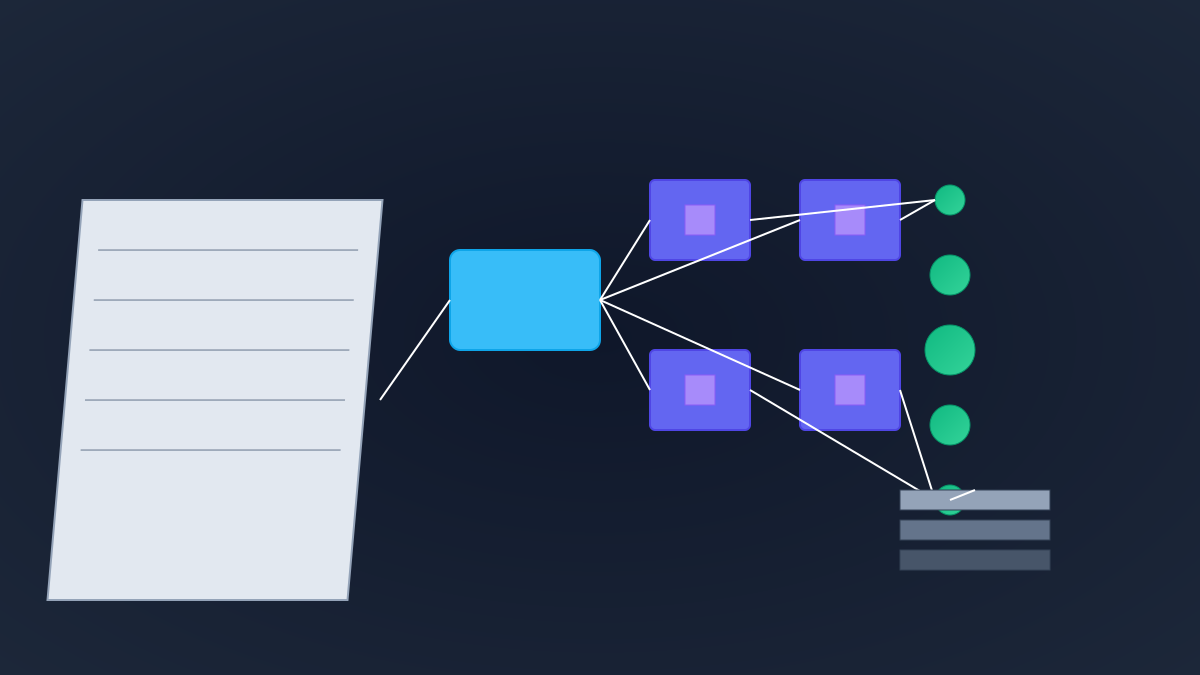
Data parallelism is adopted: input images are split into multiple batches, each GPU processes one batch, and results are aggregated afterward. This is suitable for compute-intensive OCR tasks and offers good scalability.

Memory Optimization

Technologies like gradient checkpointing, mixed-precision inference, and dynamic batch size adjustment are used to address the memory limitations of large model inference and improve hardware utilization.

Load Balancing

An intelligent task allocation mechanism is implemented to dynamically adjust loads based on the real-time capabilities of GPUs, avoiding idleness or overload and maximizing hardware efficiency.

4

Section 04

[Application Scenarios] Practical Application Areas of the Multi-GPU Inference Solution

Document Digitization Pipelines

Supports large-scale document scanning processing for enterprises, such as archive digitization, contract management, and invoice processing—quickly converting paper documents into electronic text.

Video Content Analysis

Meets the needs of real-time scenarios like video surveillance and content moderation, supporting text extraction from high-frame-rate video frames (e.g., license plate recognition, bullet comment extraction).

Cloud OCR Services

Helps cloud platforms support high-concurrency API requests, with dynamic adjustment of GPU resources to balance service quality and cost.

5

Section 05

[Advantage Comparison] Core Differences Between This Project and Other OCR Inference Solutions

Compared to other OCR inference solutions, this project has the following advantages:

  1. Advanced Model: Based on the DeepSeek large model, it outperforms traditional models in recognition accuracy and generalization ability;
  2. Deployment Flexibility: Seamless switching between single/multi-GPU modes to adapt to different hardware environments;
  3. Ease of Use: Provides clear Python scripts and configuration interfaces to lower the barrier to use;
  4. Performance Optimization: Specifically optimized for inference scenarios to fully leverage hardware performance.
6

Section 06

[Limitations and Improvements] Current Shortcomings and Future Optimization Directions

Limitations

  • Communication overhead in multi-GPU parallelism may affect scaling efficiency (especially when the number of GPUs is large);
  • Model loading and initialization time may become a bottleneck in large-scale deployments.

Optimization Directions

  • Introduce model parallelism strategies to support ultra-large-scale models;
  • Optimize communication mechanisms between multiple GPUs;
  • Provide containerized deployment to simplify environment configuration;
  • Integrate model quantization technology to reduce computational overhead.
7

Section 07

[Conclusion] Project Value and Future Outlook

deepseek-ocr-multigpu-infer provides a practical solution for the actual deployment of DeepSeek-OCR, meeting needs from individual development to enterprise-level applications through flexible single/multi-GPU configurations. As OCR technology becomes more widely adopted, such efficient and easy-to-use inference tools will play an important role in digital transformation, providing a reliable starting point for developers and enterprises exploring large-model OCR applications.

