Zing Forum

Reading

DE-Agent-Workflow: An Intelligent Data Engineering Framework Based on ReAct Loop

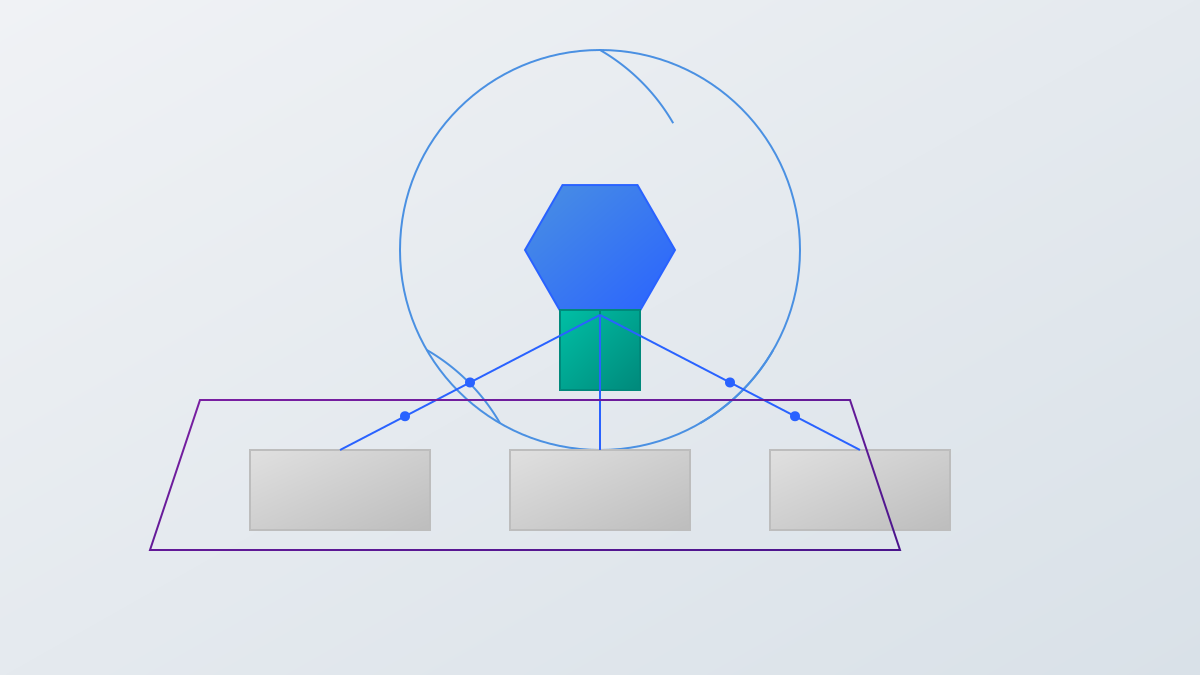
An intelligent data engineering framework integrating MCP server architecture, which enables autonomous orchestration and automated execution of data engineering tools through local large language models (LLMs) and ReAct reasoning loops.

AI Agent数据工程MCPReActLLMETL自动化数据治理智能编排
Published 2026-05-17 14:45Recent activity 2026-05-17 14:50Estimated read 5 min
DE-Agent-Workflow: An Intelligent Data Engineering Framework Based on ReAct Loop
1

Section 01

Core Guide to the DE-Agent-Workflow Framework

DE-Agent-Workflow is an intelligent data engineering framework that integrates MCP server architecture and ReAct reasoning loops. It enables autonomous orchestration and automated execution of data engineering tools through local large language models (LLMs). Its core vision is to shift data engineering tasks from manual scripting to intelligent automated execution, addressing fragmentation, privacy, and efficiency issues in traditional data engineering.


2

Section 02

Project Background and Core Concepts

Traditional data engineering faces pain points such as fragmented tool connectors, privacy risks and latency caused by reliance on cloud APIs, and repetitive manual scripting. The core concept of DE-Agent-Workflow is to integrate LLM reasoning capabilities with data engineering toolchains via AI Agent technology, based on MCP protocol and ReAct loops, to achieve intelligent task execution and self-correction.

3

Section 03

Core Methods: MCP Architecture and ReAct Loop

MCP Server Architecture: Adopts the MCP protocol proposed by Anthropic to establish a unified communication interface between AI models and external tools/data sources, eliminating fragmentation issues. It emphasizes local LLM deployment to ensure data privacy, reduce API dependencies, and lower operational costs. ReAct Reasoning Loop: Handles complex tasks through alternating iterations of Thought (reasoning analysis) → Action (tool invocation) → Observation (result feedback). It has dynamic decision-making and error recovery capabilities, distinguishing itself from traditional workflow engines with predefined DAGs.

4

Section 04

Application Scenario Examples

The framework has been validated for effectiveness in three types of data engineering scenarios:

  1. ETL Automation: Understands source data schemas, generates extraction queries and transformation logic, and dynamically adjusts incremental update, verification, and exception handling strategies;
  2. Data Quality Governance: Performs regular data profiling, anomaly identification, report generation, and proactively triggers alerts or fixes;
  3. Cross-System Integration: Coordinates synchronization of heterogeneous data sources (relational databases, data warehouses, NoSQL, SaaS) via MCP standardized interfaces, reducing integration complexity.
5

Section 05

Key Technical Implementation Details

To ensure the framework's operation, the following are required:

  1. Tool Registration and Discovery: Supports custom tool access, enabling the Agent to select the optimal tool based on tasks;
  2. Context Management: Maintains a correct understanding of task objectives, executed steps, and status;
  3. Security Control: Tool invocation permission verification, secondary confirmation for sensitive operations, and complete audit logs.
6

Section 06

Practical Value and Future Outlook

DE-Agent-Workflow significantly reduces the development and maintenance costs of complex data pipelines, freeing up data engineers' energy for data architecture and business value creation. As LLM capabilities improve and Agent technology matures, this framework is expected to become a core component of enterprise data infrastructure, driving the evolution of data engineering toward intelligence.

