Zing Forum

Reading

craft-agents-oss: A Document-Driven Multi-Task AI Agent Workflow Platform

Introducing the craft-agents-oss project, an open-source multi-task AI agent platform that simplifies API connections and multi-task processing through document-centric workflows and an intuitive interface, boosting user productivity.

AI代理工作流自动化文档驱动API集成多任务处理开源
Published 2026-04-10 05:41Recent activity 2026-04-10 06:50Estimated read 7 min
craft-agents-oss: A Document-Driven Multi-Task AI Agent Workflow Platform
1

Section 01

Introduction: craft-agents-oss—A Document-Driven Multi-Task AI Agent Workflow Platform

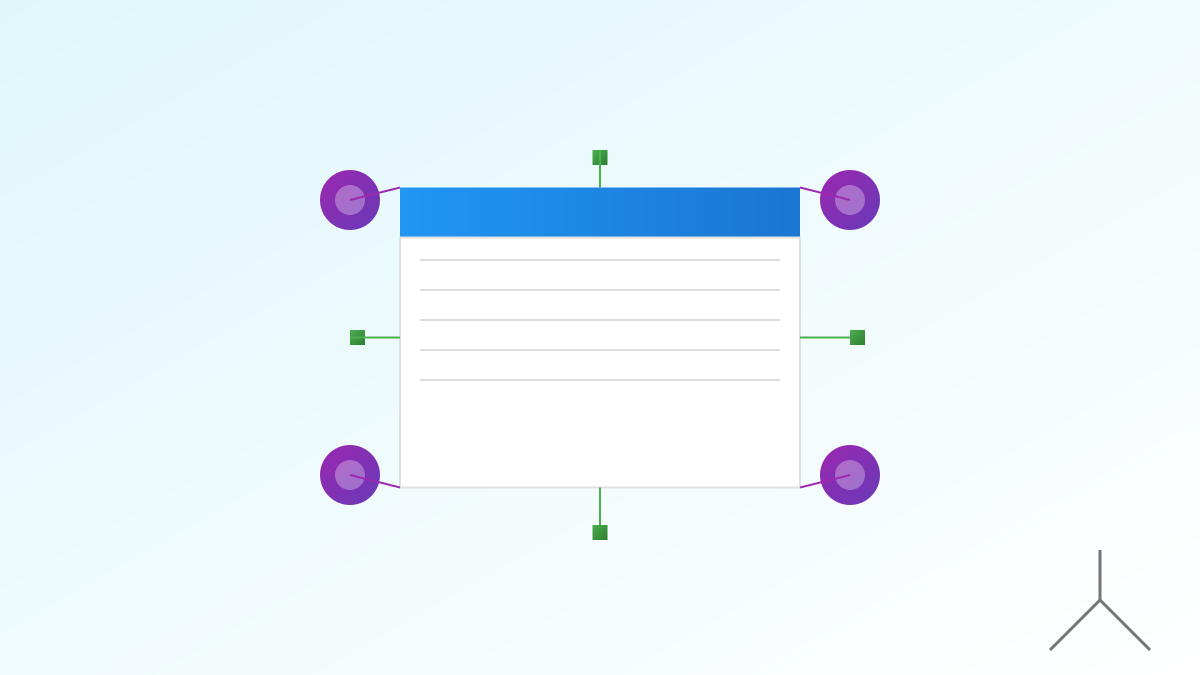
craft-agents-oss is an open-source multi-task AI agent platform that builds workflows centered on documents. It simplifies API connections and multi-task processing through an intuitive interface, addressing modern workflow pain points and enhancing user productivity. Its core idea is to make documents the unit for workflow definition, execution, and knowledge accumulation, combined with AI agents to achieve automation.


2

Section 02

Background: Four Major Pain Points in Modern Workflows

In the era of information explosion and tool fragmentation, knowledge workers face efficiency challenges:

  1. Multi-task switching cost: Frequent switching between applications/documents leads to heavy cognitive load;
  2. API integration complexity: Different services have varying authentication methods and formats, making integration tedious and error-prone;
  3. Context loss: Information is scattered, lacking a unified view;
  4. Repetitive work: Low-efficiency repetitive tasks like data organization and format conversion.
3

Section 03

Methodology: Core Concepts of Document-Driven Approach and System Architecture

Core Concept: Document as Workflow

Documents are not only information carriers but also units for workflow definition and execution. Users describe tasks in natural language, and AI agents parse and execute them (e.g., organizing meeting minutes → creating GitHub issues → sending emails). Documents also serve as data sources, execution records, and knowledge accumulation tools.

System Architecture Components

  • Document Engine: Supports multi-format parsing, version control, collaborative editing, and template system;
  • AI Agent System: Task parsing, API interaction, data processing, and coordination of agent collaboration;
  • API Connection Layer: Pre-built connectors, general HTTP client, authentication management, and rate limit handling;
  • User Interface: Document editor, workflow visualization, agent dialogue, and dashboard.
4

Section 04

Evidence: Demonstration of Typical Application Scenarios

  1. Project Management Automation: Extract action items from meeting minutes → create tasks/reminders, auto-generate progress reports, cross-tool synchronization;
  2. Content Creation Workflow: Auto-collect materials, generate first drafts, multi-channel publishing;
  3. Data Analysis and Reporting: Data acquisition → cleaning → visualization → distribution;
  4. Customer Support Automation: Ticket classification and routing, knowledge base retrieval assistance, follow-up arrangement.
5

Section 05

Technical Advantages: Natural Language Programming and Open Extensibility

  1. Natural Language Programming: No coding required; define workflows using everyday language to lower the barrier to entry;
  2. Context-Aware Execution: AI understands document context and makes intelligent decisions (e.g., auto-selecting GitHub issue labels);
  3. Progressive Automation: Supports the "human-in-the-loop" mode, requiring user confirmation at key nodes;
  4. Open Extensibility: Open-source, supporting custom agents, connectors, templates, and plugin extensions.
6

Section 06

Comparison: Differentiated Advantages Over Similar Products

  • vs Zapier/Make: More natural document + natural language interaction, stronger context understanding, fully open-source and self-hosted;
  • vs LangChain/LlamaIndex: A complete product experience for end-users, not just a developer framework;
  • vs Notion AI: Not only AI assistance within documents but also connects external APIs to achieve end-to-end automation.
7

Section 07

Ecosystem: Open-Source Community and Extensibility

Community ecosystem under the open-source model:

  • Contribution Guidelines: Welcome contributions of code, documents, templates, and connectors;
  • Plugin Market: Community-shared plugins for extended functions;
  • Template Library: Users share workflow templates;
  • Documentation and Tutorials: Rich resources to help users get started.
8

Section 08

Future: Project Development Direction and Prospects

Future plans:

  1. Multi-modal Support: Process images, audio, and video;
  2. Collaboration Enhancement: Complex team collaboration (approval, permission management);
  3. Mobile Experience: Develop mobile applications;
  4. Enterprise-Grade Features: SSO, audit logs, SLA monitoring;
  5. AI Model Optimization: Scene-specific fine-tuning to improve accuracy.

