Zing Forum

Reading

Copilot Agentic Standards: Building a Consistent AI-Assisted Development Standard System

Introduces Copilot Agentic Standards, a standardized solution for centrally managing GitHub Copilot instructions, workflows, PR templates, and MCP configurations to ensure consistency in multi-repository development.

GitHub CopilotAI 辅助开发标准化DevOps代码质量工作流MCP开发规范
Published 2026-04-11 02:11Recent activity 2026-04-11 02:25Estimated read 8 min
Copilot Agentic Standards: Building a Consistent AI-Assisted Development Standard System
1

Section 01

Introduction: Copilot Agentic Standards Builds a Consistent AI-Assisted Development System

Introduction: Copilot Agentic Standards Builds a Consistent AI-Assisted Development System

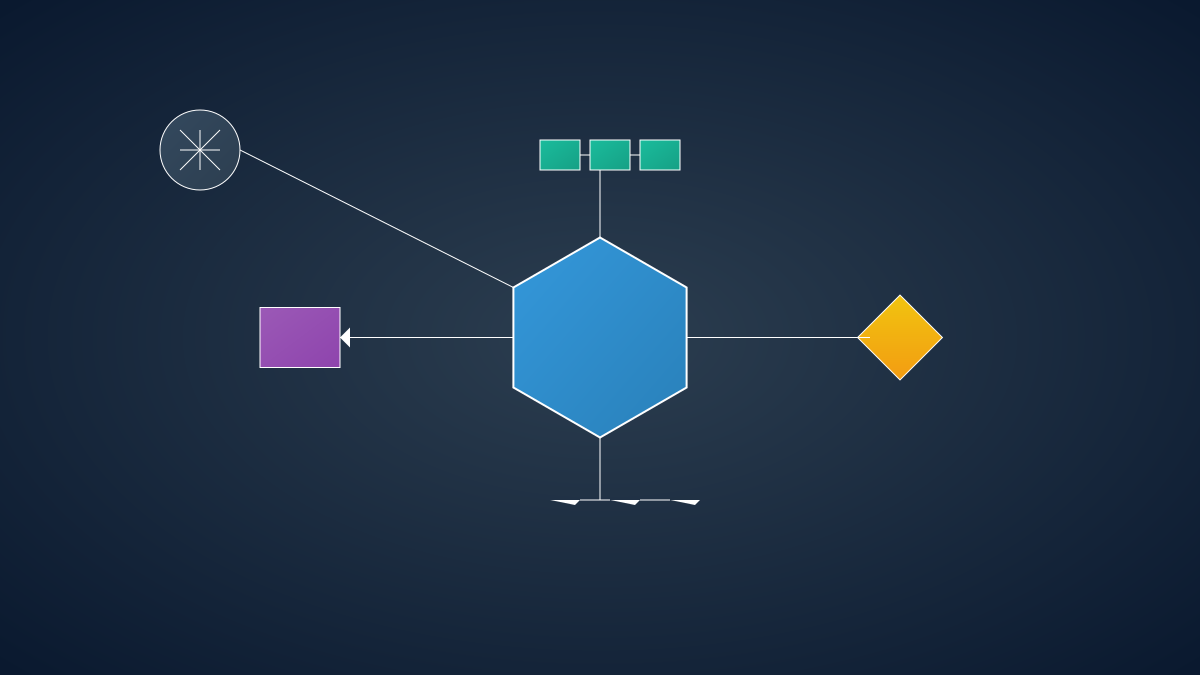
Copilot Agentic Standards is a standardized solution for centrally managing GitHub Copilot instructions, workflows, PR templates, and MCP configurations, aiming to solve the problem of inconsistent AI-assisted tool behavior in multi-repository development. Its core adopts the Hub-and-Spoke model—by storing standard configurations centrally and allowing each repository to reference them, updates take effect globally with a single change. This helps teams reduce duplicate configurations, ensure cross-project consistency, simplify new member onboarding processes, and establish a maintainable best practice system.


2

Section 02

Background: Consistency Challenges in AI-Assisted Development

Background: Consistency Challenges in AI-Assisted Development

With the popularity of AI coding assistants like GitHub Copilot, teams face the following issues in multi-repository development:

  1. Inconsistent code styles: Copilot generates code with widely varying styles across different repositories;
  2. Repeated configuration work: Each repository needs to configure Copilot custom instructions separately;
  3. Knowledge silos: Best practices are scattered across repositories, making maintenance and synchronization difficult;
  4. Collaboration friction: Team members have inconsistent expectations for AI-assisted development.

These problems led to the birth of the copilot-agentic-standards project.

3

Section 03

Core Concepts and Component Details

Core Concepts and Component Details

Core Concepts

  • Standardization equals productivity: Reduce cognitive load through unified instructions, workflows, templates, and configurations;
  • Centralized management, decentralized use: Store standards in a central repository, with each repository referencing them (Hub-and-Spoke model).

Key Components

  1. Copilot instructions: Define code styles (indentation, naming), framework rules (React components, Python type hints), security guidelines (prohibit hardcoding keys), etc.;
  2. Reusable workflows: Implement centralized definition and invocation of CI/CD and PR processes via GitHub Actions' workflow_call;
  3. PR templates: Include descriptions, type selections, checklists, etc., to ensure complete submission information;
  4. MCP configurations: Unify Model Context Protocol settings to support tool integration such as databases and file systems.
4

Section 04

Implementation Strategy: Phased Rollout

Implementation Strategy: Phased Rollout

The project recommends a three-phase implementation:

  1. Basic setup: Create a central repository, define basic instructions, core workflows, and PR templates;
  2. Pilot promotion: Select 2-3 representative repositories to integrate configurations, collect developer feedback, and iterate for optimization;
  3. Full deployment: Develop a migration plan, organize training, write automation scripts to update configurations, and continuously monitor standardization effects.
5

Section 05

Best Practices: Enhancing Standardization Effectiveness

Best Practices: Enhancing Standardization Effectiveness

Instruction Writing

  • Be specific rather than abstract (e.g., require functions to include type annotations instead of "write high-quality code");
  • Example-driven, including code samples;
  • Regularly review and update rules.

Workflow Design

  • Keep it concise, split complex processes;
  • Prioritize fast checks (e.g., linting);
  • Execute independent tasks in parallel.

Configuration Management

  • Use semantic version control;
  • Ensure backward compatibility;
  • Synchronize documentation with configuration changes.
6

Section 06

Future Directions: Expansion and Enhancement

Future Directions: Expansion and Enhancement

The project will develop in the following directions in the future:

  1. Enhanced AI capabilities: Integrate LLMs like Claude and Gemini, support custom model fine-tuning;
  2. Expanded tool ecosystem: Add MCP server integration, IDE plugins, and command-line tools;
  3. Analysis and insights: Provide code quality trend analysis, AI development efficiency metrics, and best practice recommendations.
7

Section 07

Summary: Value and Significance of Standardization

Summary: Value and Significance of Standardization

copilot-agentic-standards provides a practical standardization solution for teams using GitHub Copilot. By centrally managing configurations, teams can reduce repetitive work, ensure cross-project consistency, simplify new member onboarding, and establish a maintainable best practice system. As AI-assisted development becomes mainstream, such tools will play an important role in improving development efficiency and code quality, and are a worthy reference implementation path for organizations scaling Copilot usage.

