Zing Forum

Reading

Conductor Kit: A Unified CLI Tool for Multi-Agent Team Workflow Orchestration

A workflow orchestration tool supporting multi-agent team collaboration, providing a unified CLI interface and compatible with mainstream AI coding assistants like Claude Code, Codex CLI, and Cursor.

多代理工作流编排AI编程助手Claude CodeCodex CLICursor团队协作
Published 2026-04-24 13:48Recent activity 2026-04-24 13:56Estimated read 7 min
Conductor Kit: A Unified CLI Tool for Multi-Agent Team Workflow Orchestration
1

Section 01

Introduction: Conductor Kit — A Unified CLI Tool for Multi-Agent Team Workflow Orchestration

Conductor Kit is a workflow orchestration tool that supports multi-agent team collaboration. Its core is to provide a unified CLI interface and is compatible with mainstream AI coding assistants such as Claude Code, Codex CLI, and Cursor. It aims to solve the team collaboration challenges caused by the fragmentation of AI coding tools. Through the orchestration layer, it coordinates multiple agents (AI tools + human developers) to complete complex development tasks, preserving the advantages of each tool while standardizing workflows.


2

Section 02

Background: Development and Fragmentation Challenges of AI Coding Assistants

In recent years, AI coding assistants like Claude Code, GitHub Copilot, Cursor, and Codex CLI have become popular, improving development efficiency. However, differences in interaction protocols, context management, and workflow patterns among these tools lead to fragmentation issues. In team development, members using different tools cause collaboration difficulties, knowledge sharing barriers, and inconsistent processes. How to standardize workflows while retaining tool diversity has become an urgent problem to solve.

3

Section 03

Design Philosophy and Multi-Agent Workflow Architecture

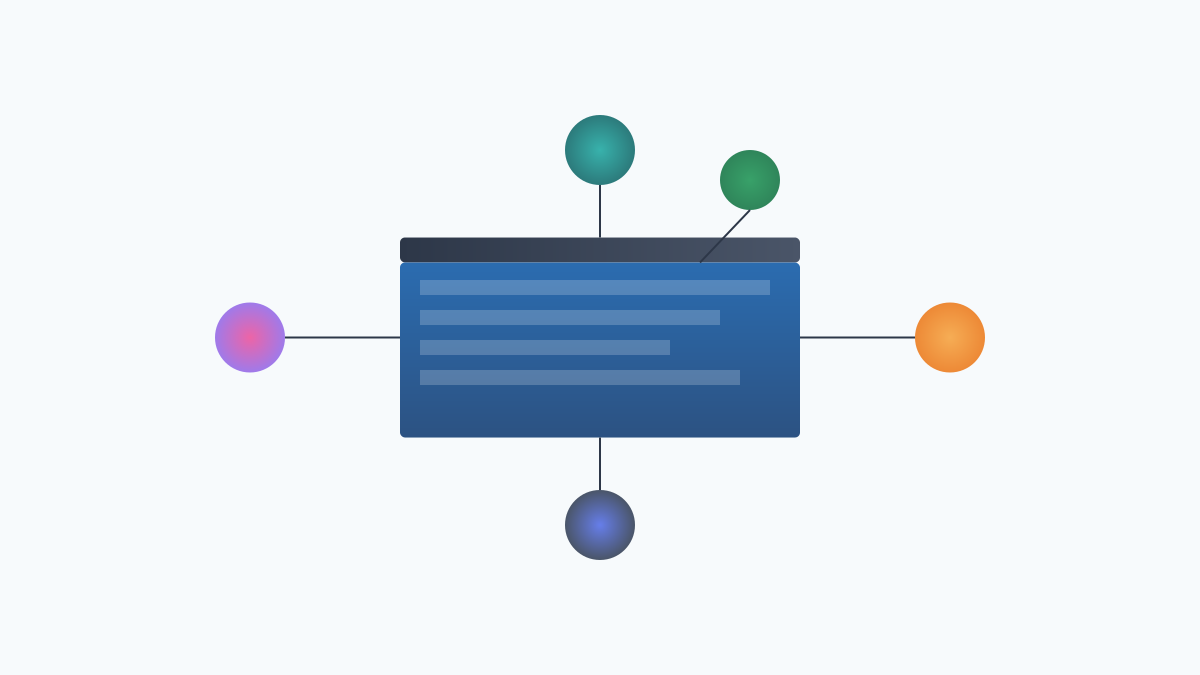
The core philosophy of Conductor Kit is "one CLI, multiple adaptations". Analogous to an orchestra conductor coordinating different performers, it coordinates multiple AI agents and human developers to complete tasks. The system architecture has three layers: the bottom layer is the AI tool layer (e.g., Claude Code), the middle layer is the adapter layer (abstracting a unified interface), and the upper layer is the orchestration layer (task decomposition, agent scheduling, result integration). Workflows are defined declaratively, and the orchestrator selects the appropriate agent based on task type, load, and historical performance.

4

Section 04

Unified CLI Interface and Adapter Design

Conductor Kit provides a unified CLI interface with main commands including workflow run (execute workflow), task delegate (delegate task), status (check status), and adapter config (manage adapters). It follows Unix philosophy and supports pipeline and script integration. Adapters are key components; each needs to implement standard interfaces (task submission, result retrieval, etc.). For example, the Claude Code adapter is suitable for complex reasoning, Codex CLI for fast code generation, and Cursor adapter for IDE integration-related tasks. Community extensions are also supported.

5

Section 05

Team Collaboration Modes and Context Management

Conductor Kit supports collaboration modes such as division of labor, parallel processing, and review: In division of labor mode, members are responsible for different stages; in parallel mode, multiple agents handle independent subtasks; in review mode, it combines AI generation + AI review + human decision-making. Workflow definitions are stored in YAML/JSON for easy version control. For context management, it maintains a global context store that records execution history and intermediate results. A status synchronization mechanism coordinates human and AI work to avoid conflicts and information loss.

6

Section 06

Typical Application Scenarios and Configuration Customization

Conductor Kit is suitable for scenarios like large-scale feature development (decomposing parallel subtasks), code review (AI pre-review + human decision-making), cross-tool migration (maintaining workflow continuity), team standardization (unifying new members' work methods), and CI/CD integration (automated code generation and testing). The configuration system is flexible, supporting workflow definition, adapter configuration, and team role permissions. It uses a layered design (global default, project override, personal preference), and advanced users can customize workflow templates.

7

Section 07

Limitations and Future Directions

The current version relies on the intelligence level of underlying AI tools and is difficult to automatically correct AI hallucinations or errors; adapter maintenance costs are high and need to be updated with AI tool iterations. Future plans include introducing a verification layer to automatically check agent outputs and establishing a community contribution mechanism to distribute adapter maintenance burdens. The long-term goal is to become the standard orchestration layer for AI-assisted development, similar to Kubernetes' position in container orchestration.

