Zing Forum

Reading

ComfyUI Agents: Building Visual Workflows Driven by Natural Language

Explore how the ComfyUI-agents project uses large language models to automatically convert natural language descriptions into ComfyUI node graphs, lowering the barrier to building visual workflows.

ComfyUIAI图像生成自然语言处理工作流自动化大语言模型节点编辑器SDXL视觉创作
Published 2026-05-22 05:55Recent activity 2026-05-22 06:22Estimated read 7 min
ComfyUI Agents: Building Visual Workflows Driven by Natural Language
1

Section 01

[Main Floor] ComfyUI Agents: Introduction to Natural Language-Driven Visual Workflow Building

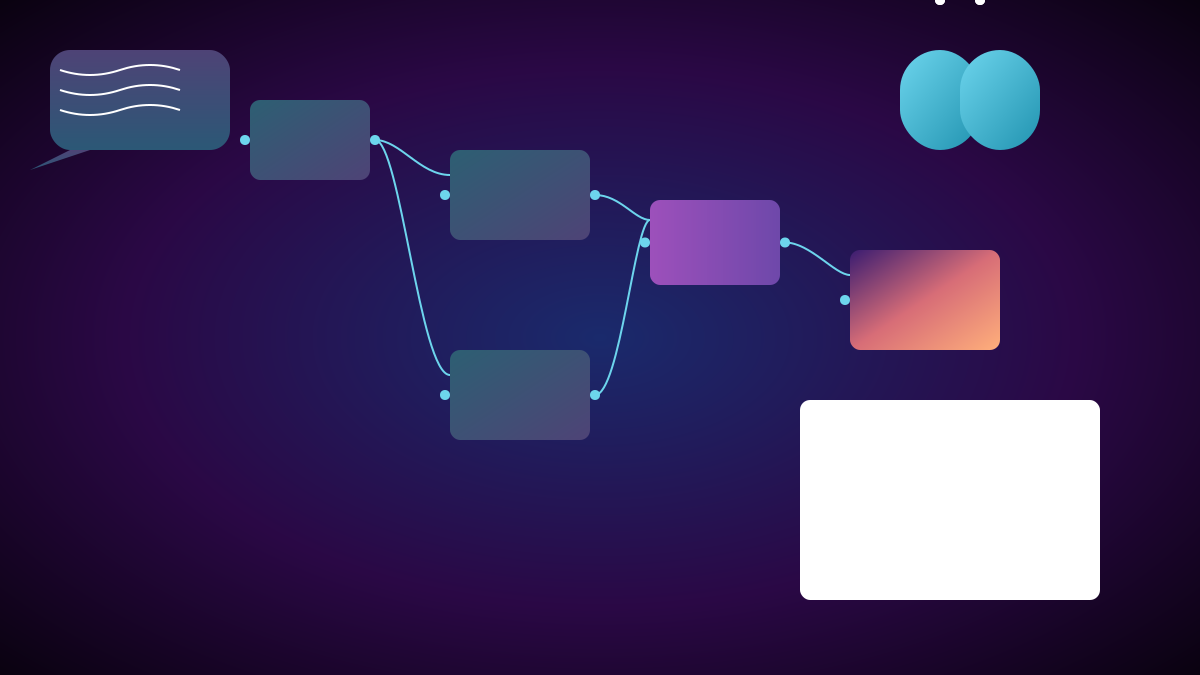
ComfyUI-agents is an open-source project that aims to build a bridge between natural language and ComfyUI workflows using large language models (LLMs). Users only need to describe their creative intent in everyday language, and the system will automatically parse it and generate the corresponding node graph configuration, lowering the barrier to building visual workflows. The project supports functions such as intent understanding, node graph generation, and execution feedback, and is suitable for scenarios like reducing the learning curve, accelerating prototype design, and promoting creative expression.


2

Section 02

Background and Motivation: The Threshold Issue of ComfyUI Usage

In the field of AI image generation, ComfyUI has become the tool of choice for professional users due to its flexible node-based workflow editor. However, building complex workflows requires users to have in-depth knowledge of various nodes, parameters, and connection methods, which poses a significant barrier for beginners. How to enable users to express their creative intent in natural language and let AI automatically complete the tedious node-building work has become a direction worth exploring.

3

Section 03

Core Mechanism: Conversion Process from Natural Language to Node Graph

Intent Understanding Layer

The system first parses the user's natural language input through a large language model and extracts key information: task type (text-to-image, image-to-image, etc.), model selection (SDXL, Stable Diffusion 1.5, etc.), style and parameters (artistic style, resolution, etc.).

Node Graph Generation

Based on the parsed intent, the system selects appropriate node types from a predefined node library, automatically configures parameters and establishes data flow connections, and generates a JSON configuration that can be directly imported into ComfyUI.

Execution and Feedback

The generated workflow can be run directly, and users can also adjust it through natural language (e.g., adding an upscaling step, changing the style), and the system will modify the node graph accordingly.

4

Section 04

Technical Highlights: LLM Integration and Modular Design

Integration of LLM and Structured Output

The project combines the semantic understanding capability of large language models with structured data generation, which can both understand ambiguous descriptions and output precise node configurations, demonstrating the potential of AI to lower the threshold of professional tools.

Modular Design

The system adopts a modular architecture, allowing developers to expand node types, connect to different LLM backends, and customize workflow template libraries.

Context-Aware Optimization

By maintaining dialogue context, the system can understand progressive modification requests; users do not need to repeatedly describe the entire workflow, and only need to point out the parts to be adjusted for intelligent modification.

5

Section 05

Application Scenarios: Lowering Thresholds and Improving Creative Efficiency

Reducing the Learning Curve

Users new to ComfyUI do not need to memorize a large number of node names and parameters; they can get started quickly with natural language, significantly reducing learning costs.

Accelerating Prototype Design

Professional users can use natural language to quickly build workflow prototypes and then make refined adjustments, improving creative efficiency.

Promoting Creative Expression

By leaving technical details to AI, users can focus more on the creativity itself, achieving a 'what you think is what you get' creative experience.

6

Section 06

Limitations and Future Outlook

The current system may be limited when handling highly customized or unconventional workflows, and the coverage of the predefined node library affects the quality of generation. Future development directions include: supporting more complex multimodal workflows, integrating community node extensions, and continuous learning optimization based on user feedback.

7

Section 07

Conclusion: A New Direction for Intent-Driven Creative Tools

ComfyUI-agents represents an important direction for AI-assisted creative tools: letting machines understand human intent and automatically handle technical implementation details. This 'intent-driven' interaction model is not only applicable to image generation but also provides inspiration for the human-computer interaction design of other complex software tools.

