Zing Forum

Reading

Codex Workflows: Building Structured Agent Programming Workflows for OpenAI Codex CLI

Codex Workflows provides structured workflow support for OpenAI Codex CLI. Through specialized AI subagents, planning phases, and quality gates, it enhances the reliability and maintainability of complex programming tasks.

Codex WorkflowsOpenAI CodexAI编程智能体工作流子智能体代码审查质量门禁
Published 2026-05-27 15:46Recent activity 2026-05-27 15:54Estimated read 6 min
Codex Workflows: Building Structured Agent Programming Workflows for OpenAI Codex CLI
1

Section 01

Introduction: Codex Workflows – A Structured Agent Programming Workflow Framework

Codex Workflows is a structured workflow framework built on OpenAI Codex CLI. It addresses the limitations of single agents in complex programming tasks and improves task reliability and maintainability through specialized AI subagents, planning phases, and quality gate mechanisms. The project is maintained by shinpr, and the source code is hosted on GitHub (https://github.com/shinpr/codex-workflows).


2

Section 02

Background: Limitations of AI Assistants in Complex Programming Tasks

As an AI programming agent, OpenAI Codex CLI can understand natural language instructions and perform multi-step operations. However, when dealing with complex tasks (such as code refactoring, framework migration, large-scale feature development, and code review), the single-agent model has limitations: simple prompt engineering struggles to handle multi-step or domain-specific tasks, leading to decreased output quality and unpredictability.

3

Section 03

Methodology: Design Philosophy and Technical Architecture of Codex Workflows

Core Design Philosophy

Adopt specialized division of labor, decompose complex tasks into multiple professional subagents, each focusing on specific responsibilities.

Workflow Structure

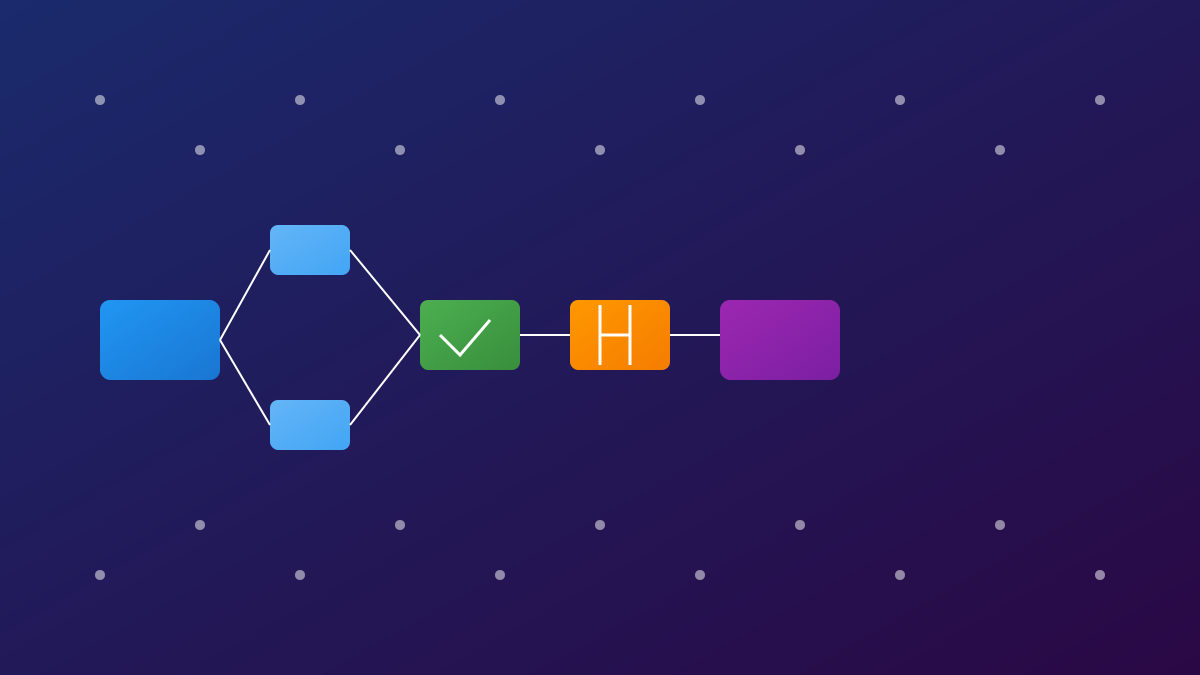
Includes planning phase (analyze tasks and formulate plans), execution phase (subagents execute), quality gates (checkpoints to ensure quality), and review phase (multi-dimensional code review).

Technical Architecture

  • Directory structure: .agents/skills/ (agent skill definitions), .codex/agents/ (subagent configurations), bin/ (executable scripts), etc.
  • Predefined subagents: Planning agent (task decomposition), Implementation agent (code writing), Testing agent (test generation), Review agent (code review), Refactoring agent (code refactoring).
4

Section 04

Evidence: Typical Workflow Application Examples

Scenario 1: Large-scale Refactoring Task

  1. Planning agent analyzes codebase and dependencies
  2. Refactoring agent performs refactoring
  3. Testing agent generates regression tests
  4. Review agent verifies quality
  5. Submit changes after passing quality gates

Scenario 2: Framework Migration

  1. Planning agent formulates migration roadmap
  2. Multiple implementation agents handle module migration in parallel
  3. Review agent verifies API compatibility
  4. Testing agent verifies functional integrity

Scenario 3: New Feature Development

  1. Planning agent designs solution and structure
  2. Implementation agent writes business logic and UI components
  3. Testing agent generates unit/integration tests
  4. Review agent conducts code review
5

Section 05

Conclusion: Practical Value and Core Significance of Codex Workflows

Practical Value

  • Predictability: Structured workflows make AI behavior more controllable and output quality guaranteed
  • Reviewability: Subagent outputs can be reviewed individually, enabling precise problem localization
  • Reusability: Standardized workflows can be reused across projects
  • Extensibility: Supports customization and addition of new subagents

Core Significance

Represents the evolutionary direction of AI-assisted programming—from single code generation to structured agent collaboration, integrating AI into professional development processes and allowing humans to focus on creative work.

6

Section 06

Recommendations and Outlook: Applicable Scenarios and Future Development Directions

Applicable Scenarios

Suitable for team projects, critical system development, legacy code refactoring, learning exploration, etc. For simple single-file modifications, it is recommended to use Codex CLI directly.

Future Outlook

  • Add professional agents (security audit, performance optimization, etc.)
  • Visual workflow orchestration tool
  • AI automatic scheduling of optimal workflow paths
  • Multi-developer and AI agent collaboration mode

