Zing Forum

Reading

Codex Parallel Sub-Agent Architecture: Practical Orchestration of GPT-5.4-Powered Data Analysis Workflows

The comext-analysis-codex project demonstrates how to build an efficient data analysis workflow using OpenAI Codex and GPT-5.4. The core highlight of this project lies in its adoption of a parallel sub-agent architecture, where the main agent focuses on task orchestration, result review, and final integration, thereby enabling automated and intelligent processing of complex data analysis tasks.

CodexGPT-5.4多代理架构数据分析工作流编排并行计算AI AgentCOMEXT
Published 2026-04-25 20:15Recent activity 2026-04-25 20:24Estimated read 5 min
Codex Parallel Sub-Agent Architecture: Practical Orchestration of GPT-5.4-Powered Data Analysis Workflows
1

Section 01

[Introduction] Codex Parallel Sub-Agent Architecture: Core Highlights of GPT-5.4-Powered Data Analysis Workflows

The comext-analysis-codex project demonstrates how to build an efficient data analysis workflow using OpenAI Codex and GPT-5.4. Its core innovation is the adoption of a "main agent-sub agent" layered architecture: the main agent is responsible for task orchestration, result review, and integration, while sub-agents process subtasks in parallel. This solves problems such as context limitations and insufficient reasoning depth of a single agent, enabling automated and intelligent processing of complex data analysis tasks.


2

Section 02

Project Background: Practical Needs for COMEXT Data Analysis

COMEXT is an official international trade database maintained by Eurostat, containing billions of trade records with multi-dimensional information, making it an important data source for international trade research. Traditional analysis faces pain points such as large data scale, complex dimensions, inconsistent code quality, and difficulty in result integration. The code generation and reasoning capabilities of large language models provide new ideas for automation, but the collaborative organization of multiple agents is a key technical challenge.

3

Section 03

Architecture Design: Division of Labor and Collaboration Between Main Agent and Sub-Agents

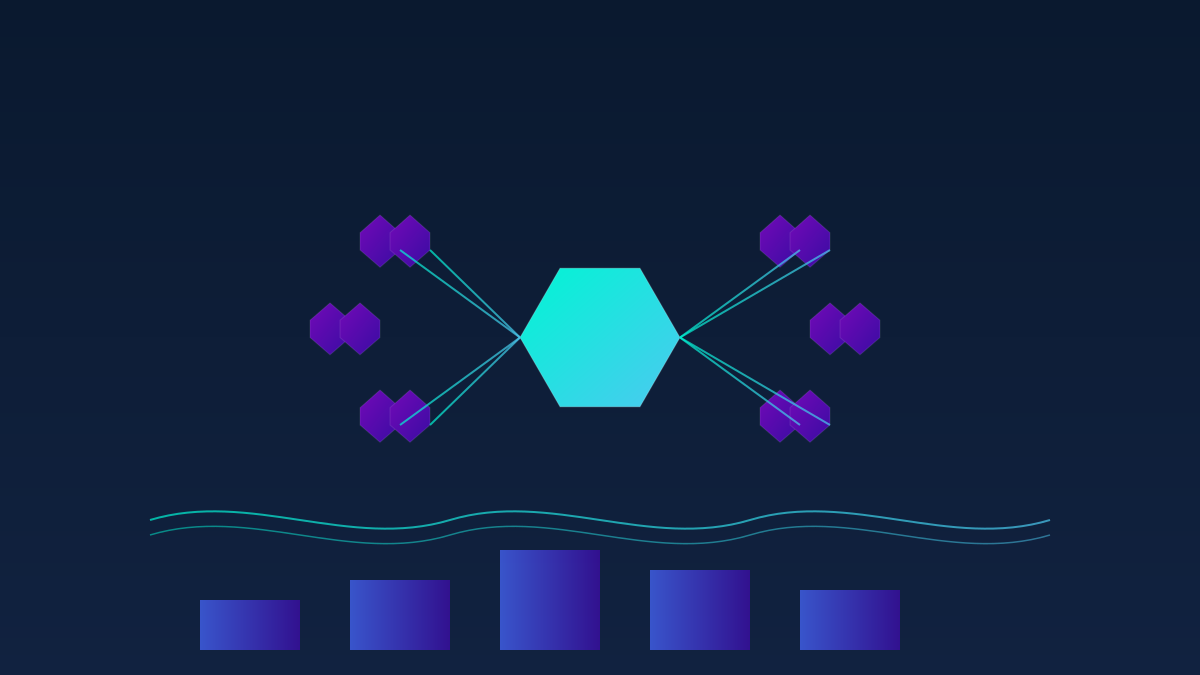
The architecture follows the principle of "separation of concerns", decomposing complex tasks into independent subtasks for parallel processing. The main agent's responsibilities include task decomposition and planning, sub-agent scheduling and orchestration, result review and quality control, and final integration and output. Sub-agents are specialized in areas such as data preprocessing, time-series analysis, spatial analysis, commodity analysis, and visualization, each focusing on specific tasks.

4

Section 04

Technical Implementation: Collaboration Between GPT-5.4 and Codex and Parallel Practice

GPT-5.4 enhances capabilities in deep code understanding, multi-step reasoning, and error diagnosis and repair; Codex efficiently generates standardized code, supporting multi-language and context awareness. Parallel execution addresses engineering issues such as state isolation and context management, result aggregation mechanisms, and error handling and retry strategies.

5

Section 05

Practical Value: Efficiency Improvement and Scenario Applications

Parallel processing significantly reduces the time for complex tasks (e.g., the time for a five-dimensional task is compressed to 1/5 of the original); main agent review ensures code quality and result reliability; it supports complex workflow management; the modular design of sub-agents is scalable and reusable, suitable for multi-dimensional analysis scenarios.

6

Section 06

Challenges and Optimization: Current Issues and Future Directions

Current challenges include communication overhead, state consistency, and error propagation. Future optimization directions: intelligent batch processing to reduce communication, caching to avoid repeated calculations, adaptive scheduling for task allocation, and human-machine collaboration at key nodes.

7

Section 07

Industry Insights: Data Analysis Field and Cross-Domain Promotion

Insights: AI is an enhancement rather than a replacement for humans; a reasonable architecture unleashes the potential of models; quality control is indispensable. This architecture can be promoted to fields such as financial risk control, medical data analysis, scientific research, and content production to coordinate multi-step tasks.

