Zing Forum

Reading

Codex Reconciler: AI Code Review and Reconciliation Workflow Under the Adversarial Collaboration Paradigm

This article introduces the codex-reconciler project, which innovatively adopts an adversarial-collaboration model to enable two AI coding agents—Claude Code and Codex—to review, debate, and reconcile each other's work, thereby improving code quality and decision transparency.

对抗协作AI代码审查Claude CodeCodex多代理系统代码质量可解释性自动化工作流
Published 2026-05-31 22:45Recent activity 2026-05-31 22:51Estimated read 8 min
Codex Reconciler: AI Code Review and Reconciliation Workflow Under the Adversarial Collaboration Paradigm
1

Section 01

【Main Thread Guide】Codex Reconciler: Core Introduction to the Adversarial Collaboration AI Code Review Project

Project Core

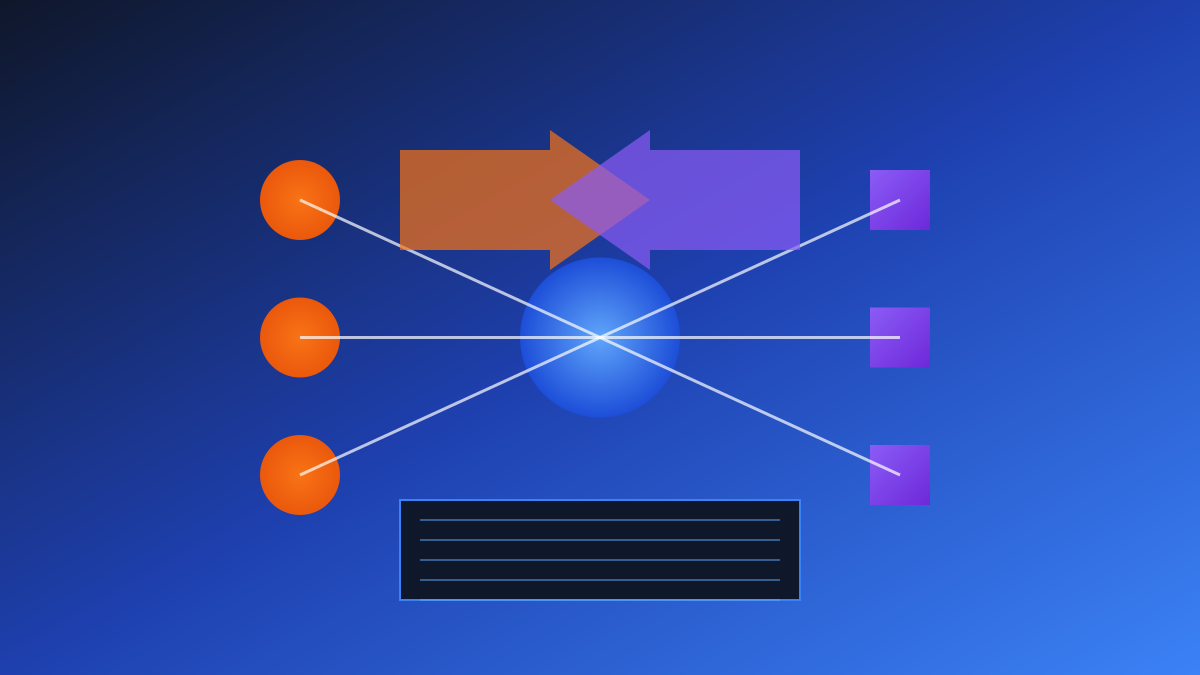
The codex-reconciler project innovatively adopts an adversarial collaboration model, allowing two AI coding agents—Claude Code and Codex—to review, debate, and reconcile each other's work to improve code quality and decision transparency.

Project Origin

Problem Solved

It provides an automated solution to address the limitations of single AI agents (such as hallucinations and biases) and the challenge that manual reviews struggle to keep up with the growing scale of AI-generated code.


2

Section 02

Background: Limitations of Single AI Agents and the Proposal of Adversarial Collaboration

Large language models excel at code generation, but single AI agents have inherent limitations such as model hallucinations, biases, and rigid training data patterns, which can easily lead to potential code issues.

Traditional manual code reviews rely on human effort, but the scale and speed of AI-generated code are growing rapidly, making pure manual reviews hard to keep up with demand.

This leads to the idea: let multiple different AI systems review and debate each other, and improve the final output quality through adversarial collaboration—this is the core concept of codex-reconciler.

3

Section 03

Adversarial Collaboration Paradigm and Dual-Agent Architecture

Definition of Adversarial Collaboration

Adversarial Collaboration originates from cognitive science, referring to researchers with different views jointly designing experiments, analyzing data, and approaching the truth through constructive confrontation. This project introduces it to the field of AI code review.

Dual-Agent Architecture

The system includes two core AI agents:

  • Claude Code: Developed by Anthropic, known for long-context understanding and safety alignment
  • Codex: Developed by OpenAI, excels in code completion and generation

The two agents come from different teams, are based on different training data, and their differences in style and design preferences form the foundation for adversarial collaboration.

4

Section 04

Workflow: Independent Generation → Adversarial Review → Reconciliation & Integration

The project defines a three-stage structured workflow:

  1. Independent Generation: Given the same task description, Claude Code and Codex generate code independently to ensure output independence.

  2. Adversarial Review: The two agents review each other's code, covering:

    • Correctness (logical errors, boundary handling)
    • Style (language idioms, naming conventions)
    • Design quality (architectural rationality, SOLID principles)
    • Security (vulnerability risks)
    • Performance (algorithm complexity, resource efficiency)
  3. Reconciliation & Integration: The two agents reach a consensus on review comments and integrate best practices to generate the final code; if consensus cannot be reached, controversial points are marked for human adjudication.

5

Section 05

Technical Implementation: Structured Debate and Iterative Convergence

Structured Debate Protocol

Agents communicate following a fixed format:

  • Claim: Clearly state the problem or suggestion
  • Evidence: Specific code snippets or reference materials
  • Reasoning: Explain the necessity of the problem
  • Suggestion: Specific improvement plan

Iterative Convergence Mechanism

Convergence conditions are set: terminate when there is no reduction in controversial points for consecutive rounds, or when the maximum number of iterations is reached; the final output is determined based on confidence and consensus.

Human Intervention Points

  • Request human adjudication when disputes cannot be resolved
  • Mandatory manual confirmation for high-risk changes
  • Regular manual audits to evaluate effectiveness and adjust parameters
6

Section 06

Value Advantages and Application Scenarios

Value Advantages

  • Improved code quality: Cross-review identifies boundary cases and bugs ignored by single agents; studies show it can improve test pass rates and security
  • Enhanced interpretability: Intermediate outputs (review comments, debate records) provide clues for humans to understand AI decisions
  • Discovery of model blind spots: Disagreements reveal model knowledge gaps or biases, guiding model improvements

Application Scenarios

  • Critical system code (finance, healthcare)
  • Security-sensitive code (privacy, payment)
  • Complex algorithm implementation
  • Large-scale code refactoring
7

Section 07

Limitations, Challenges, and Future Outlook

Limitations and Challenges

  • Computational cost: Dual agents + multiple iterations lead to high API call costs
  • Consensus dilemma: Agents may get stuck in deadlocks; need to optimize convergence mechanisms
  • Model homogenization: Overlapping training data reduces adversarial effects; need to introduce diverse models

Future Outlook

  • Expand to multi-agent collaboration
  • Apply to tasks such as document writing and test case generation

Summary

The project opens up a new direction for AI-assisted software development through the adversarial collaboration paradigm. Despite challenges, it has reference value for teams pursuing code quality and interpretability.

