Zing Forum

Reading

Codex Team Orchestration Toolkit: A Workflow Management Solution for Multi-Agent Parallel Programming

Introduces a team orchestration toolkit designed specifically for Codex AI, enabling efficient collaboration in multi-agent parallel programming tasks through shared kanban boards, strict file control, and reusable prompts.

Codex多智能体并行编程工作流编排团队协作AI编程看板管理
Published 2026-04-05 03:44Recent activity 2026-04-05 03:55Estimated read 6 min
Codex Team Orchestration Toolkit: A Workflow Management Solution for Multi-Agent Parallel Programming
1

Section 01

Codex Team Orchestration Toolkit: Guide to Multi-Agent Parallel Programming Collaboration Solution

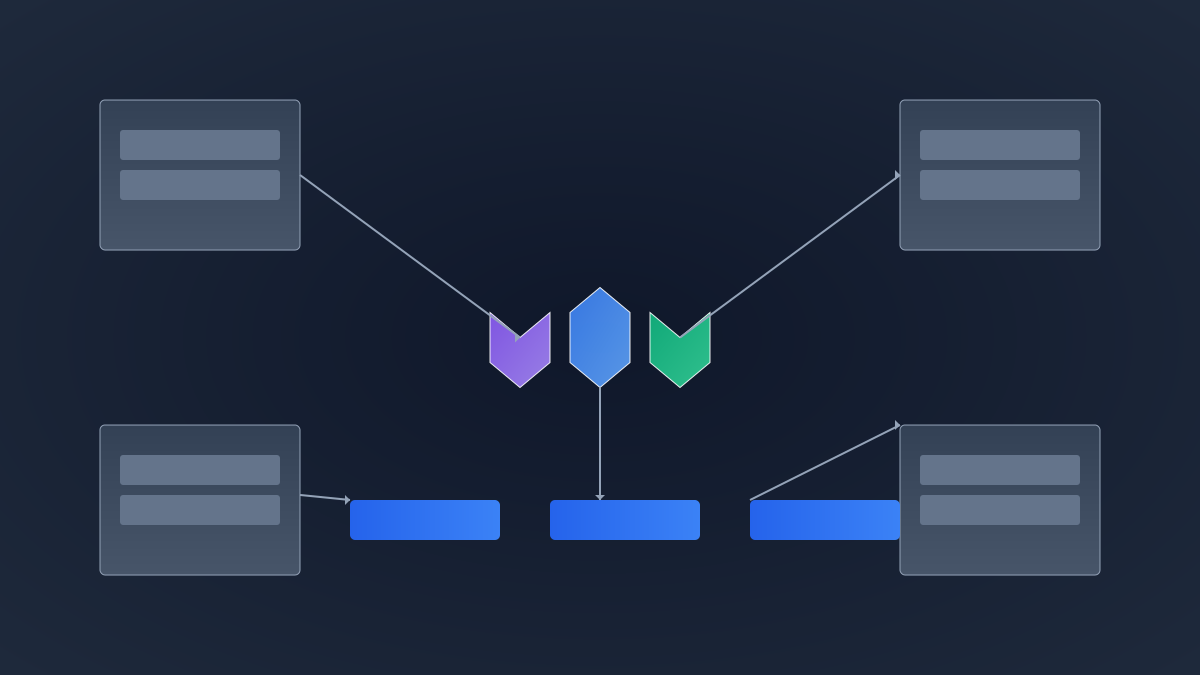
Introduces the open-source project codex-team-orchestrator-kit, designed specifically for Codex AI, aiming to address the limitations of a single Codex agent when handling complex projects (e.g., context constraints, task switching costs, etc.). Through three core components—shared kanban boards, strict file control, and reusable prompts—it enables efficient collaboration in multi-agent parallel programming tasks, providing a structured collaboration framework for AI programming teams.


2

Section 02

Background: Limitations of Single Agents and the Necessity of Multi-Agent Collaboration

Limitations of Single Agents

A single Codex session faces challenges such as context constraints (exceeding the model's processing window), high task switching costs, insufficient specialization (difficulty covering multiple domains), and lack of parallelism.

Advantages of Multi-Agent Collaboration

Breaking down large projects into subtasks handled in parallel by specialized agents can improve focus, parallelism, scalability, and maintainability, but it also brings coordination challenges—this is exactly where the orchestration toolkit adds value.

3

Section 03

Methodology: Core Components and Workflow Design

Core Components

  1. Shared Kanban Board: Visualizes task statuses (Backlog/To Do/In Progress/Review/Done), enabling status synchronization, workflow, and priority management.
  2. Strict File Control: Provides mechanisms for file locking, change tracking, access control, version management, and conflict resolution.
  3. Reusable Prompts: Includes template libraries, variable substitution, context injection, version management, and support for A/B testing.

Workflow

  1. Requirement Analysis → Task Creation → Agent Assignment → Parallel Execution → Progress Synchronization → Integration Verification
  2. Parallel Strategies: By module, by layer, by task type, master-slave mode, etc.
4

Section 04

Evidence: Typical Use Case Examples

Full-Stack Application Development

Multiple agents handle database/API, front-end UI, and integration testing/deployment respectively, with progress tracked via the kanban board.

Code Refactoring Project

Modules are divided and refactored by different agents; file control prevents conflicts, and integration verification is done incrementally.

Multi-Language Project

Agents specialized in different languages collaborate, with standardized interface interactions and unified kanban management.

5

Section 05

Recommendations: Best Practices for Multi-Agent Collaboration

Task Granularity Control

Tasks should take 15-30 minutes to complete; avoid tasks that are too large (causing blockages) or too small (high coordination overhead).

Dependency Management

Clearly define dependencies, avoid circular dependencies, and prioritize critical path tasks.

Communication Standards

Standardize status update formats, clarify handover content, and document decision assumptions.

Quality Gates

Set up checkpoints such as code style checks, static analysis, unit testing, and integration testing.

6

Section 06

Conclusion: Limitations, Future Directions, and Summary

Limitations and Challenges

Coordination overhead (task assignment/synchronization/conflict resolution), context fragmentation (local optimality issues), and tool ecosystem dependencies (Codex API limitations).

Future Directions

Intelligent coordination (automatic task assignment/load balancing), enhanced visualization (real-time views/heatmaps), and integration expansion (support for more AI programming assistants).

Summary

This toolkit is an important step in the evolution of AI-assisted programming toward team collaboration, providing an orderly and controllable multi-agent collaboration model for complex projects. It will become even more important as AI capabilities continue to advance.

