Zing Forum

Reading

Coder Agent: A New Paradigm for AI Programming Assistants Based on Kanban Workflow

Coder Agent is an innovative AI programming agent framework that transforms any LLM CLI into a disciplined software development assistant. Through kanban-driven task management, an AI-optimized memory system, and a human-AI collaborative review mechanism, it addresses the issues of traditional AI programming tools lacking contextual memory and version traceability.

AI编程LLM CLI看板工作流项目管理代码生成知识图谱人机协作Obsidian
Published 2026-04-12 18:45Recent activity 2026-04-12 18:49Estimated read 5 min
Coder Agent: A New Paradigm for AI Programming Assistants Based on Kanban Workflow
1

Section 01

Coder Agent: An Innovative AI Programming Assistant Paradigm (Introduction)

Coder Agent is an innovative AI programming agent framework that transforms any LLM CLI into a disciplined software development assistant. It addresses the core pain points of traditional AI programming tools—lack of persistent context memory and version traceability—through three key mechanisms: kanban-driven task management, AI-optimized memory system, and human-AI collaborative review. This framework represents a shift from simple code generation tools to collaborative partners with full project understanding and memory capabilities.


2

Section 02

Background: Pain Points of Traditional AI Programming Tools

Current AI programming tools (e.g., GitHub Copilot, Claude Code, Gemini CLI) can generate code from natural language but lack persistent context memory and project-level understanding. When dialogue windows close or tasks switch, previous architecture decisions, technical selections, and code logic relationships are lost. Developers have to repeatedly explain project backgrounds, leading to low efficiency and inconsistent code. Coder Agent solves this problem as a set of agent instruction systems enabling any LLM CLI to have persistent memory and strict workflow.

3

Section 03

Core Design: Zero-Infrastructure Markdown-Driven Architecture

Coder Agent uses a zero-infrastructure design (no servers/databases, only Markdown files and LLM CLI). Advantages include portability/privacy (local Markdown storage, full data control) and seamless integration with tools like Obsidian. Its AI-first philosophy optimizes Markdown files for LLM consumption via semantic compression, layered loading, and domain separation.

4

Section 04

Kanban-Driven Workflow: Human-AI Collaboration Lifecycle

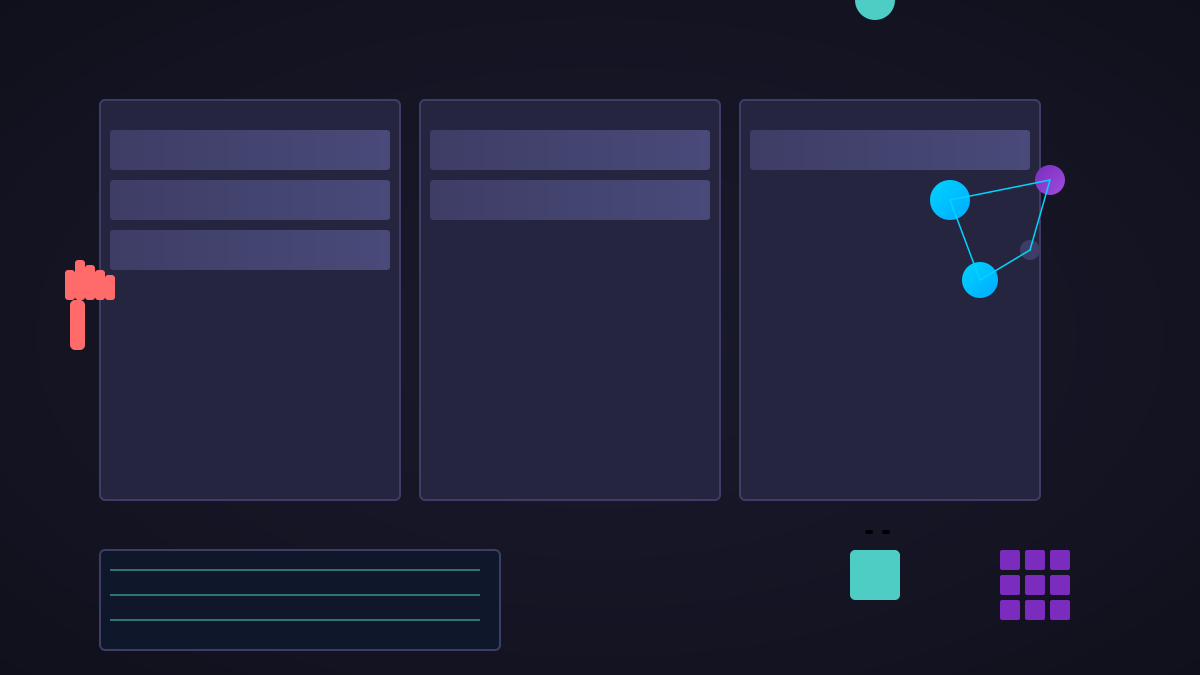
The workflow has six stages: BACKLOG (to-do), PLAN (detailed implementation plans), REVIEW (human feedback on AI plans), EXECUTION (code writing), TESTING (developer validation), DONE (archiving). Mandatory human review before execution improves code quality and establishes a decision traceability chain with clear responsibilities and time records.

5

Section 05

AI-Optimized Memory System: Knowledge Graph & Traceable Structure

The memory system includes knowledge graphs (component dependencies), versioned architecture decisions, tech stack docs, and feature-requirement mapping. Each task uses a six-section Markdown structure: USER PROMPT, SECTION INDEX, INSTRUCTIONS, PLANNING (versioned), EXECUTION (versioned), BUG FIX (versioned) for completeness and traceability.

6

Section 06

Key Features: Bug Detection & CLI Compatibility

Bug Detection: Matches reported issues to existing tasks to avoid context fragmentation. CLI Compatibility: Works with any LLM CLI via 'Coder' prefix commands (e.g., 'Coder create task', 'Coder plan') to avoid conflicts with LLM capabilities.

7

Section 07

Application Scenarios & Practical Value

Suitable for: long-term maintenance projects (accumulates knowledge for new devs), multi-person collaboration (consistent code quality), complex refactoring (identifies dependency risks), compliance projects (audit logs meet traceability requirements).

8

Section 08

Limitations & Future Outlook

Limitations: No real-time distributed collaboration; AI-optimized memory format is not human-friendly. Future Directions: Git integration (auto-sync code and knowledge graphs), visualization interfaces, concept-based semantic retrieval.

