Zing Forum

Reading

CodeMind: Enterprise-Grade AI-Native IDE and Autonomous Engineering Agent

This article introduces the CodeMind project, an enterprise-grade AI-native integrated development environment (IDE). Driven by large language models (LLMs) and machine learning technologies, it operates as an autonomous engineering agent that can proactively analyze code logic, execute tests, and fix vulnerabilities in real time, thereby significantly accelerating the development workflow.

CodeMindAI原生IDE自主工程智能体企业级开发代码分析漏洞修复大语言模型开发自动化
Published 2026-05-23 05:22Recent activity 2026-05-23 05:26Estimated read 5 min
CodeMind: Enterprise-Grade AI-Native IDE and Autonomous Engineering Agent
1

Section 01

CodeMind: Introduction to the Enterprise-Grade AI-Native IDE and Autonomous Engineering Agent

CodeMind is an enterprise-grade AI-native integrated development environment (IDE) driven by large language models (LLMs) and machine learning technologies, operating as an autonomous engineering agent. It can proactively analyze code logic, execute tests, and fix vulnerabilities in real time, significantly accelerating the development workflow. This article will detail the project from aspects such as background, technical architecture, core capabilities, and application scenarios.


2

Section 02

Background and Project Overview of CodeMind

Integrated Development Environments (IDEs) have evolved from simple editors to feature-rich platforms, and AI technology is driving their transformation into autonomous agents. Created by developer vivek3770, CodeMind is an AI-native IDE for enterprise applications. Unlike traditional IDEs that offer auxiliary functions, it acts as an autonomous engineering agent to proactively understand code, execute tests, and fix vulnerabilities, achieving comprehensive acceleration of the development process.

3

Section 03

Core Positioning and Technical Architecture of CodeMind

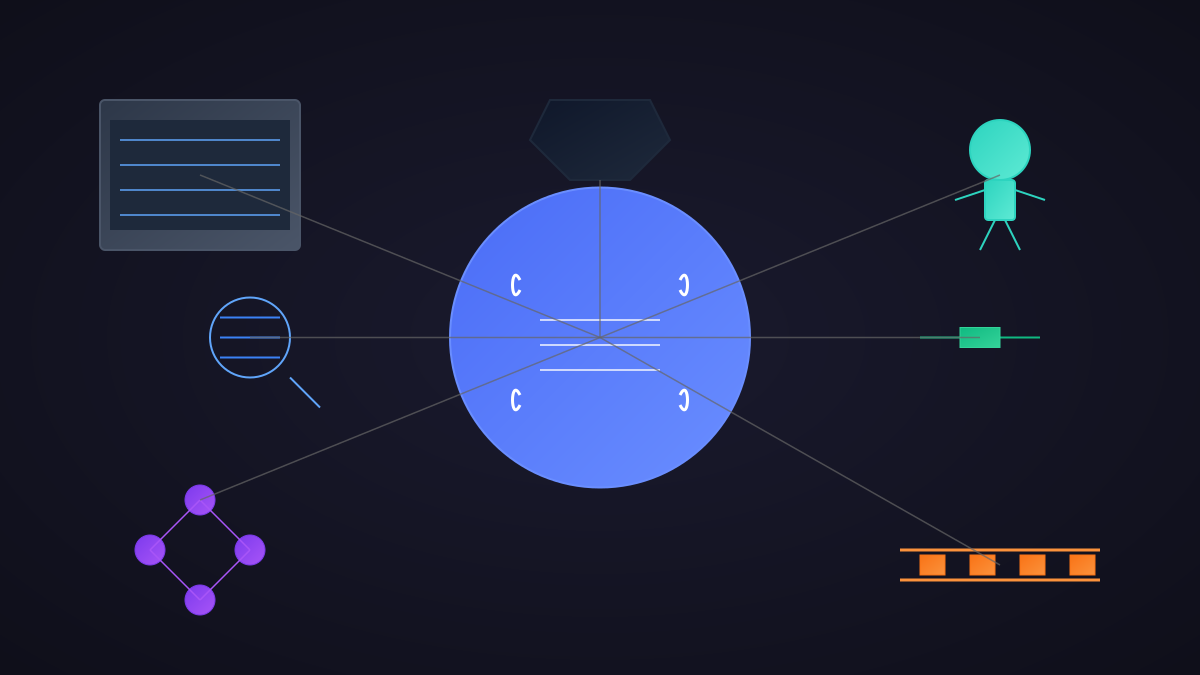
Core positioning includes: AI-native architecture (AI as the core driver rather than a plugin), autonomous engineering agent (proactively analyzing problems and executing fixes), and enterprise-grade design (considering security compliance, scalability, etc.). The technical architecture is divided into: model layer (supporting multiple LLMs), analysis engine (incremental code analysis), execution environment (sandbox isolation), and knowledge base (storing project information and best practices).

4

Section 04

Core Technical Capabilities and Functional Features of CodeMind

Core technical capabilities include: LLM-driven (code understanding and reasoning), proactive code analysis (background scanning for issues), automated test execution (automatically running tests and locating failures), real-time vulnerability repair (identifying and fixing security issues), and workflow acceleration. Functional features include: intelligent code completion and generation, context-aware refactoring, intelligent debugging assistance, automated code review, and document generation and synchronization.

5

Section 05

Enterprise-Grade Features and Application Scenarios of CodeMind

Enterprise-grade features cover: security compliance (code security scanning, compliance checks), team collaboration support (code style consistency, shared knowledge base), scalable architecture (integration with internal tools), and audit and tracking (key operation logs). Application scenarios include: enterprise development teams, code modernization projects, security-sensitive applications, and rapid prototyping.

6

Section 06

Comparison with Existing Tools and Future Development Directions of CodeMind

Comparison with existing tools: traditional IDEs (AI as an additional feature), AI programming assistants (plugin form), AI engineers like Devin (balancing autonomy and developer leadership). Future directions include: multi-agent collaboration, domain-specific optimization, and natural language programming.

7

Section 07

Conclusion and Summary of CodeMind

CodeMind represents the evolution direction of IDEs from passive tools to active agents. By deeply integrating LLMs with enterprise-grade design, it provides a new paradigm for modern software development. With the advancement of AI, AI-native IDEs are expected to become industry standards, redefining the way developers interact with code.

