Zing Forum

Reading

Codeksei: A Local-First Personal Life Assistant Agent Bridge Layer

A local-first life assistant Agent Bridge that integrates WeChat, Codex runtime, timeline, diary, review, and persistent notes into a single sustainable personal workflow, enabling AI assistants to truly become long-term collaborative partners.

本地优先Agent微信Codex时间线日记复盘个人助理工作流开源
Published 2026-04-11 19:46Recent activity 2026-04-11 19:49Estimated read 7 min
Codeksei: A Local-First Personal Life Assistant Agent Bridge Layer
1

Section 01

Codeksei: A Local-First Personal Life Assistant Agent Bridge Layer (Introduction)

Codeksei is a local-first personal life assistant bridge layer that integrates WeChat, Codex runtime, timeline, diary, review, and persistent notes into a sustainable personal workflow. Its core value is to enable AI assistants to become long-term collaborative partners, with the ability to continuously remember conversation threads, maintain context state, and seamlessly resume interactions after the user disconnects.


2

Section 02

Background: Pain Points of Current AI Applications and Codeksei's Core Philosophy

In the current AI application ecosystem, most products rely on cloud-based SaaS services or are just prompt-driven chat shells, lacking continuity and deep personalization. Codeksei proposes a local-first approach with core principles: 'One Thread, One State, Seamless Resumption', aiming to be a long-term collaboration foundation rather than a one-time Q&A tool.

3

Section 03

Core Architecture and Module Design

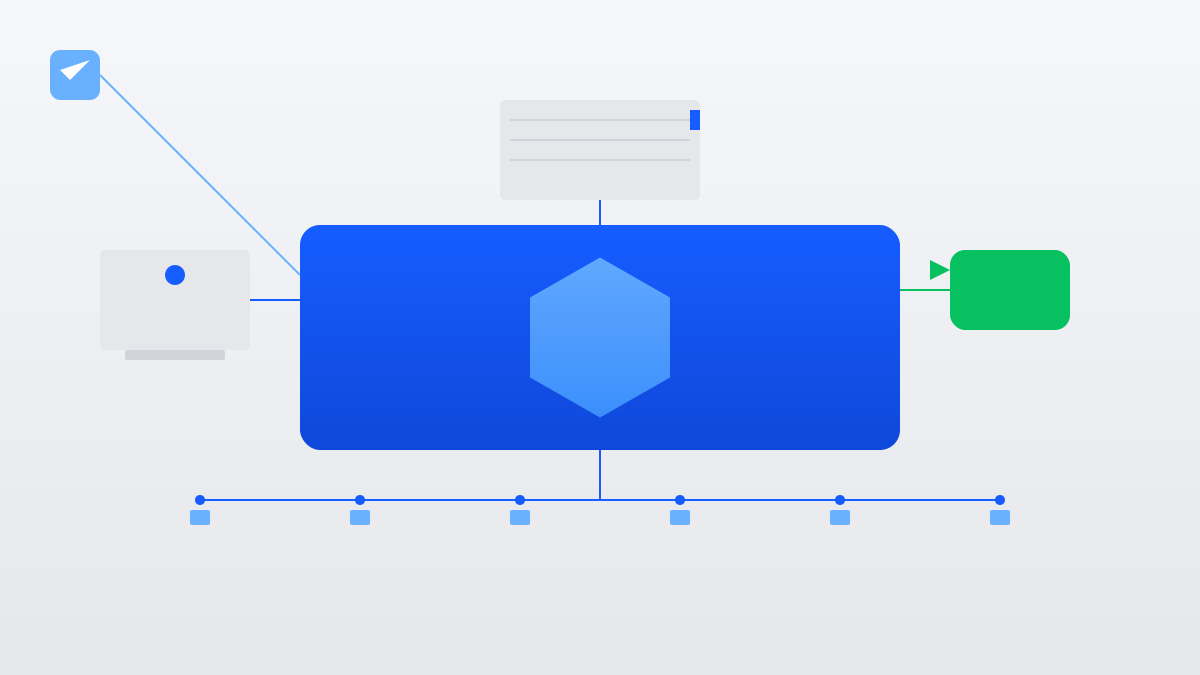
Codeksei is built around several core modules:

  1. WeChat Bridge Layer: Main interaction entry, supports cross-device thread sharing, streaming responses, and authorized user control;
  2. Codex Runtime Integration: Provides shared servers, thread binding, and approval flow control (e.g., /yes/no to confirm key operations);
  3. Timeline Management: Based on the timeline-for-agent project, supports event recording, querying, and local storage;
  4. Diary System: Automatically integrates scattered information into structured diaries, suitable for users needing executive function support (e.g., ADHD);
  5. Review Mechanism: Generates structured reports on nightly/weekly/monthly cycles;
  6. Persistent Notes: Managed in three categories: auto/maybe/sync;
  7. Workspace Continuity: Supports multi-workspace switching and context maintenance.
4

Section 04

Local-First Data Philosophy

Codeksei adheres to local-first storage; all data (accounts, sessions, diaries, timelines, etc.) is stored in the user's local file system by default. Advantages include:

  • Privacy protection: Sensitive information is not uploaded to the cloud;
  • Data control: Users can view, modify, back up, or delete data at any time;
  • Long-term availability: Does not rely on external service operations;
  • Customizability: Advanced users can directly operate underlying files.
5

Section 05

Usage Modes and Configuration

Usage Methods:

  • Regular users: Quick installation via npm install -g codeksei;
  • Advanced custom users: Clone the repository for local modification and debugging. Configuration: Uses environment variables prefixed with CODEKSEI_* (compatible with CYBERBOSS_*), key items include authorized user list, workspace root directory, diary storage directory, etc. Background Running: Install system service via npm run background:install to enable auto-start and self-healing after sleep/unlock.
6

Section 06

Target Users and Scenarios

Target Users:

  • Users who prefer WeChat as their main interaction entry;
  • Users needing AI to remember thread states, timelines, and unfinished tasks;
  • Users who value local data control and auditability;
  • Users with ADHD or executive function challenges who need seamless resumption capabilities. Typical Scenarios: Daily activity tracking, project progress management and review, personal knowledge management, long-term goal decomposition and follow-up.
7

Section 07

Open Source License and Community

Codeksei is open-sourced under the AGPL-3.0-only license. If modified and used to provide network services, the complete source code must be made available to users. The project originated from the original cyberboss implementation but has undergone extensive modifications (e.g., shared bridge lifecycle, workspace continuity, etc.). Please refer to this repository's documentation and code for usage.

8

Section 08

Conclusion

Codeksei represents an AI application paradigm focusing on depth, continuity, and user control. Through its local-first architecture, natural WeChat interaction entry, and complete workflow modules, it aims to make AI assistants truly integrate into users' lives. For users seeking a long-term companion AI experience, it is a solution worth exploring.

