Zing Forum

Reading

Hybrid Machine Learning Architecture for Galaxy Morphology Classification: Multimodal Fusion of CNN and Random Forest

This article introduces a hybrid architecture combining Convolutional Neural Networks (CNN) and Random Forest for galaxy morphology classification tasks. It improves classification accuracy through multimodal data fusion, providing an efficient automated tool for astrophysics research.

星系形态分类卷积神经网络随机森林多模态学习天文学机器学习深度学习天体物理
Published 2026-06-08 09:16Recent activity 2026-06-08 09:29Estimated read 7 min
Hybrid Machine Learning Architecture for Galaxy Morphology Classification: Multimodal Fusion of CNN and Random Forest
1

Section 01

Introduction: Hybrid Machine Learning Architecture Aids Galaxy Morphology Classification

This article introduces the hybrid machine learning architecture for galaxy morphology classification developed by eva10samuel-dot (Project source: github, original title: galaxy-morphology-ml, release date: 2026-06-08). This architecture combines Convolutional Neural Networks (CNN) and Random Forest, improving classification accuracy through multimodal data fusion. It aims to solve the problem of automated classification of massive galaxy images generated by modern sky survey projects (such as SDSS, DES), providing an efficient tool for astrophysics research. The core idea is to leverage the visual feature extraction capability of CNN and the advantages of Random Forest in processing structured data and strong interpretability to form a complement.


2

Section 02

Background: Scientific Needs and Challenges of Galaxy Morphology Classification

Galaxy morphology contains physical information such as formation history and evolutionary stages. Traditional manual visual classification is accurate but inefficient, unable to handle hundreds of millions of sky survey data. Deep learning (such as CNN) performs well in astronomical image analysis, but faces challenges like data diversity (resolution, redshift differences), morphological complexity (mergers, special structures), label scarcity, and class imbalance.

3

Section 03

Methodology: Design and Technical Implementation of the Hybrid Architecture

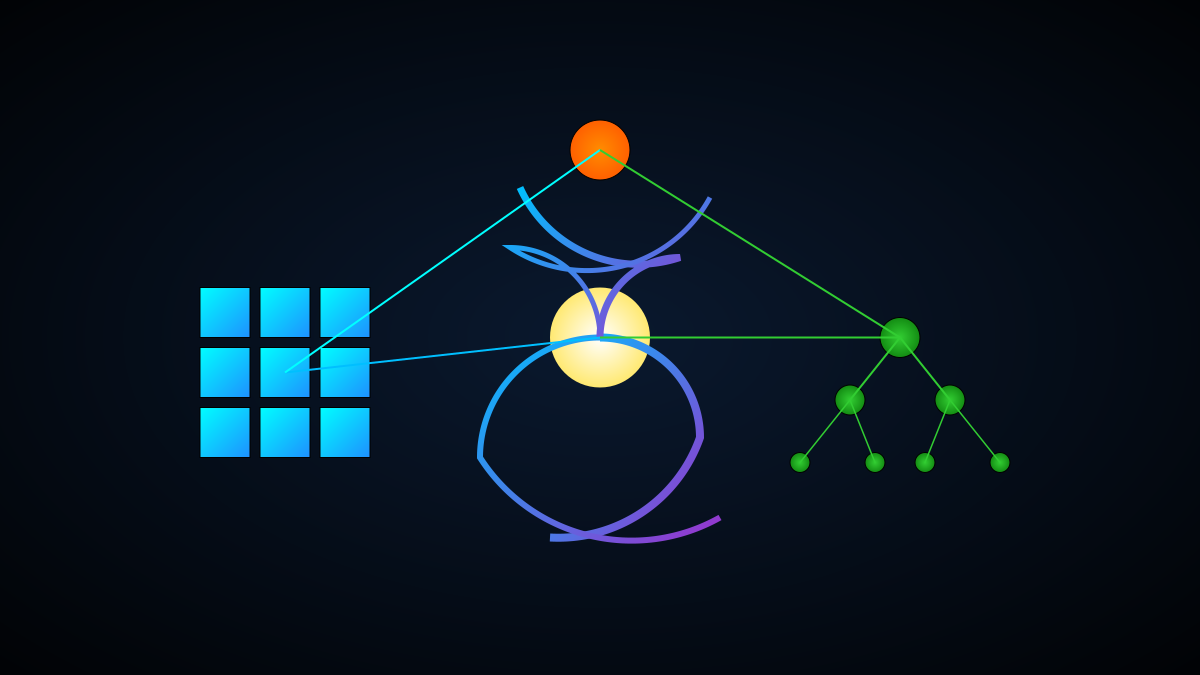
  • Multimodal Input: Integrate images (g/r/i bands), physical parameters (brightness, redshift, etc.), and metadata (observation conditions);
  • CNN Feature Extraction: Use classic or astronomy-specific networks (e.g., AstroNet) to extract visual features through transfer learning and data augmentation;
  • Random Forest Fusion: Concatenate CNN features with physical parameters, output classification results via ensemble learning, supporting probability output and feature importance analysis.
4

Section 04

Training and Optimization: Phased Strategy and Class Imbalance Handling

  • Phased Training: First train CNN alone to extract visual features, then train Random Forest combined with physical parameters, with optional end-to-end fine-tuning;
  • Class Imbalance Handling: Adopt strategies like resampling, class weights, focal loss, SMOTE, etc.;
  • Hyperparameter Optimization: Adjust parameters of CNN (learning rate, batch size) and Random Forest (number of trees, depth) via grid search and Bayesian optimization.
5

Section 05

Performance Evaluation: Metrics and Benchmark Comparison

Evaluation metrics include accuracy, precision/recall/F1, confusion matrix, ROC-AUC, and Cohen's Kappa. The model will be compared with pure CNN (e.g., Galaxy Zoo CNN), pure machine learning (SVM, XGBoost), and other hybrid methods, and validated against Galaxy Zoo crowdsourced annotation data for consistency with experts.

6

Section 06

Application Scenarios: Scientific Value and Practical Applications

  • Large-scale Sky Survey Processing: Real-time classification of newly observed galaxies, support for data release, and discovery of rare morphologies;
  • Scientific Research: Assist in studies of galaxy evolution, environmental effects, merger history, and dark matter distribution;
  • Citizen Science: Prioritize complex cases for volunteers, quality check mislabels, and improve efficiency.
7

Section 07

Limitations and Future Improvement Directions

Current limitations: Dependence on training data quality, morphological distortion of high-redshift galaxies, insufficient samples of rare categories, and weak interpretability of CNN. Future directions: Self-supervised learning (reduce annotation dependence), multi-task learning (joint prediction of multiple attributes), attention mechanisms (focus on key regions), integration of physical constraints, and uncertainty quantification.

8

Section 08

Open Source Value and Summary Outlook

The open-source project supports reproducibility, community collaborative improvement (new architectures, data preprocessing), and educational value (case study of machine learning in astronomy applications). This architecture provides an efficient solution for large-scale galaxy classification, and can be extended to astronomical tasks such as star classification and supernova identification in the future, helping to explore the mysteries of the universe.

