Zing Forum

Reading

Clinical Workflow Assistant: An AI Assistant for Converting Clinical Notes into Structured Intelligent Reports

This article introduces the Clinical Workflow Assistant project, an AI assistant for clinical workflows based on FastAPI and Groq LLM, which can automatically extract key medical information from unstructured clinical notes and generate structured reports.

医疗AI临床工作流自然语言处理FastAPIGroq信息抽取电子病历智能助手
Published 2026-05-02 15:13Recent activity 2026-05-02 15:17Estimated read 4 min
Clinical Workflow Assistant: An AI Assistant for Converting Clinical Notes into Structured Intelligent Reports
1

Section 01

[Introduction] Clinical Workflow Assistant: AI-Powered Generation of Structured Intelligent Reports from Clinical Notes

This article introduces the Clinical Workflow Assistant project based on FastAPI and Groq LLM. This AI assistant can automatically extract key medical information from unstructured clinical notes and generate structured intelligent reports, aiming to address pain points in medical document processing and improve clinical efficiency.


2

Section 02

Pain Points and Opportunities in Clinical Document Processing

In the medical industry, massive clinical notes exist in free text form, leading to problems such as data silos, difficult retrieval, and insufficient decision support. Traditional manual entry is time-consuming and labor-intensive (doctors spend 35% of their working time on document processing) and prone to errors. AI technology converting unstructured text into structured data has become an important research direction.

3

Section 03

Technical Architecture of Clinical Workflow Assistant

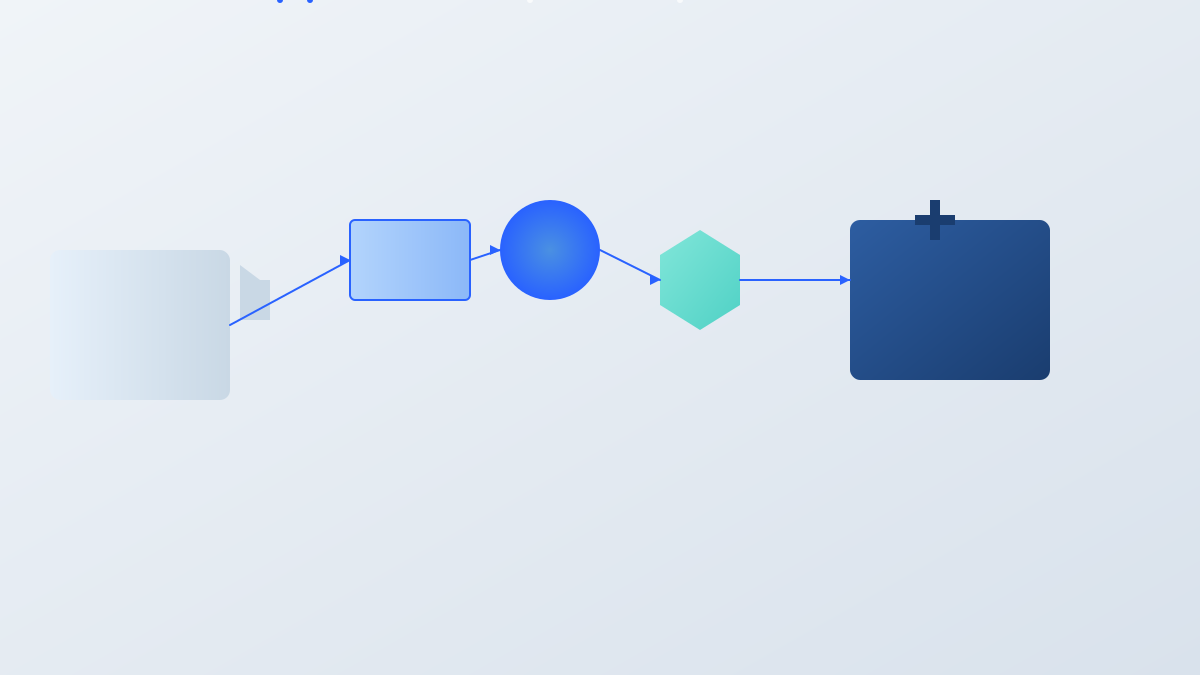
The project uses FastAPI to build an asynchronous API service and integrates Groq LLM capabilities. Its core is a three-stage processing pipeline: 1. Information Extraction: Identify six categories of entities such as symptoms, diagnoses, and medications; 2. Structured Reorganization: Organize discrete information into a standardized format (supports human-readable reports and JSON); 3. Intelligent Recommendation Generation: Provide auxiliary decisions such as differential diagnosis and recommended tests based on extracted information.

4

Section 04

Technical Advantages of Groq and FastAPI

Groq was chosen for its real-time low latency (tensor flow processor architecture) and support for open-source models (flexible customization and controllable data privacy); FastAPI's advantages lie in high-performance asynchronous processing, automatic document generation, and type validation, simplifying development and maintenance.

5

Section 05

Practical Application Value and Multi-Scenario Empowerment

For doctors: Reduce document processing time and focus on diagnosis and treatment; For managers: Structured data supports quality monitoring and resource allocation; For scientific research: Batch extraction of research variables to accelerate retrospective studies; For education: Serve as a learning example to help understand clinical norms.

6

Section 06

Open-Source Ecosystem and Future Development Directions

The project is released as open-source, and the community can extend it (e.g., integrate knowledge graphs, connect to HIS systems). Future directions: Deep integration with electronic medical records, specialty-specific models, multi-modal processing, and feedback-optimized models. The ultimate goal is to become a capable assistant for doctors, enabling technology to serve clinical practice and patients.

