Zing Forum

Reading

Claude Multi-Agent Research System: A Parallel Execution and Audit-Driven Structured Research Tool

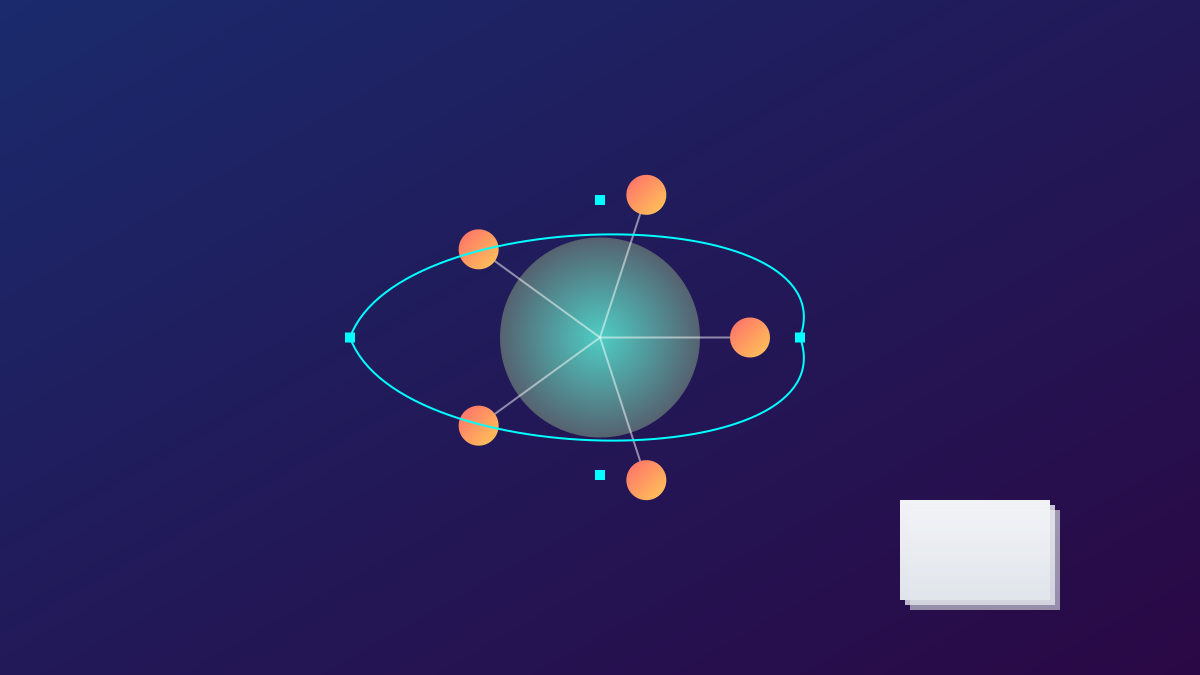
Claude Multi-Agent Research System is a multi-agent research system inspired by the Anthropic Claude Agent SDK, supporting parallel execution, audit tracking, and structured research. It provides a user-friendly interface, enabling non-programmers to easily orchestrate multiple AI agents to collaborate on complex research tasks.

多AgentClaude研究工具并行执行审计追踪AI辅助研究结构化调研文献综述竞品分析
Published 2026-04-13 20:45Recent activity 2026-04-13 20:54Estimated read 10 min
Claude Multi-Agent Research System: A Parallel Execution and Audit-Driven Structured Research Tool
1

Section 01

Claude Multi-Agent Research System: Guide to Parallel and Audit-Driven Structured Research Tool

Claude Multi-Agent Research System is a multi-agent research system inspired by the Anthropic Claude Agent SDK, with core features including parallel execution, audit tracking, and structured research. It offers a user-friendly UI, allowing non-programmers to easily orchestrate multiple AI agents to collaborate on complex research tasks. It is suitable for scenarios such as academic literature reviews, market competitor analysis, consulting industry research, and in-depth news investigations, aiming to improve research efficiency, ensure result reliability, and lower the barrier to using AI tools.


2

Section 02

Background: Demand for Intelligent Transformation of Research Work

In the era of information explosion, traditional research faces challenges such as massive data screening and multi-source cross-validation. Relying on a single researcher has limited efficiency and is prone to cognitive biases. Single AI models have limitations like context length, knowledge cutoff, and hallucinations. Thus, multi-agent collaboration architectures emerged—through specialized agents working in parallel and validating each other, more efficient and reliable research outputs are achieved. This system is a practical platform built on this concept.

3

Section 03

System Overview and Core Functions

Design Goals

  • Reduce usage threshold: Graphic UI supports non-programmers
  • Parallel execution: Multiple agents work simultaneously to shorten cycles
  • Auditability: Complete recording of research processes
  • Structured research: Guide systematic workflows

Core Features

  • Zero-code UI: No programming required for creating projects, defining agent roles, monitoring progress, exporting reports, etc.
  • Multi-agent collaboration: Supports roles like data collection, analysis, verification, writing, review; collaboration modes include serial, parallel, iterative, conditional branching
  • Parallel execution example: Traditional serial competitor analysis takes 4 hours, while multi-agent parallel takes only 1.5 hours (3 collection agents in parallel +1 analysis agent)

Applicable Scenarios

Academic research, market analysis, consulting planning, product user research, news investigation, etc.

4

Section 04

Audit Tracking: Visualization and Verifiability of Research Processes

The system completely records the research process to ensure auditability and reproducibility:

  • Execution logs: Agent start/end times, input/output, intermediate snapshots, error messages
  • Decision tracking: Information transfer paths between agents, key decision-making basis, conflict resolution processes
  • Version management: Project version history, configuration change records, result evolution

Value: Verifiable results, easy error localization, reusable experience, meeting compliance audit requirements.

5

Section 05

Usage Flow and Best Practices

Quick Start Flow

  1. Download and install: Get platform-specific files from GitHub Releases (supports Windows/macOS/Linux)
  2. Create project: Define topic, select template, configure number and roles of agents
  3. Configure agents: Set roles, skills (retrieval/processing/generation/quality control), execution parameters
  4. Start research: Monitor progress, view intermediate results
  5. Export results: Reports (Markdown/PDF/Word), audit logs (JSON), configuration templates

Best Practices

  • Task decomposition: Sub-task granularity of 15-30 minutes, clear dependencies
  • Agent configuration: Clear role boundaries, set verification agents and timeout mechanisms
  • Quality control: Important conclusions verified by at least 2 agents, manual review for key steps
  • Result integration: Use dedicated agents for summarization, define conflict resolution rules (e.g., majority voting)
6

Section 06

Application Scenarios and Value Analysis

Academic Research

  • Solution: 3 agents retrieve from different databases, 1 extracts citations, 1 classifies and deduplicates, 1 generates reviews
  • Value: Compresses days of work into hours, ensuring coverage and accuracy

Market Analysis

  • Solution: 5 agents research competitors, 1 analyzes pricing, 1 organizes user feedback, 1 generates reports
  • Value: Parallel research on multiple competitors, quickly obtaining market insights

Consulting Projects

  • Solution: Collect industry data, analyze competitive landscape, research policies, organize cases, generate strategic recommendations
  • Value: Complete comprehensive research in limited time, supporting high-quality delivery

News Investigation

  • Solution: 4 agents investigate different information sources, 1 cross-validates, 1 organizes timeline, 1 writes draft
  • Value: Accelerates investigation, improves report accuracy
7

Section 07

Limitations and Comparison with Similar Tools

Limitations

  • AI models: Knowledge cutoff, hallucination issues, context limitations
  • System dependencies: Internet connection, Anthropic API key, API costs
  • Applicable scope: Suitable for information collection/analysis, does not replace professional judgment
  • Data security: Do not input sensitive information; privacy compliance needs to be considered

Tool Comparison

Tool Features Applicable Scenarios Differences
AutoGPT Fully automatic autonomous decision-making Exploratory tasks This system emphasizes manual control and audit
LangChain Flexible customization via programming framework Technical development This system is ready-to-use without programming
CrewAI Python library for code orchestration Developers This system provides a GUI and is non-technical friendly
GPT Researcher Focuses on single-agent research Quick research This system supports multi-agent parallelism

Unique value: Parallel capability + GUI + audit tracking, suitable for structured and verifiable research scenarios.

8

Section 08

Summary and Future Outlook

Claude Multi-Agent Research System represents the evolution of AI-assisted research tools towards multi-agent collaboration platforms. It improves efficiency through parallel execution, ensures quality via audit tracking, and lowers the threshold with a user-friendly interface. It will not replace researchers' professional judgment, but can accelerate information collection and preliminary analysis, allowing researchers to focus on high-value creative work.

Future directions: Stronger agent intelligence, domain-specialized agents, better result verification, richer collaboration modes (human-machine collaboration, dynamic adjustment, etc.).

