Zing Forum

Reading

Claude Code Orquesta: An Experimental Framework for AI Agent Orchestration

A personal AI agent orchestration experimental project based on Claude Code, exploring the application of persistent memory, role definition, and structured workflows in AI collaboration.

AI Agent智能体编排Claude Code持久化记忆工作流多智能体系统
Published 2026-05-05 00:44Recent activity 2026-05-05 00:50Estimated read 6 min
Claude Code Orquesta: An Experimental Framework for AI Agent Orchestration
1

Section 01

Claude Code Orquesta: Introduction to the AI Agent Orchestration Experimental Framework

Claude Code Orquesta is a personal AI agent orchestration experimental project based on Claude Code. Its core focus is exploring the application of persistent memory, role definition, and structured workflows in AI collaboration, aiming to solve key problems in multi-agent collaborative work.


2

Section 02

Project Background and Core Challenges of Agent Orchestration

Project Background

With the improvement of large language model capabilities, AI agents have moved from theory to practice, but issues such as multi-agent collaboration, role assignment, and cross-session memory still plague developers, leading to the birth of this project.

Definition and Challenges of Agent Orchestration

Agent orchestration refers to the process of coordinating multiple AI agents to complete complex tasks. Core challenges include: role definition (clarifying responsibility boundaries), communication mechanisms (effective information exchange), task allocation (breaking down and assigning to appropriate agents), and state management (maintaining system operation status and intermediate results).

3

Section 03

Analysis of Core Features of the Project

Persistent Memory System

Breaking through the context window limitations of traditional large models, achieving cross-session memory continuity, building structured knowledge representation, allowing agents to "learn" and "grow".

Role and Permission Management

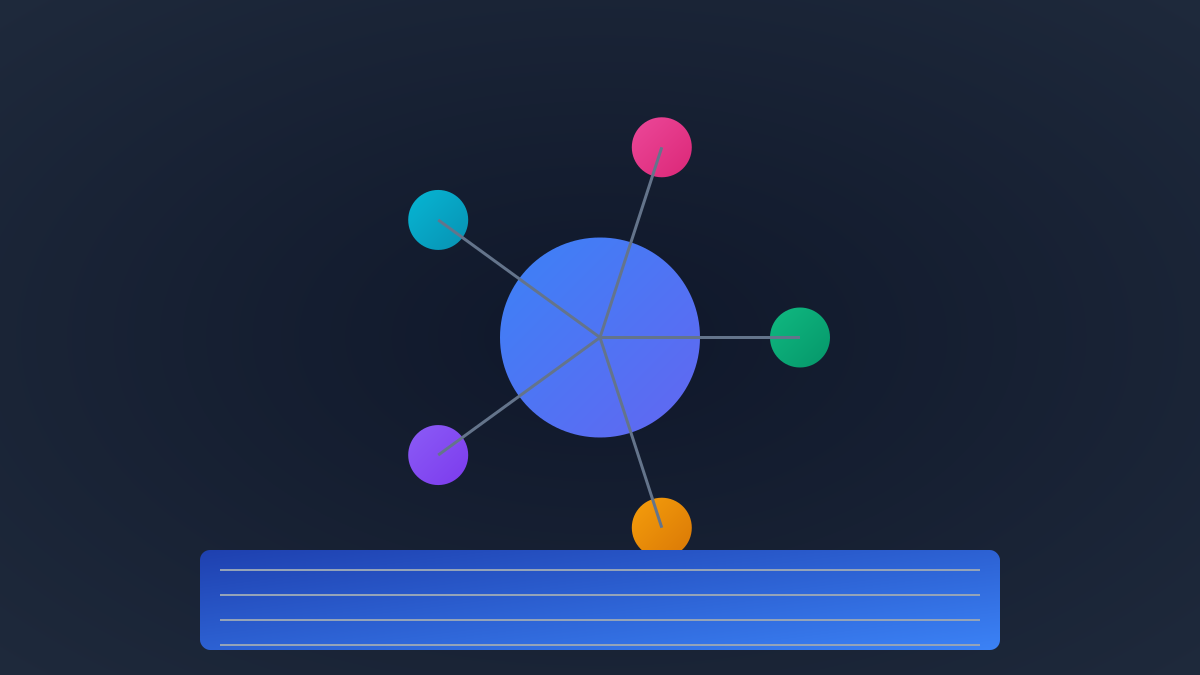
Experimenting with multiple role models: Planner (task decomposition, strategy formulation), Executor (tool calling and operation), Verifier (result quality check), Coordinator (collaboration process management), each role has clear input and output specifications.

Structured Workflow

Converting unstructured dialogue into predictable workflows, defining standard stages such as requirement understanding, solution design, step-by-step execution, and result verification, balancing flexibility and process constraints.

4

Section 04

Speculations on Technical Implementation Ideas

  1. File-based Persistence: Using the local file system to store memory and state
  2. Claude Code Integration: Deeply leveraging its context understanding and code operation capabilities
  3. Modular Design: Each component can be independently replaced or upgraded
  4. Configuration-driven: Defining roles and workflows through configuration files to avoid hardcoding (Note: Specific implementation details are not fully disclosed)
5

Section 05

Outlook on Application Scenarios

This framework has potential in multiple fields:

  • Software development: Coordinating code generation, testing, and documentation writing
  • Content creation: Integrating research, writing, editing, and publishing
  • Data analysis: Connecting data acquisition, cleaning, analysis, and visualization
  • Project management: Assisting in task decomposition, progress tracking, and risk early warning
6

Section 06

Project Limitations and Facing Challenges

As an experimental project, it faces the following challenges:

  • Reliability: Uncertainty in AI behavior affects system stability
  • Cost: Multi-agent collaboration increases API calls and token consumption
  • Debugging Complexity: High difficulty in troubleshooting distributed system failures
  • Security Boundaries: Preventing harmful outputs or unauthorized operations
7

Section 07

Summary and Future Thoughts

Claude Code Orquesta represents the evolutionary direction of AI applications from single agents to multi-agent collaboration. The concepts it explores, such as persistent memory, role definition, and structured workflows, may become standard components of future AI application architectures. For developers, this project provides a reference for guiding AI behavior through reasonable architectural constraints and serving actual business needs.