Zing Forum

Reading

Claude Code Cognitive Annotation Plugin: Analyzing Cognitive Behavior Evidence in Dialogues Using a Multi-Agent Architecture

A Claude Code-based plugin that uses four specialized sub-agents to analyze dialogue records in parallel, extracting cognitive behavior evidence across four dimensions—executive functions, metacognition, memory and reasoning, and user mental models—to provide structured data support for AGI research.

Claude Code认知标注多智能体AGI评估认知科学对话分析执行功能元认知心智模型
Published 2026-06-02 00:09Recent activity 2026-06-02 00:20Estimated read 6 min
Claude Code Cognitive Annotation Plugin: Analyzing Cognitive Behavior Evidence in Dialogues Using a Multi-Agent Architecture
1

Section 01

Claude Code Cognitive Annotation Plugin: A Core Tool for Analyzing Dialogue Cognitive Behavior via Multi-Agent Architecture

This article introduces a Claude Code-based cognitive annotation plugin that uses four agents to analyze dialogue records in parallel, extracting cognitive behavior evidence across four dimensions—executive functions, metacognition, memory and reasoning, and user mental models—to provide structured data support for AGI research. The plugin is zero-dependency, purely native to Claude Code, and follows scientifically rigorous annotation principles, helping to understand the deep cognitive processes in human-computer interaction.


2

Section 02

Background: Necessity and Theoretical Basis of Cognitive Annotation

With the widespread application of LLMs in dialogue scenarios, traditional dialogue analysis struggles to capture deep cognitive processes (e.g., task planning, metacognitive monitoring). Google DeepMind's 2026 paper Measuring Progress Toward AGI: A Cognitive Framework proposes that AGI evaluation should be based on a cognitive science framework, decomposing intelligence into measurable cognitive dimensions and providing a new methodology for dialogue analysis.

3

Section 03

Project Architecture and Methodology: Four-Agent Parallel Annotation Design

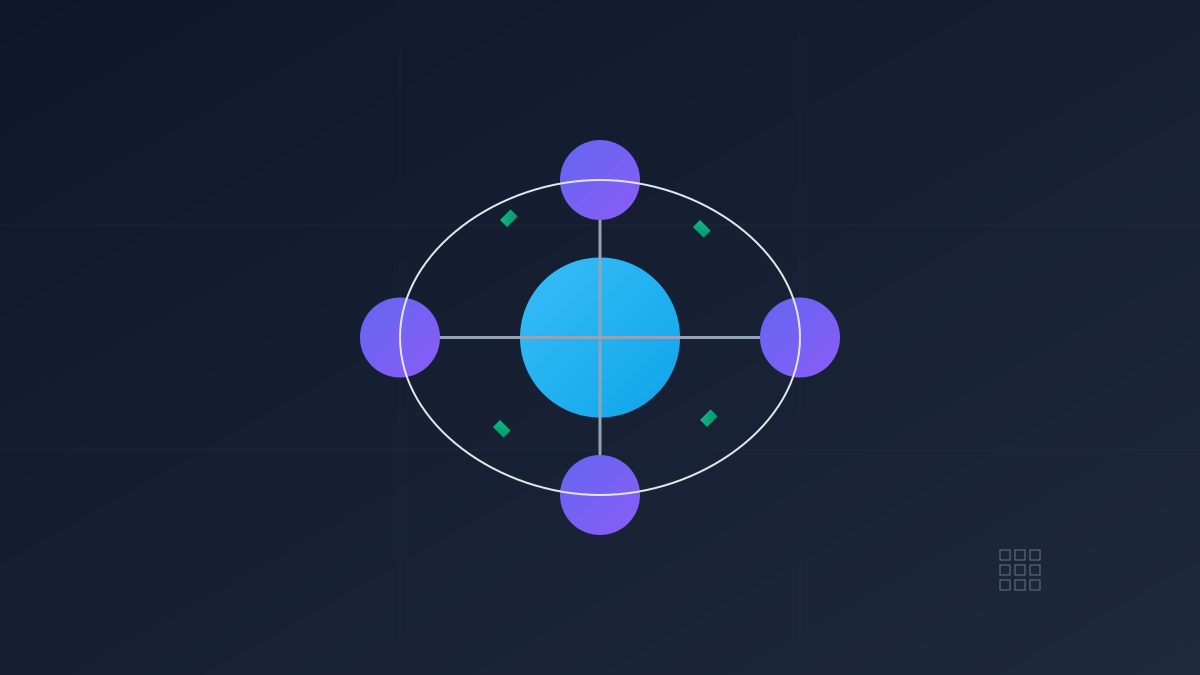
The plugin's core is a coordinator + four specialized sub-agent architecture, each responsible for one cognitive dimension:

Agent Annotation Dimension Extracted Content
Executive Functions Executive Function Behaviors Planning, inhibition, switching behaviors
Metacognition Metacognitive Processes Knowledge boundary awareness, confidence calibration, etc.
Memory & Reasoning Memory & Reasoning Patterns Domain knowledge injection, various reasoning types
User Mental Model System Mental Model Model updates, collaboration strategies

The system architecture includes an entry layer, coordination layer, execution layer, and merging layer; the execution flow is user call → parse records → invoke sub-agents → merge results. Annotation follows four core principles: lenient extraction, trivial substitution, no pattern filling, and annotation only for human turns.

4

Section 04

Theoretical Basis: Four Pillars of Cognitive Science

The plugin's theory is derived from classic cognitive science research:

  • Executive Functions: Miyake et al.'s 2000 update/inhibition/switching model;
  • Metacognition: Nelson & Narens' 1990 monitoring and control framework;
  • Memory and Reasoning: Peirce's reasoning types + Gentner's 1983 structure mapping theory;
  • User Mental Model: Norman's 1983 mental model theory for interactive systems.
5

Section 05

Application Scenarios and Practical Value

The plugin can be applied in:

  1. Academic research: Providing structured dialogue cognitive data for AGI evaluation;
  2. Product optimization: Helping AI teams understand user interactions and optimize dialogue design;
  3. Educational technology: Analyzing interactions between learners and AI tutoring systems, and evaluating metacognitive strategies;
  4. Clinical assistance: A standardized dialogue cognitive analysis tool for cognitive assessment and rehabilitation.
6

Section 06

Relationship with Python SDK and Usage Recommendations

The plugin is a native Claude Code form, with an additional Python version (using the Claude Agent SDK to implement parallel execution and write to results.json). Usage recommendations:

  • Use the Claude Code plugin for interactive annotation;
  • Use the Python pipeline for batch processing/automation.
7

Section 07

Conclusion: Toward Measurable AGI

The cognitive-annotation-plugin combines cognitive science theory with LLM capabilities to build a scalable and reproducible cognitive analysis tool, which is an important cornerstone for the standardization of AGI evaluation. As human-computer interaction deepens, understanding dialogue cognitive processes will become the core of AI research. This plugin provides researchers with an out-of-the-box scientific tool to help explore the nature of intelligence.

