Zing Forum

Reading

Claude Code Dashboard: A Local Observability Solution for AI Programming Agents

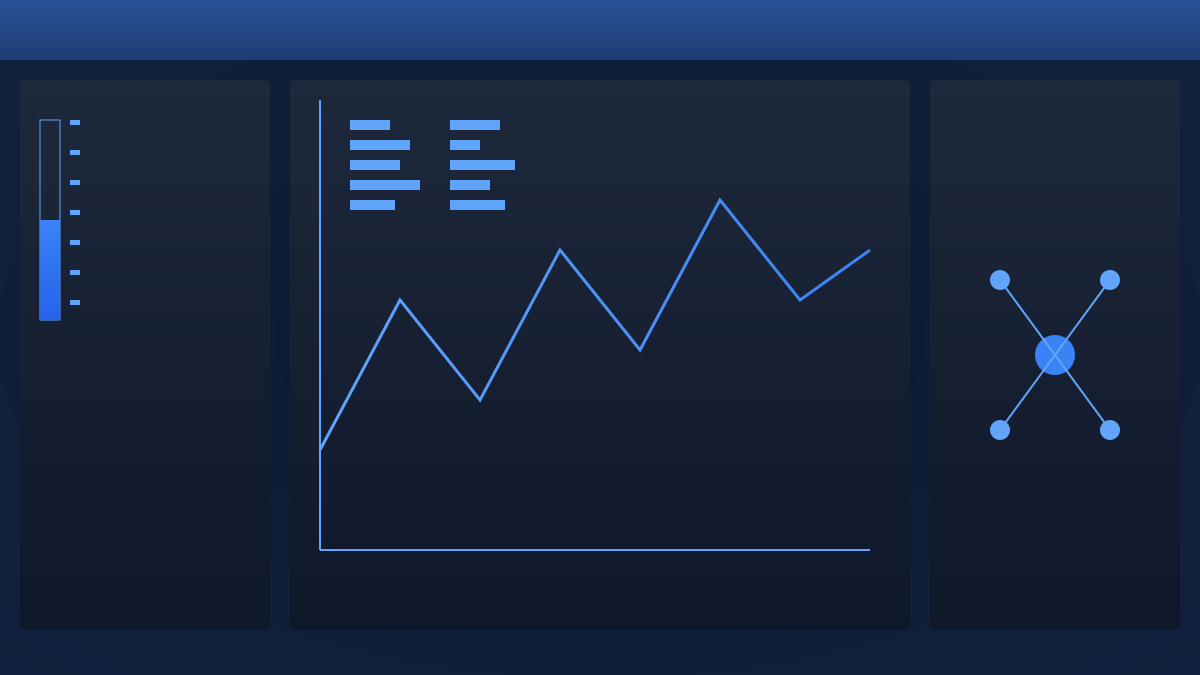
Claude Code Dashboard provides local-first observability support for Claude Code agent workflows, enabling developers to track task scheduling chains, routing decisions, and token costs in real time, and gain deep insights into the working mechanism of AI programming assistants.

Claude Code可观测性AI编程Token成本智能体监控
Published 2026-03-29 10:15Recent activity 2026-03-29 10:21Estimated read 6 min
Claude Code Dashboard: A Local Observability Solution for AI Programming Agents
1

Section 01

[Main Post/Introduction] Claude Code Dashboard: A Local Observability Solution for AI Programming Agents

Claude Code Dashboard is an open-source, local-first observability tool designed specifically for Claude Code agents. It aims to address issues such as the opaque decision-making process of AI programming assistants and the difficulty in monitoring token costs. By tracking task scheduling chains, routing decisions, and real-time token costs, it helps developers gain insights into the AI's working mechanism, optimize usage strategies, and protect privacy through local storage.


2

Section 02

Background: Transparency and Cost Challenges of AI Programming Tools

With the popularity of AI programming assistants like Claude Code and Cursor, their decision-making processes are often "black boxes", making it difficult for users to understand the underlying logic and paths. In team collaboration, reviewers need to understand the basis for AI modifications, but information is scattered in conversation history; the token cost consumption pattern of API calls is unclear, leading to difficulties in optimization and cost control.

3

Section 03

Project Introduction: Positioning and Goals of Claude Code Dashboard

Claude Code Dashboard is an open-source observability tool that adopts a local-first architecture (data stored in local SQLite). It intercepts and parses Claude Code runtime events to build an execution trajectory graph. Its core goal is to fill the observability gap in AI programming tools, serving as a structured analysis platform to help understand decision chains, identify issues, and optimize usage patterns.

4

Section 04

Core Features and Implementation Mechanisms

Task Scheduling Chain Visualization Tracking

Capture internal task scheduling events, display the sequence and dependencies of subtasks decomposed from complex operations, and help understand the AI's "thinking process"

Transparent Routing Decisions

Record the AI's decision points (direct answer/view file/run test, etc.) when handling requests and their context (prompt information, tool list, results)

Real-time Token Cost Monitoring

Count input/output tokens and cumulative costs, support viewing consumption patterns by session/task/time dimensions

Local Storage and Privacy Protection

All data is stored in local SQLite; sensitive information does not leave the machine, ensuring immediate availability without a network connection.

5

Section 05

Practical Application Value: Benefits for Individuals and Teams

  • Individual developers: Learn AI collaboration patterns, optimize prompts to get more accurate outputs
  • Teams: Audit AI-assisted coding processes, judge the rationality of modifications during code reviews, and formulate usage norms to balance efficiency and quality
  • Cost management: Identify high-cost call patterns and reduce operational costs of AI-assisted development
6

Section 06

Technical Architecture and Extensibility

Adopts a modular design: The event collector intercepts logs/APIs to obtain raw data, and the analysis engine is responsible for structured storage and insights; the architecture is easy to adapt to other AI tools (as long as a similar event stream interface is provided). The front end uses a modern web stack, supporting real-time viewing in browsers and report export.

7

Section 07

Summary and Outlook: The Future of Observability for AI Tools

Claude Code Dashboard is an important exploration in the field of AI tool observability. As the capabilities of AI programming assistants improve, understanding and controlling their behaviors become increasingly important. The transparency and insights it provides help users better use AI and also provide a data foundation for AI-assisted software engineering research. We look forward to more tools to promote the maturity and standardization of the ecosystem.

