Zing Forum

Reading

Claude Code Three-Tier Model Routing Strategy: Reducing AI Development Costs via Intelligent Layering

This article introduces the claude-model-router project, a three-tier model routing system designed for Claude Code. By using Sonnet as the default routing layer, delegating simple tasks to Haiku and complex reasoning tasks to Opus, it achieves a dynamic balance between cost and quality.

Claude Code模型路由AI开发成本优化Claude SonnetClaude OpusClaude Haiku分层策略智能代理开发工作流
Published 2026-06-09 00:11Recent activity 2026-06-09 00:20Estimated read 6 min
Claude Code Three-Tier Model Routing Strategy: Reducing AI Development Costs via Intelligent Layering
1

Section 01

[Introduction] Claude Code Three-Tier Model Routing Strategy: Reducing AI Development Costs via Intelligent Layering

This article introduces the claude-model-router project on GitHub, a three-tier model routing system designed for Claude Code. By using Sonnet as the default routing layer, delegating simple tasks to Haiku and complex reasoning tasks to Opus, it achieves a dynamic balance between cost and quality, helping developers solve the problem of cost waste or insufficient quality caused by the inability to dynamically switch fixed models.


2

Section 02

Background and Problem: Development Dilemmas Caused by Fixed Models

When developing with Claude Code, developers face the problem of being limited to a fixed model per session—using the same model regardless of task difficulty, leading to cost waste or insufficient quality. Asymmetric error costs exacerbate this dilemma: errors in simple tasks are easy to fix, while errors in complex tasks may take a lot of debugging time, and token-based billing fails to reflect the real development cost.

3

Section 03

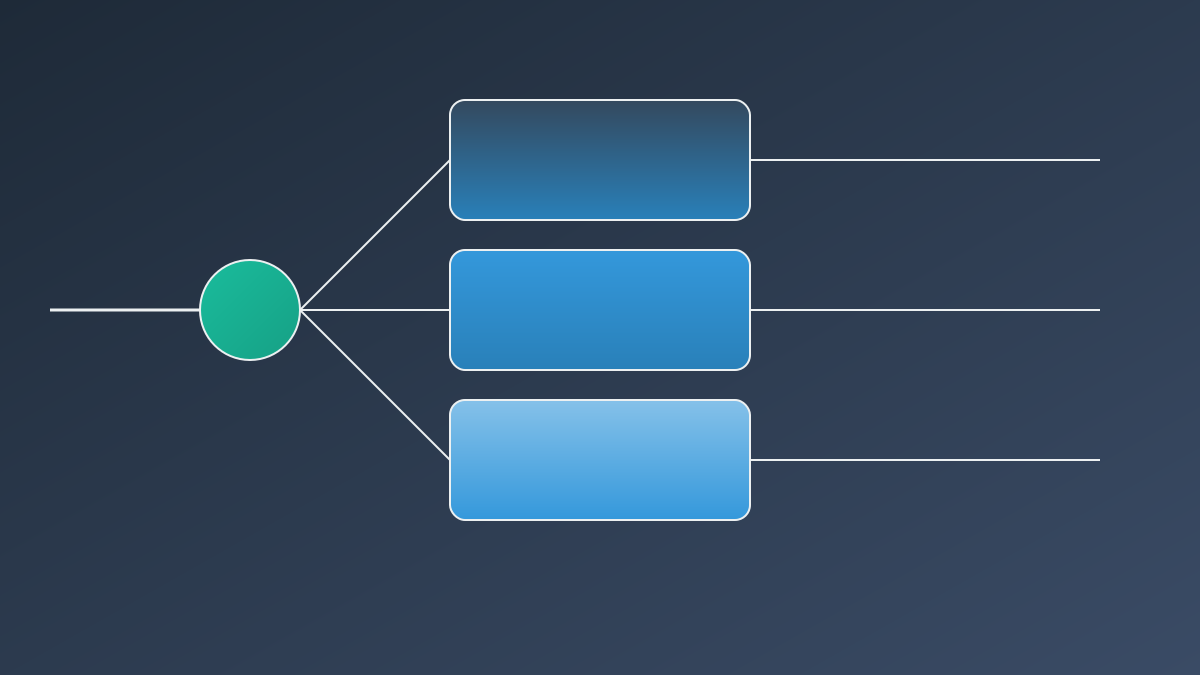
Detailed Explanation of the Three-Tier Model Architecture

The project proposes a three-tier model routing strategy:

  1. Fast Layer (Haiku): Handles mechanical, self-verifiable tasks (e.g., file copying, renaming) with low error costs, at 1/3 the cost of Sonnet;
  2. Standard Layer (Sonnet): Serves as the default router and executor, responsible for daily development and task level judgment, with zero-latency routing without additional classification steps;
  3. Deep Layer (Opus): Handles complex reasoning tasks (e.g., algorithm optimization, architecture design) with high error costs, at 5 times the cost of Sonnet, following the principle of "round up when uncertain".
4

Section 04

Core Design Principles

The project's core design principles include:

  1. Optimize error cost rather than token price: The real cost is rework time—use low-cost models for simple tasks and high-quality models for difficult tasks;
  2. Three tiers instead of four: Oppose adding a fourth tier because boundaries between similar models are hard to judge and cost savings are minimal; valuable dividing points are simple ↔ standard and standard ↔ difficult;
  3. Reactive upgrade rather than predictive upgrade: Sonnet can dynamically upgrade to Opus when it finds the task is harder during execution, which is more accurate than pre-prediction.
5

Section 05

Limitations and Boundaries

The project has limitations: Sub-agents run in an isolated environment until completion and cannot be guided interactively. It is suitable for closed, well-defined difficult tasks (e.g., optimizing function return diffs) but not for collaborative exploratory tasks (e.g., rethinking architecture). For this, it is recommended to switch directly to Opus in the session (using the /model opus command).

6

Section 06

Installation and Customization Methods

Installation: Copy the agent configuration to the ~/.claude/agents/ directory via a script and set the default model to Sonnet; Customization: Edit the model pre-matters in the agent files to change models, or override via the project-level .claude/settings.json; routing rules are stored between specific markers in CLAUDE.md, which users can adjust.

7

Section 07

Practical Significance and Insights

This project represents a new idea for AI-assisted development: Treat models as a resource pool with different capabilities and costs, and use intelligent routing to achieve optimal configuration. This idea can be extended to other AI scenarios (identifying task features, matching resource tiers, dynamic adjustment) or become a standard practice. For teams, it can control AI development costs without sacrificing quality and allocate resources rationally.

8

Section 08

Conclusion: A Pragmatic Approach to AI Development Resource Allocation

Today, as AI development tools become popular, efficient and economical use of tools is key. The answer provided by claude-model-router is not to choose the "best" model, but to build an intelligent layering mechanism so that each task is handled by the appropriate model. This pragmatic engineering thinking is needed for high-quality AI application development.

