Zing Forum

Reading

Multi-Agent Software Development Platform: Automated Collaboration Practice Driven by Claude Code

Explore the multi-agent software development platform based on Claude Code, and learn how product, development, and testing agents achieve autonomous collaboration through structured workflows to revolutionize traditional software development models.

多智能体Claude Code自动化开发AI编程软件工程智能体协作DevOps
Published 2026-05-04 16:13Recent activity 2026-05-04 16:25Estimated read 4 min
Multi-Agent Software Development Platform: Automated Collaboration Practice Driven by Claude Code
1

Section 01

Introduction: Claude Code-Driven Multi-Agent Software Development Platform

This project builds a multi-agent software development platform based on Claude Code. Through the structured collaboration of three specialized agents (product, development, and testing), it revolutionizes traditional software development models and explores the possibility of AI autonomous collaboration to complete the software lifecycle.


2

Section 02

Background: Efficiency Bottlenecks in Traditional Software Development

Traditional software development involves multiple stages such as requirement analysis, architecture design, and code implementation, which are highly dependent on manual coordination. Communication costs and context switching have become efficiency bottlenecks. With the improvement of large language model capabilities, the question arises: can multiple AI agents autonomously collaborate to complete the entire software development lifecycle?

3

Section 03

Methodology: Platform Architecture and Collaboration Mechanism

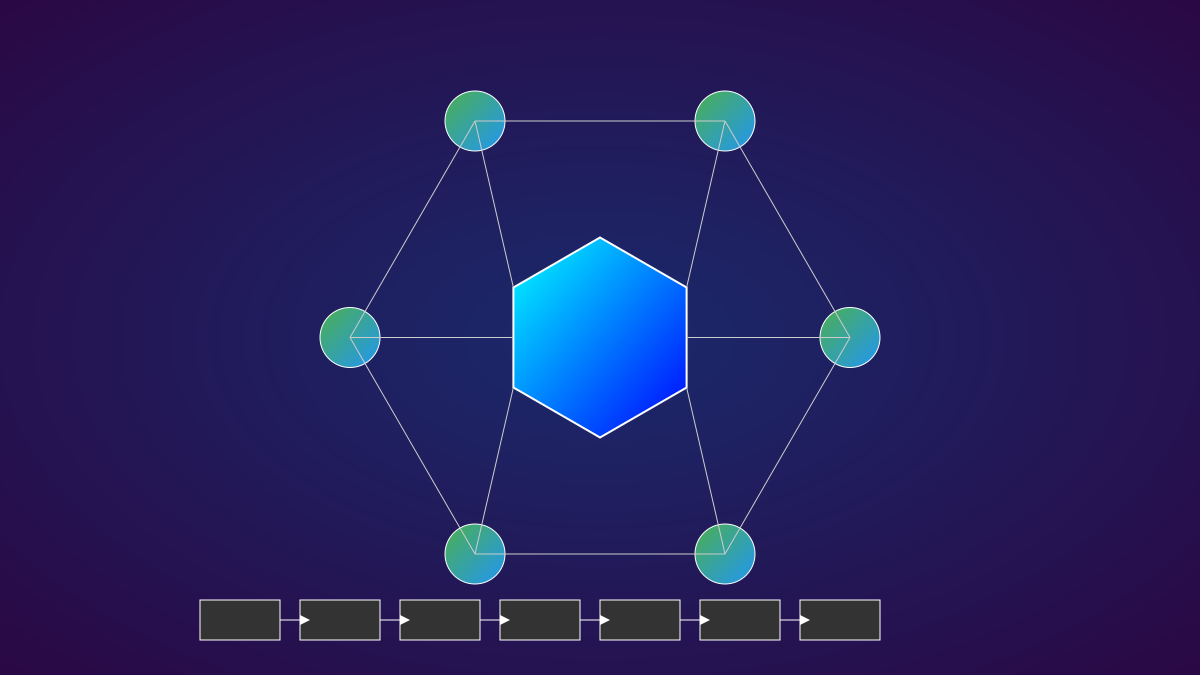
The platform defines three agent roles: product agents are responsible for requirement analysis and function planning, development agents undertake code implementation, and testing agents focus on quality assurance. Collaboration is achieved through a structured workflow consisting of five stages: requirement clarification, technical design, iterative development, quality verification, and delivery review.

4

Section 04

Key Technical Implementation Points

Build an agent orchestration layer based on Claude Code extensions; implement structured context management to avoid information overload; design rule-based decision-making processes to resolve agent conflicts; and integrate built-in logging and tracking functions to ensure observability and debugging.

5

Section 05

Application Scenarios and Value

Suitable for scenarios such as rapid prototype verification, standardized task automation, 24/7 continuous development, knowledge precipitation and reuse, etc., which can significantly improve development efficiency in specific scenarios.

6

Section 06

Limitations and Future Directions

Current limitations include challenges in complex architecture design, creative bottlenecks, and security and trust issues. Future directions include enhancing agent negotiation capabilities, introducing human-in-the-loop hybrid collaboration, and improving evaluation and feedback mechanisms.

7

Section 07

Conclusion: Evolution Direction of AI-Assisted Programming

Multi-agent platforms represent the shift of AI-assisted programming from tool enhancement to process automation. Although there is still a gap from fully autonomous development, the structured collaboration model can already improve efficiency, and a new paradigm of human-machine collaboration is gradually taking shape.