Zing Forum

Reading

Cerebro: An Open-Source, Local-First AI Agent Platform to Build Your Personal Intelligent Team

Cerebro is an open-source, local-first AI platform that automates life through collaboration among specialized Agent teams. It features core capabilities like a memory system, workflow orchestration, and approval gating, making it an ideal alternative to cloud-based AI services for privacy-sensitive users.

CerebroAI Agent本地优先开源项目隐私保护自动化工作流多Agent协作
Published 2026-04-16 07:15Recent activity 2026-04-16 07:20Estimated read 6 min
Cerebro: An Open-Source, Local-First AI Agent Platform to Build Your Personal Intelligent Team
1

Section 01

Cerebro: An Open-Source, Local-First AI Agent Platform to Build Your Personal Intelligent Team [Introduction]

Cerebro is an open-source, local-first AI platform that automates life by assembling specialized Agent teams. It has core features like a memory system, workflow orchestration, and approval gating. It aims to address the privacy risks, service dependency, and cumulative costs of cloud-based AI services, providing an ideal alternative for privacy-sensitive users.


2

Section 02

Why Do We Need a Local-First AI Platform?

Most mainstream AI services currently use cloud architecture, which has three major pain points:

  1. Privacy Risk: Uploading sensitive data may lead to leaks or misuse; it's hard to rule out the possibility of internal access or government requests.
  2. Service Dependency: Availability is affected by network conditions and service provider policies; service outages or account issues can result in loss of tools and data.
  3. Cumulative Costs: Pay-as-you-go models incur significant long-term costs for frequent users. Cerebro's local-first architecture directly targets these pain points, allowing users to maintain full control over their data.
3

Section 03

Core Architecture: Specialized Agent Team Collaboration and Key Features

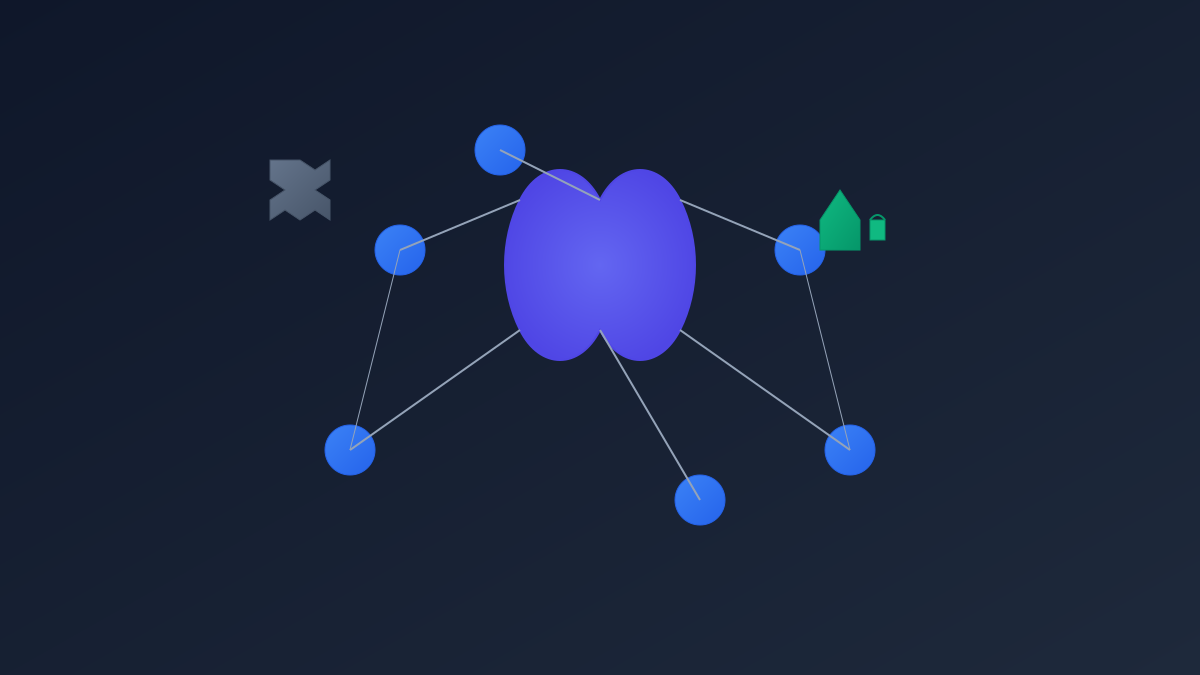
Cerebro adopts a multi-Agent collaboration design:

  • Specialized Division: Agents for schedule management, email processing, financial tracking, knowledge management, task execution, etc., focus on specific domains.
  • Memory System: Long-term memory is stored in a local vector database, remembering user preferences and past interactions while ensuring data sovereignty.
  • Workflow Orchestration: A visual editor defines Agent call sequences, data transfer, and conditional branches to complete complex tasks.
  • Approval Gating: Critical operations require user confirmation, supporting manual/conditional automatic/full trust modes to balance efficiency and security.
4

Section 04

Technical Implementation and Flexible Deployment Options

Cerebro is built on an open-source tech stack and supports multiple deployment methods:

  • Desktop App: Cross-platform graphical interface, ready to use for ordinary users.
  • Docker Container: Deploy on servers or NAS, supporting remote access.
  • Command-Line Tool: Flexible scripted control for developers. It supports integration with local open-source models (e.g., Llama, Mistral) or configuration of APIs to use cloud models; the hybrid mode meets diverse needs.
5

Section 05

Application Scenarios: From Personal Productivity to Privacy-Sensitive Industries

Cerebro is suitable for various scenarios:

  • Personal Productivity: Automatically organize inboxes, schedule appointments, track to-dos.
  • Small Teams: Standardize processes with shared workspaces, such as customer response templates and project progress tracking.
  • Privacy Industries: Lawyers, doctors, etc., can handle sensitive information without leaking privacy.
  • Offline Environments: Rely on local AI to complete work when there's no network.
6

Section 06

Open-Source Ecosystem: Community-Driven Continuous Evolution

Cerebro is an open-source project with a permissive license allowing commercial use and secondary development. The community has already developed plugin extensions covering third-party service integration, additional Agent types, custom themes, etc. The open model accelerates feature iteration and reduces vendor lock-in risks; even if the original project stops maintenance, the community can fork it to continue development.

7

Section 07

Future Outlook: Potential of Local-First AI and Cerebro's Value

The improvement in edge AI chip performance and advancements in open-source models are driving the rapid development of local-first AI. Cerebro represents an important attempt in this trend, and its multi-Agent team concept may influence the evolution of AI application architectures. For users pursuing privacy and autonomous control, Cerebro is a worthy option; amid the homogenization of cloud AI, the local-first path may open up a new blue ocean.

