Zing Forum

Reading

Care-Nexus AI: A Multi-Agent Assistant Architecture for Enterprise Workflows

An enterprise-level multi-agent workflow assistant project that explores how to enhance the automation level of enterprise business processes through multi-agent collaboration.

多智能体AI Agent企业工作流流程自动化人机协作RPA大语言模型企业应用
Published 2026-06-14 20:46Recent activity 2026-06-14 20:50Estimated read 8 min
Care-Nexus AI: A Multi-Agent Assistant Architecture for Enterprise Workflows
1

Section 01

Care-Nexus AI Project Guide: Multi-Agents Empowering Enterprise Process Automation

Care-Nexus AI is an enterprise-scenario-oriented multi-agent workflow assistant project. It aims to enhance the automation level of enterprise business processes through multi-agent collaboration and explore new paradigms of human-machine collaboration. Addressing the limitations of traditional RPA in complex scenarios, this project attempts to use a multi-agent architecture to solve problems such as context understanding and decision-making beyond structured tasks.


2

Section 02

Project Background: Limitations of Traditional RPA and the Rise of Multi-Agents

In enterprise process automation, traditional RPA has been widely used in finance, HR, customer service, and other fields, but it can only handle structured, rule-clear repetitive tasks and struggles with complex scenarios (such as context understanding and exception handling). Against the backdrop of rapid iteration of AI Agent technology, multi-agent architecture has become a solution to this challenge by decomposing complex tasks and enabling professional division of labor and collaboration.

3

Section 03

Multi-Agent Architecture Design of Care-Nexus AI

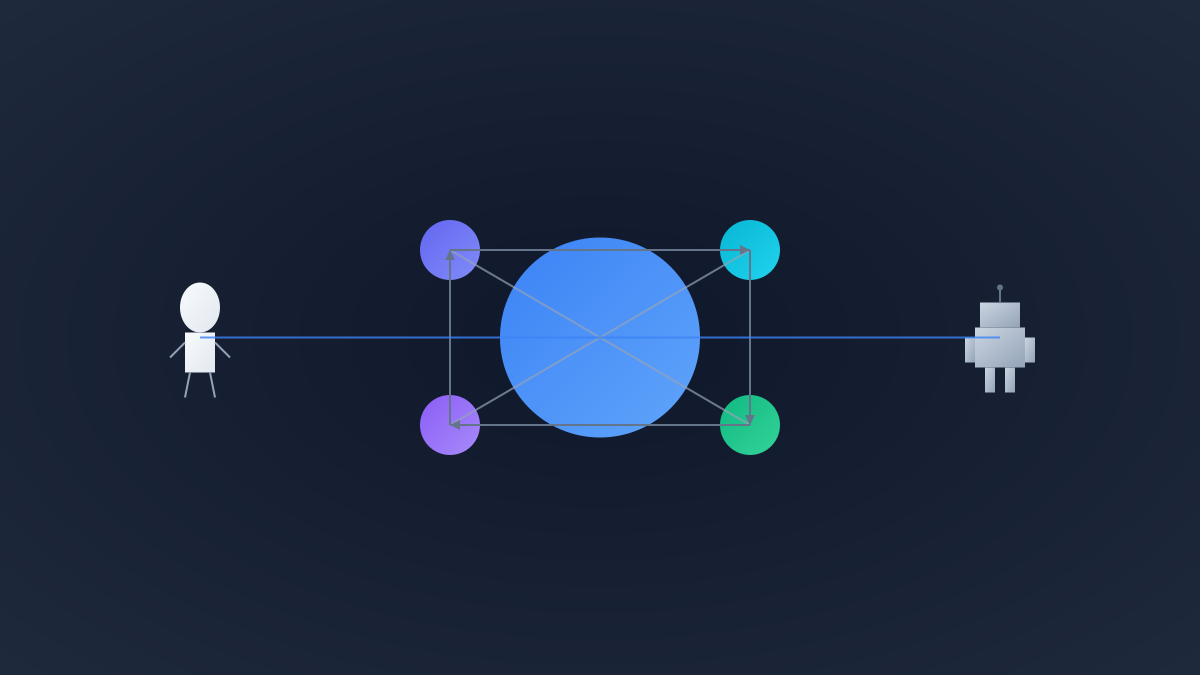
Core Architecture Vision

  1. Specialized Agent Division of Labor: Includes professional agents for document processing, data analysis, approval processes, etc., accumulating knowledge through domain fine-tuning or RAG;
  2. Coordination and Scheduling Layer: The central coordinator is responsible for task decomposition, agent scheduling, and progress monitoring;
  3. State Management and Memory: Persistently stores cross-session states to support process interruption recovery;
  4. Human-Machine Collaboration Interface: Retains manual review at key decision nodes to ensure human control over decision-making in high-risk areas.
4

Section 04

Application Scenarios: Covering Core Enterprise Processes Such as Finance, IT, and Customer Service

Financial Reimbursement Process: Document recognition agent extracts invoice information → compliance check agent verifies policies → approval routing agent assigns approvers → notification agent sends reminders;

IT Service Management: Ticket classification agent identifies types → knowledge retrieval agent finds solutions → execution agent handles standardized operations → escalation agent transfers complex tickets to engineers;

Customer Service: Intent recognition agent understands demands → information query agent retrieves CRM/order data → solution agent generates responses → satisfaction tracking agent collects feedback.

5

Section 05

Key Technical Implementations: Communication, Fault Tolerance, and Security

Inter-Agent Communication Protocols

  • Message queue: Asynchronous communication for decoupling;
  • Function calls: Similar to microservice API calls;
  • Shared state: Exchanging information via shared storage (concurrency consistency needs to be handled);

Fault Tolerance and Recovery

  • Timeout retry: Retry or switch to backup when an agent is unresponsive;
  • Circuit breaker pattern: Isolate agents that continue to fail;
  • State snapshot: Regularly save states to support breakpoint recovery;

Security and Permissions

  • Principle of least privilege: Agents only get necessary permissions;
  • Operation audit: Record all operation logs;
  • Data isolation: Logical isolation of department/project data.
6

Section 06

Industry Trends and Competitive Landscape Analysis

Existing Products:

  • Microsoft Copilot Studio: Custom Copilot, multi-agent collaboration, integrated with M365 ecosystem;
  • Google Vertex AI Agent Builder: Visual tool for building enterprise agents;
  • Open-source frameworks: LangGraph, CrewAI, AutoGen lower development thresholds;

Potential Differentiation of Care-Nexus: Deeply focus on specific industries (medical/legal), private deployment, and powerful visual orchestration tools.

7

Section 07

Implementation Challenges: Integration, Cost, and Organizational Change

  1. Integration Complexity: Enterprise existing systems have different interfaces, requiring a lot of customized development;
  2. Cost Considerations: Multi-agent multiple calls to large model APIs cost more than single-agent solutions;
  3. Interpretability: The decision path of multi-agent collaboration is hard to trace, affecting compliance audits;
  4. Organizational Change: Need supporting process adjustments to let employees accept and effectively use AI assistants.
8

Section 08

Summary: Future Prospects of Multi-Agent Enterprise Assistants

Care-Nexus AI represents the exploration direction of enterprise-level multi-agent workflow assistants. It breaks through efficiency, accuracy, and scalability through professional agent collaboration. For developers, it is a window to observe the application of multi-agents in business scenarios. With the improvement of large model capabilities and tool refinement, such assistants are expected to be widely used in the next few years.

